The #1 Way For A Ministry To Avoid A Ministry Migraine

Recently, a friend of mine, who applied for a particular Christian ministry position, was asked what he would do in a situation involving wrong-doing within that institution.  Before he could respond, this comment was made . . . . “You do realize that we have to protect our ministry; its reputation is always on the line in these kinds of situations.”

Upon hearing that from her, I indicated that my response would have been . . . .

“The best way to protect your ministry and its reputation is to be open and transparent.  When you try to cover up what actually took place, the ministry and those in leadership find themselves in a mess!  Ask RZIM about how covering-up works out!”

Study the past year’s ministry and church scandals, and you will see a series of actions that appear over and over when real institutional wrong-doing is misaddressed.   Those in positions of leadership and power seek to divert attention away from what was actually done.

Midst wrong-doing, the temptation is to . . . . .

  • cover-up the wrong-doing
  • silence the “critics”
  • limit exposure to the facts of the situation
  • pull in others to vouch for your story
  • reposition people, who are or have been supportive, into roles of greater power/control
  • call-up the years of past ministry as a plausible argument against the possibility of misconduct today 
  • repeatedly claim victimhood
  • seek sympathy from those who know little-to-nothing as to what has actually happened [1] 
  • publicly create personal sympathy as one who has been unfairly “attacked” – from “Victimology 101”

The best way to protect a ministry from damage,
and to guard one’s personal reputation and integrity,
is to be transparent from the beginning. 

Various ministries and churches, that have faced serious problems, would tell you exactly that — NOW — after all the damage was done.

Various ministries and churches, that have faced serious problems, would tell you that because that was their greatest mistake as they sought to control the situation they created for themselves!

Most all ministries and churches would give you that advice long before they themselves were facing such a problem because this is not “hidden wisdom” that can only be learned after failing the transparency test.  Most all ministries and churches understand that UNTIL they themselves are clearly engaged in wrong-doing, made some terrible and even indefensible decisions, or were embarrassed about their words and/or actions. 

Then — ministries and leaders often begin using the word “transparency” . . . .

  • as a newly found badge, proving that they have integrity
  • to now bolster their claim that they are committed to honesty and oversight
  • after they have failed at being anything but transparent
  • after people have jumped-ship because serious questions have again remained unanswered

The best way to protect a ministry, a church, a pastor, deacons, an elder, or administrators, is to be transparent from the beginning, allow those who have a meaningful stake in the organization, ministry, or church to hear what actually happened.  Provide a sincere, genuine, and “as long as it rightfully takes” opportunity for God’s people to hear from those of different vantage and to ask any and all questions.

Fail at that, expect questions to linger, stories to be continually told-retold (accurate, inaccurate, most partially true), and the next problem to be worse than the previous one because of an eroding trust that will follow you issue after issue.

The best way to protect a ministry from damage,
and guard one’s personal reputation and integrity,
is to be transparent from the beginning & throughout

All understand that if you have nothing to hide, then you will be open, above-board, and straightforward; that you will be transparent as to what took place as well as to how it all transpired from the beginning.



1. They don’t know, primarily because they have been denied the opportunity to rightfully know.
The RZIM fiasco illustrates the results of that approach as men and women vouched for RaviZ’s integrity, only to be embarrassed, but not ashamed enough to resign from their positions of trust.

Note:  If you want to see how twisted it all gets . . . . 

There was little-to-no transparency while it was all taking place, but “now that this trust has been fundamentally compromised, [and] the situation demands transparency. . . . . “We believe that the most God-honoring approach is to pursue transparency.”

There was little love shown to those who were publicly manhandled by those in positions of power, but now let’s talk about “being loving.”  It’s hypocrisy or a dismal lack & level of self-awareness. 

There was little willingness to show grace, but now . . . . “We pray for God’s grace and mercy for all, and for restoration that brings peace, hope, forgiveness, and change where most needed.”

There was little willingness to get at the truth as to what was said and done, but now . . . . . “our prayer has been that the truth would be known.”

Church Ministry: How To Make The Problem Worse! — The Top 3 Ways!

Someone has suggested asking this question in a problem-solving situation . . . .

If you were going to make this problem worse, how would you do it? [1]

What a great brainstorming question to ask when facing any and all problems! As stated, it requires that we invert our thinking processes which then provides a valuable and totally different vantage on the problem.

There are ministries and local churches that would do well to ask that question when dealing with a difficult situation and problem! –” What could we do to make this worse?”

The answer to that question might highlight what you do not want to do — though easily tempted and maybe even contemplating!  During my years in teaching and pastoring, I have often thought and said that some pastors create their own problems and trials in ministry.  Then they call for a pity party and claim victimhood.

Let me list out some ways to make things worse, to heighten a self-created ministry or church problem . . . .

#1 — Make Decisions Without Seeking Desiring The Sincere & Genuine Input Of Others.

They are convinced that they know what is best, and that is what will happen at the end — Every man is right in his own eyes.  The problems come because “his own eyes” and not the way others see it.  There are other ways!  There are good, better, and best ways.  There are terrible ideas that are clothed with enough euphemistic and justifying garb that such terrible ideas survive in that ministry leader’s mind.

Some take final concession as agreement. Others may go along with what the ministry leader wants — in the end — but that does not mean that they are convinced. They have merely grown tired of pushing back when the end seems certain.  The end seems certain because there is little-to-no movement or adjustment.

Make decisions without the sincere and genuine input . . . .

    • sincere and genuine input that changes and revamps an idea
    • sincere and genuine input which moves from good to better or best
    • sincere and genuine, which seeks the input of those affected, or who might well be in opposition
    • sincere and genuine input which changes an idea or decision to where it may no longer even be desired by the ministry leader
    • sincere and genuine input that even leads to its abandonment because of all of its flaws and implications
    • sincere and genuine input, which reveals that it is not best for the ministry, but self-serving.

. . . . and then send out invitations to your pity party after criticism regarding some very bad decisions.

. . . . . . 

#2 — Make Ministry About You —  about your comfort, advantage, and privilege.

If a pastor does not believe that God’s people cannot recognize a self-serving spirit, they are woefully naive, or worse yet, indifferently ignorant.

    • make decisions that do not strengthen the ministry, but make your ministry easier
    • reflect an unawareness about the health of others, but highlight your health situations
    • focus on your financial income and benefits, with little honest, practical, or authentic concern about those making far less in that ministry
    • hire, position, or highlight family members in the work of that ministry
    • keep passing off ministry to others — visitation / preaching / special day events
    • promote nepotism in that ministry
    • stay away from any “hands-on” work — alongside others
    • make “salary /benefits” and “giving” a repeated ministry topic
    • talk about how hard you have had or have it in ministry

When several of these markers show up, God’s people see them!  They understand what is taking place.  They know who is the most important person in that ministry — and it isn’t them.

Make ministry about you, and then send out invitations to your pity party and claim victimhood when people catch on!

. . . . . . 

#3 — Mishandle & Manhandle God’s People — disregard, disrespect, and even abuse your power and position in ministry.

A quick way to lose ministry leadership is to make some damaging mistakes and follow through on some terrible “people-decisions.”  I have seen youth pastors who “have to leave” because of a damaging mistake that they will never be able to outlive in that ministry.  A child or teen was injured — while a mistake and not malicious in any way — but unrecoverable!

Likewise, some terrible “people-decisions” can cause so much damage when it comes to a youth pastor, a staff member, a missionary, a ministry volunteer, a church officer, or even a well-like and long-term drifter.

Those in ministry clearly know and understand that reality.  It is supported by the fact that those in ministry will seriously consider the implications of people-decisions.  Replacing a staff member, moving someone to another position, not hiring this-or-that person, asking someone to head up a ministry, not asking someone, or even firing for a good reason all have serious ministry implications.  Ministry leaders and pastors know that!

Church life is about relationships.  That is why some people stay in churches which are doctrinally askew — “Yea, I know that they believe and teach this-or-that, but . . . . . ” That is why some people join churches that are “not their cup of tea,” but they have some good friends there!

Instead of recognizing that the ministry is filled with good and great people, see any who honestly and/or legitimately disagree as the enemy; it is you against them!  If you want to make the problem worse, be true to form and categorize those who have honest and legitimate disagreements, as trouble-makers.

After repeating the go-to argument of “sowing discord,” send out invitations to your pity party and claim victimhood.

. . . . . . 


1. If you were going to make this problem worse, how would you do it?

“Here is a wonderful gotcha! question. It comes from Sunni Brown, author of Doodle Revolution. This question is delightfully mischievous. It requires us to invert our thinking and look at a situation from a completely new angle. The insights from this question reveal to us what we should do.”

2. An example of that is Dr. John MacArthur.  At times, it is not that what he often says is not technically correct, but he chooses to make statements that create controversy — i.e. Lordship salvation / the blood of Jesus / et al.  At other times, he opens up himself to warranted or unwarranted criticism — you decide.

3. In fact, some ministry leaders live with what they deem to be “difficult people situations” for that very reason — they cannot do what they would like to do without an “uproar.”  What they would like to do has meaningful ministry implications.  To make that move may be the last straw for some of God’s people, and they suspect that — and some do it anyway — go back to points #1 & #2.

Church Attendance: This May Be As Good As It Gets

. . . . . . .

Tone Deaf” — Those were my thoughts on Easter Sunday morning, as I attended church this past Easter Sunday.  Those words speak of. . . .

“. . . . having or showing
an obtuse insensitivity
or lack of perception
particularly in matters of
public sentiment, opinion, or taste.”

. . . . . . .

  • After a year of a pandemic lockdown . . . .
  • After the decision by many to make this Easter Sunday the first in-person church service they attend . . . .
  • Because Easter/Resurrection Sunday is one of the holiest days of the religious calendar. . . . .
  • Because of the increased likelihood that many of the less-regular and/or new people will be attending . . . .

. . . what would you plan as the first hymn sung by the congregation-choir-singer?

If you are tone-deaf . . . . the answer is  . . . . a hymn or song which addresses anything other than the resurrection of Christ!

If you are tone-deaf, you will begin (and continue through much of the service) with music that fails to connect with the anticipatory thinking and sentiments of God’s people on Easter 2021.

Instead of beginning with possible hymns such as . . . . .

  • Christ the Lord Is Risen Today
  • Christ Arose
  • The Old Rugged Cross
  • He Lives
  • He Is Lord
  • I Know that My Redeemer Liveth
  • My Hope Is In The Lord
  • Rise Again
  • Crown Him With Many Crows
  • In The Garden
  • Were You There
  • et al.

. . . some will have begun the service with music that celebrates their obtuse insensitivity and/or lack of perception.

. . . . . 

If you are tone-deaf, Easter Sunday will start with and/or use contemporary songs that have nothing to do with the resurrection.

If you are tone-deaf, Easter Sunday will start with and/or use contemporary songs that few even know.

If you are tone-deaf, you will begin with and/or use music and songs that you might enjoy, but fail to effectively minister. [1]

If you are tone-deaf, you employ well-known hymns, but you put them to an upbeat musical score that changes the traditional tempo, wording, or pace, and appreciation by that audience.

If you are tone-deaf, you add roving and flashing lighting effects regardless of any reasonable musical,  practical, or theological justification.

If you are tone-deaf, you will begin with and/or use well-known hymns to a different musical score that fails to carry the emotions and feelings in could and would.

If you are tone-deaf, you will throw the musical balance in the direction of what does not connect with your audience, in favor of your musical preferences. [2]

If you are tone-deaf, Easter Sunday will focus more on the death than on the resurrection.

. . . . . 

Easter Sunday 2021 — after one of the most “affective years” that has deeply impacted church ministries, when many made Easter Sunday the day when they would return to a congregational in-person meeting, after the loss of loved ones and friends, after . . . after . . . .

Easter Sunday 2021 should have been one of the most sermonicly and musically inspiring days for God’s people who decided to be there again, in-person!

Easter Sunday 2021 should have been the beginning of a growing in-person attendance and return to local church worship, ministry, and fellowship.

Easter Sunday 2021 should have been a time when God’s people said — “This is what the church is about.  This is the worship experience I have been missed due to this tragic pandemic.”

But for too many — it may well have failed to accomplish that!
Why?  — Because of Tin Ears.

The Results:  Sunday’s attendance may be the highpoint, as good as it is going to get for the next year(s) in this-or-that local church ministry!  The conclusion may be — “Listening online (to you and/or others) works!”

P.S. “The Easter Sunday Sermon” — That is another discussion — unfortunately, a sad discussion of a missed-failed opportunity to congregationally rejoice in the defeat of our last enemy — death, the grave, and hell!

. . . . . 


1. An effective music ministry can be is jettisoned by using music that is . . .

  • unfamiliar or totally new
  • unsuited or difficult for congregational singing
  • misfocused and ignores the appreciation of those worshiping
  • traditional or contemporary, but unrelatable musically
  • well-known, but employing a different musical score
  • an arrangement that moves so far away from the original composition
  • new/unknown (contemporary or classical in form) and poorly worded and/or written
  • et al.

2. It is not that music that is new, different, unfamiliar, an arrangement of, classical or contemporary, known or unknown cannot be used or introduced in a local church setting.  Nevertheless, if the balance is driven by the musical leader’s “taste-opinions-position-convictions-theology-education-appreciation” — whether that results in a “contemporary” or “classical”  outcome — it is self-serving!

With too many, the music ministry is about them.  The selection of songs has little-to-nothing to do with the service, the message, the day, or the audience assembled.  It is about their musical appreciation — “Just stand up and be quiet and sing!.  Start loving the music I love, listen to, and appreciate!  No criticism will be permitted!  I am the paid music director.”  Some who criticize the CC music movement, are as musically self-serving as those they criticize!  They operate with the same selfish mentality.

Four Ways To Address Church Attendance “Midst Covid.”

hand it over 3…………

A good way to damage your credibility along with church attendance re-attendance is to turn off people, and even God’s people, regarding their attendance, as the tragic Covid pandemic dissipates. [1]   Some have already done significant damage from the beginning of this crisis, and the cost of that approach is already being paid.

Instead of some “self-righteous and arrogant” approach of — “If can make it to Home Depot, you can make it back to church on Sunday morning!” [2] —  how about these four statements . . . .

. . . . . . 

#1 – There are some who should NOT be returning yet because they are still at the highest risk until they are immunized.  In fact, they may want to wait for several more weeks to determine that the national immunization has been effective.  My mom and/or dad, who are in the seventies, are in that category.

#2 — There are those who can be and should be back in church.  Their age — and perhaps even now having been immunized —  their health history — and with reasonable cautions — can be and should be back in church.   We do not know, nor are we going to speculate as to who those people are!

#3 – There are those who are still conflicted and uncertain and should NOT be back until they are convinced that it is safe for them.  Whether it is safe or not, a decision we are about to make for others during these difficult and tragic days for many.  It is not our decision but is rightfully their decision, and they must settle on the timing before they are comfortable.  And we fully understand that for each person, that time is different.  We support those who are rightfully concerned and uncertain about the best time for their family — or the various family members.

#4 – There are those who are very comfortable being back in an in-person — brick and mortar — church service.  Their age, life situation, personal health history, and/or even their personality may allow them to feel more comfortable.  They are not seeking to make any statement by their attendance. They are willing to take whatever precautions are helpful to those who are more cautious and concerned because they love the people who have also chosen to be here regularly or sporadically at this time, midst this pandemic.

…………

…………


1. Some ministries fully demonstrate their pastoral ignorance biblical ineptitude when it comes to dealing with this tragic pandemic.  The words “tragic Covid pandemic” even irritate some because they cannot even recognize the pain of so many others over the loss of loved family members and friends — at least until it happens to them or those they love/loved — and then some even forget that experience so quickly!

Some speak about medical issues as if they are actually qualified.  Not even the medical profession has found a unified voice, but some seminary graduates have the chutzpah to speak with authority.  Some pastors have again demonstrated that they lack genuine concern, empathy, and compassion for those who are “not quite as spiritual as they are.”

At times, you want to say to some pastors (humorously). . . .

“Okay — turn over your Bible — hand it over — you don’t know how to rightfully use what it teaches.  When you learn how to read and understand the Scriptures, we will give back the Book.  But for now, you reveal that you will use verses and passages to argue your own personal viewpoints.  So hand it over till such a time as you are willing to use it as a good under-shepherd, for the good of God’s sheep!”

2. Taking short trips shopping for food and/or purchasing needed items to work on projects that can be accomplished during these weeks and months of quarantine, is far from attending an “hour” service, with singing, and any possible expectations and temptations of fellowship.  But if you want members to breeze in and out ( or “pick up” a copy of the sermon notes at the door) in a quick 15-minute appearance, I am sure some might be willing to accommodate such a ludicrous comparison!


P.S. With some, it is really about them and their security.  They need the pews filled because for some it is about their perceived influence, their ego.  They need to know that they are important and that is hard to do virtually.  The return of people is about their level of importance.  They need to believe that — “I’m making a difference.” 

Over the months of being virtual, that was and is missing — “Get yourself back to church services!  This is your pastor speaking!” — You know, the pastor who said he had a heart for God’s people, but never even personally called you.  You know, the pastor’s heart who had others do that work! 

Now, that far fewer have trickled back, it is speaking a message to them, accurately or inaccurately — but nonetheless cogently!  Maybe they as a pastor are not that well regarded as they would like to believe–  and their attempts at creating guilt has had little effect.

  • Some need to hear “That was a great sermon pastor!”
  • Some need to hear someone to say “Thanks Pastor — I appreciate you!”
  • Some miss the affirmations of support.
  • I need to hear you “AMEN” / clap / nod in agreement
  • Some pastors feel that such affirmation is more importantly received by them, than they think others, who are not in ministry, need hear it.
    (Odd, isn’t it?  The shepherd seeks the needs that he is supposedly there to provide for the sheep.  Odd!)

If it was about God’s people, they would have stayed connected with the sheep from the most uncertain days in the beginning, to the months which have passed since.  I still hear God’s people say — “Have never got one call from my pastor since last March.” SHAMEFUL!  

Forget the excuses — It is about them!  Don’t be confused about what has happened across the spectrum of ministries, the self-serving nature of many a ministry has been exposed by the words and actions (or lack) of those in ministry and church leadership.

The pandemic has proven who some are; they do not have the heart of a shepherd. This has been an opportunity to implement what they have always wanted to put into place — less work, less contact and “counseling” with God’s people, and less preaching to the smaller audiences in “Sunday Schools,” on Sunday evenings, and/or mid-week services.

Far too many — no, not all — have been on a “covidcation” and AWOL from the earliest days when it comes to pastoral ministry!  There was little attempt by far too many to come up with new and different ways to address the crisis — unlike many of the pastors scattered throughout the world who figure it out midst persecution — midst real-life shepherding!  They are the ones who have the heart of a shepherd, unseen in the lives of anemic American pastors who are tired — tired out after a few weeks!  

I am almost ready to start a new church!  It is not the lack of resources, the potential and anticipated response, or even the energy, but the thought. . . 

“Tampa does not need another church.  There are too many already!”

However, I remember new graduated youth pastor, who was looking for his first youth ministry, saying to me . . . 

“There are so many youth pastors out there already!”

My response . . . .

“But not a lot of good ones. 
Play a children’s game, and you will attract children.
Play a man’s game, and yoiu will attract men — like David did! — 600 of them who were fighters!
You be good, and you will attract those who want to really want to minister to families and teens!”

That advice still speaks to my own heart! 


Three “Duct Tape” APPROACHES TO CHURCH PROBLEMS

duct taped tire  As we too well know,  “Duct Tape” has become a metaphor for patching up a problem — at least temporarily! [1] Perhaps, “Flexy Seal” will become its generational replacement — “Just Flexy Seal It!  — Doesn’t sound as catchy!

In ministry, there are ways to “duct-tape” problems.

#1) Tape over “weak-poor-little-terrible-no” church growth.  If the truth be told, too many pastors have lost the vision for effectively reaching a lost world.  The church ministry is really about them!  There are a number of “duct tape” approaches to taping over the lack of vision and growth . . . .

  • Discount It:  “The Lord is not interested in numbers.  It is faithfulness that we as pastors are called to in ministry.”  You will have to argue with all the references to numbers in the book of Acts, and throughout the Scriptures.  It is not an either-or issue — faithfulness or numbers.  It is both-and!
  • Nuance It: “We have had a good number of people join the church ministry over the last year.”  While that may be technically true, there have been two or three new individuals or families, it misleads some to think that there must be more than the two or three of which I am aware.  Legitimate businesses could never get away with hyping the numbers; only the church can do that and get away with it over time.
  • Hype-It: “There have been a good number of spiritual decisions made over the past year within our church — both personally, in families, in baptisms, in membership, in attendance.” Go evangelistic and speak in broad terms.  Stay away from being specific.  Never allow the actual numbers to be known or visualized / graphed out.
  • Count Everything:  While new babies added to the church attendance, and the baptism of children are of great importance, those additions do not reflect the kind of genuine church growth that ought to be taking place!
  • Excuse-Explain It:  “Midst all that has taken place over the past year, we are doing good as a ministry.  There are other ministries which have experienced loss.”  Talk about growth, but never become effectively focused on reaching the world!  Keep doing what has not made a difference in the name of “holding on to the faith.”

Given enough time, some will excuse themselves into a level of decline that only a new pastor can and must address.

#2) Tape over “weak-poor-little-terrible” preaching.  The church is composed of two “wings” — preaching and fellowship.  If you lack either wing of ministry, you are either not a church, or not an effective church ministry.  Tape it over with complaints about today’s world, the lack of spirituality of God’s people in the church, the lack of attendance.  By the way, whatever you are seeing in your church, is the result of your ministry!  The sermons are going nowhere because effective preaching takes more than knowing what the Scriptures teach!

3) Tape over legitimate criticism:  When God’s people begin to realize that their church is in decline and/or poor preaching is being duct-taped and covered up, plan on criticism.   The criticism is legitimate and deserved!   Pastors have been given the privilege of being freed from the work-a-day world of the secular.  They are primarily responsible for the condition of the church!  Learning how to fairly listen to and hear the truth in criticism, and not retaliating or growing angry is what you ought to be at as the pastor!  Rather than invoke Matthew 18, calling up the defensive shield of “they are sowing discord,” engaging in procedures and processes to protectively contain the criticism, or seeking “loyalty oaths”  — how about get honest!  Don’t patch it over. Fix it by applying some genuine and honest humility!! [2]

I am certain that there are more than
“Three Flexy Seal Approaches”
to church problems, but these may be the most prevalent!


1. https://www.readersdigest.ca/home-garden/tips/5-things-do-duct-tape/

2. P.S. — A lack of honesty and humility can be patched over and covered up as well!

Now That’s An Offer!

As you know, when your birthday rolls around, you receive all kinds of “celebration offers” from all kinds of businesses and websites.  This one came from Best Buy [1] . . . . . You don’t have to read it — if you can read it.  The offer EXCLUDES everything that you may be interested in purchasing!

I read it, and said — “What a joke!”  Someone ought to reach out to Best Buy’s promotional department and express how disingenuous and trivial such an offer comes across.  It makes me not want to buy anything from them!

My next thought was . . .

— I’m thankful that this is not the offer given regarding my spiritual birthday! —

Blessed be the God and Father of our Lord Jesus Christ,
who hath blessed us with all spiritual blessings 
in heavenly places in Christ

Now & Forever!
♦♦♦♦♦
Now, That’s An Offer!

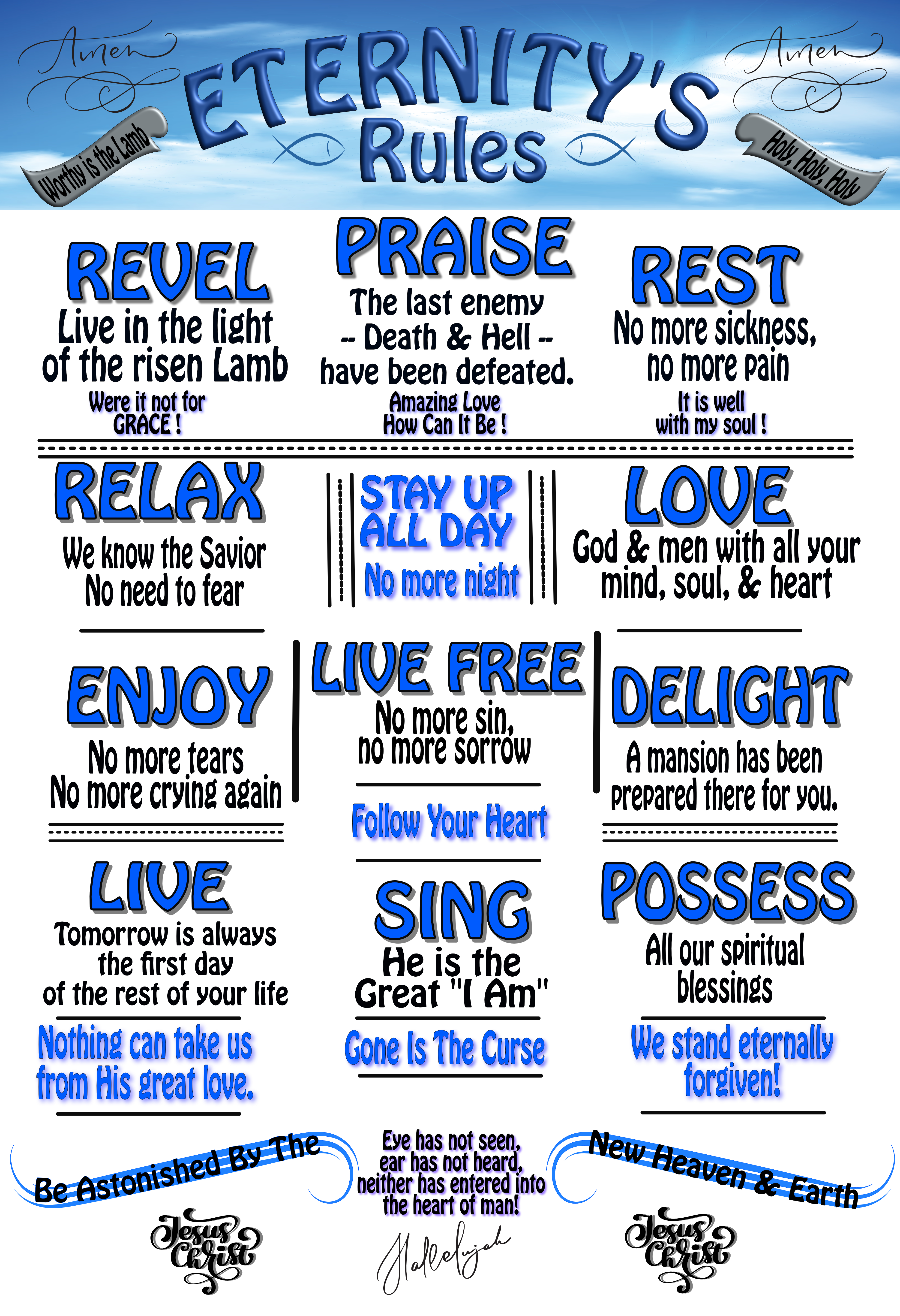
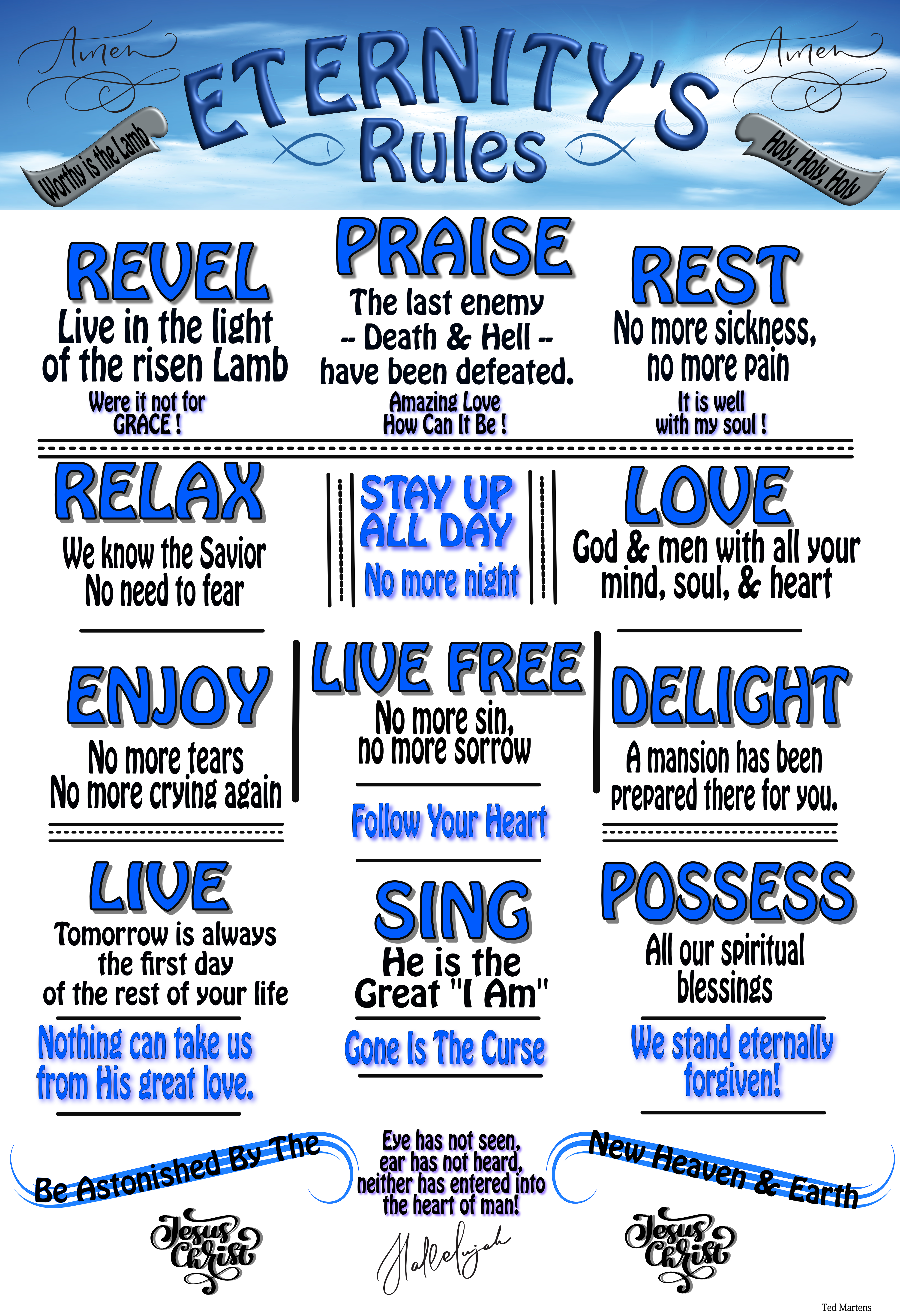
Heaven's Rules V32

Flourish png centered

It is this
BLESSED HOPE
which is part of what the Lord uses to strengthen us,
as well as to guide and direct our thinking and decisions!

This poster is available as a free PDF. or JPG.
You can print it out in any size you find useful.


  1. Best Buy’s Birthday Offer!  What a Joke!

Screen Shot 2021-03-24 at 6.41.16 AM

The #1 Way To Damage Your Credibility.

Dave Ramsey’s ministry is the next domino to fall — not because of the 15 million dollar sale of his home or their stated standards of conduct, leading to the dismissal of an employee for immoral behavior, but because of the loss of his personal credibility!

That loss of credibility comes from inconsistency!  At times, there are difficult calls in ministry or business, and even in family and living out the Christian life.  However, there are also known and/or willful inconsistencies between what one says and what one does.

Leadership inconsistencies have been accentuated even more in 2020 by the “for thee, not me” approach of national leaders and ministries and local churches have not been exempt from the same charge of inconsistency — “It’s unaddressed when it is Mr. or Mrs. X, but when it comes to Mr. or Mrs. Y, then action is taken!”  It depends on who you are, not on principle!

One of the reasons that “reputation” is so vital to ministry and the local church is that “listening” leans on believing that a person is a principle.  Why preach and teach Gospel truths if those listening are saying to themselves — “Sure, tell me about that pastor, while you allow . . . . .”

Claiming to be a person of principle is quickly undermined when people are treated in clear and known disparate ways. Merely because there are people arrayed in the pews does not mean that they put significant stock in what “a man of the cloth” claims to be what the Scriptures teach.  I often use the words “effective” and “ineffective” because it speaks to the very reason a person even assumes a position of leadership.  Those two words speak to the very purpose of preaching and teaching — to make a meaningful difference in the lives of the hearers — or not!

  • When it takes a civil suit, which is about to uncover the wilful inconsistency . . . [1]
  • When it takes subpoenas to shed light on Ramsey’s allowance for the immoral behavior of radio host Chris Hogan . . .
  • When Ramsey finally breaks with Hogan, who promoted his ministry, midst known immoral behavior  . . . .
  • When Ramsey was apparently more interested in the coffers than morality — for one, but not another . . . .

. . . . his effectiveness has ended.

Dave Ramsey is becoming more and more “ineffective” — though the “pews” and the coffers may still look full, he and “Financial Peace University” will become just another ministry that will fade away into insignificance.  Like the memory of Bill Gothard and many other ministries and local churches, “Financial Peace University” will become a distant memory because of willful inconsistent leadership!

Most only need to think about the many local churches which are no longer an effective or meaningful influence in and around where we live or minister.  They have become memories of past impact and effectiveness.  Since those days, that ministry has been on a continual slide into insignificance!  Why?  In many, if not most cases, the ministry or church leadership has lost credibility and therefore influence.

P.S.
Kirk Franklin is next in line!


1. “On Monday, O’Connor’s lawyer asked for several documents, including any information involving Hogan’s violation of Ramsey core values, according to court documents.”

“On Wednesday, Hogan released his apology and left the company [Ramsey Solutions].”

2. The effective ministries and local church pastors, who are a memorial and testimony to long-term credibility, are made up of people such as . . . .

  • Elizabeth Elliot
  • Joni Eareckson Tada,
  • Larry Crabb
  • Chuck Colson
  • Dr. Billy Graham
  • Luis Palau
  • John Von Casper i.e. “Jack” Wyrtzen
  • Dr. John Whitcomb
  • Dr. Lee Roberson
  • Add to that list many small ministries and local church leaders who are warmly remembered because they were effective; they were “without guile” and finished well.

And some of the many others In my sphere of life — “Thank You” for being an example of an effective ministry!  Pastor Dan Gelatte, Pastor Paul Williams, Herman Meister, Pastor Don Shirk, Matthew Kimak, Ron Dunston, et al.

When Is The Leader Really The Problem . . . .

After spending years in both teaching at the college & university level and behind the desk (and pulpit — but this is about the desk), I have been reminded over and over of how poorly served many ministries and local churches have been by its pastors and leaders.

For me, a series of ministry events and what has taken place far too often midst the COVID-19 crisis have been reagents.  They have uncovered the existence of leaders and pastors who see people, and even their own ministry people, as a means to accomplishing their ends.  The ministry leader and/or pastor is being shown to be the problem in many a parachurch organization of local church ministry.

There comes a time when giving the benefit of the doubt is not only naive, but unwise!  Ministry leaders and pastors can become a problem for this-or-that ministry and/or the local church.  The proof is all too obvious — well beyond James Bakker, Jimmy Swaggart, Ted Haggard — yea, remember those names.  Today the names are Moody Bible Institute, James Macdonald, Tullian Tchividjian, Ravi Zacharias, and Dave Ramsey.

Dave Ramsey’s house in Tennessee is for sale,
in case anyone is looking for a house in the area.

The Next Domino To Fall!

The problem is not largeness,
but position & power!

The problem is not the size of the ministry but the position in a ministry.  The fact that these names all reflect large ministries or local churches is not an indicator of the cause of the problem — that of largeness.  The largeness of these ministries is what has caused an alert to these kinds of problems.  Were there no such mega-ministries crashes, the smaller examples would not be scrutinized!  It is only the mega-ministries that have the potential of creating the needed scrutiny needed at all levels of ministry.  The mega-scrutiny has produced a needed examination of those in positions of power in all ministries.

When the 727 Max crashes and kills hundreds of people, people become warier and focus on the FTC’s oversight of all levels of flight and operations.  The mega-disaster sends an alert about potential problems at oversight, inspections, and safety regulations at all levels.  It is the mega-COVID-19 pandemic that will put more focus on the seasonal flu, vitamins, and general health concerns.

The “MEGA” is only a high-level alert about what happens when power and position are unchecked in ministry and in the local church.  At least it should be!

#1) Don’t Be Naive — At Best:

One of the problems on the “less-than-mega” ministries and churches is that when it comes to addressing the president, CEO, administrator, or pastor, many begin with the belief that their leader or pastor would never do anything so grievous that would disqualify him from his position.  Second to that problem is the belief that only the most egregious wrong-doing or sins can disqualify.  Simply stated, RZ disqualified himself LONG BEFORE his most heinous acts, and so did those who were either ignorant or were willingly ignoration.

Apparently, all those in positions of responsibility of oversight, to this day, still do not think they ought to resign as well because they have been disqualified from such a position of oversight.  No one has done that!  If that isn’t telling, nothing is.

It is a meaningful and significant difference between “giving the benefit of the doubt” to a ministry leader or pastor and refusing to believe, from the beginning, that there is anything their pastor has done that ought to disqualify him from further pastoral or pulpit ministry.  For many, before the facts are even laid out, the idea that the leader, pastor, or missionary could be the problem has been decided — impossible!

When it comes to disciplining a pastor, many in the church simply refuse to believe that their pastor is capable of sin or of disqualifying himself from the pastorate. Before the evidence is even presented, they have already decided it is impossible for their pastor to actually be the problem.

  • We don’t know people’s hearts.
  • We should not judge.
  • His heart was right.
  • He did not intend to say or do that.
  • He meant well.
  • His motives were good.

Maybe — to all of the above.  Maybe, but not — “The pastor always means well.” — even when the evidence suggests and even says otherwise.  Selfish, self-serving, lazy, neglectful, apathetic, negligent, and/or sinful words and actions can be seen for what they are, or they can be plausibly denied by those who do not want to believe otherwise.

#2) Cut Off The Blame Shifting:

There seems to be a consistent pattern when ministry or church problems are uncovered.  The leader is involved in a “blame-shifting” operation.  I say “operation” because it is a concerted effort by the problem ministry leader or pastor to convince others that he is not the problem, but the “accuser” is.

The pattern — there is a pattern that runs through such accounts.  The ministry leader and/or pastor . . . . .

  • points to the love-less-ness of that person
  • warns about bitterness and the need to resolve it in their hearts
  • invokes Matthew 18 as the needed remedy against him/her
  • points to their long history of ministry and their faithfulness
  • interjects defensive words into his messages
  • leans on his relationships to speak up and out
  • returns fire, not as to the issues, but as to the person

Calling out the wrong-doing of a ministry leader or pastor is not wrong or sinful.  It is only wrong if there was no wrong-doing and there was no attempt to first address the issue with those who were directly responsible for the wrong-doing.

If the pattern is that the pastor is the victim, let a flag go off.  Flipping the table is all too common a ministry tactic to avoid accountability.  Shifting the blame is what typically happens in ministry (and the world around us, as we well know.  He or she had no reason to be upset, offended, or disruptive — “I have done nothing wrong!”   — Yes, back to #1.

An interesting question to ask is — What have you done wrong to create such a situation that someone would so upset and/or leave the ministry or local church?  Forget the blame-shifting. Regarding this situation, what should you be held accountable for as the leader of this ministry?  When the blame-shifting begins — cut it off and ask that question.  What is your culpability in all this?

RZIM: What Is The #1 Legitimate Charge Against Others?

COMPLICITY!

It would be the exception, surely not the rule, that spiritual disasters which happen over time, happen only because of complicity!  Others are involved in what has taken place — ignorantly or knowingly!

There were others complicit in the RZ disgrace — in “The scandal of the century!” 

Yes, the RZ spiritual disaster (to date) far exceeds many, if not all, of even those of the last century! [1] It involves . . . .

  • an individual known across the world
  • an organization that was as unaware
  • an individual and an organization that has dominated Christian apologetics
  • behavior (rape!) that is as morally reprehensible as it gets
  • clear criminally
  • decades of devoted and supportive followers, readers, and givers
  • a process of uncovering, which is also shameful
  • OTHERS, who were in a position of responsibility to “protect the gates!”

The timeline of this scandal establishes the complicity.  It is not that “overnight” this scandal broke, and all and everybody was shaken to the core!  There was not “a day” in 2021 when what was taking place was suddenly uncovered.  That “first day” took place when the first accusations of sexual wrong-doing were asserted years ago.  There was no complicity on that “first day” when all were legitimately taken back by such a suggestion. However, this scandal did not break when the first-out-of-the-blue charge was leveled, but after years of sexual misconduct and then fully after RZ’s death.

No one was complicit when such a possibility was first charged.  However, this situation was on the radar screen and brewing for years, with “inadequate” investigation.    How does RZ immoral behavior continue for such a period of time without adequate investigation, legitimate skeptical distrust, and vigilant functional curious oversight!?

When it comes to wrong-doing and wrong-doers in ministries and/or the local church, “others” are complicit in allowing what is taking place, to take place.  Sometimes that includes other leaders, pastors, board members, deacons, administrators, “co-pastors,” presidents, and key and influential members.  It happens because it is allowed to happen by little-to-no pushback during stages that would have made a difference.  It grows because others “water” seeds with supportive words, misplaced loyalties, mediocre action, the passivity of indifference, [2] and the permission of silence.

“Others,” who were just as complicit and should have already resigned and even closed down the ministry, reflect the same attitudes that undergirded this horrific scandal!  If you need proof of such complicity here it is . . . .

Screen Shot 2021-02-24 at 9.56.44 AM

It is shameless to continue to use the logo and the letters RZIM after what has taken place!  They are still complicit in the damage that has taken and is taking place by such a practice.  The complicity is demonstratable by shamelessly allowing RZ’s letters to be even used and/or connected with that organization! 

Close it down! 
Turn over the door sign – “CLOSED.” 
Turn off the lights! 
Shut and lock the door behind you!

Start building the platform over  — from scratch!
And include some “lumber” that also holds other leaders accountable when they are also complicit.

It is when others are reminded and know with surety that they too will be held accountable for whatever they knew, and for what they could and should have known, that the relational dynamics will change.  When other “leaders” are reminded that they are in their position of responsibility to represent God’s people, not to be a hedge of protection for wrong-doing  — that then other leaders will take their role more soberly!

How about . . .

RZIM X

AND THEN STATE . . . 

We have closed down
any and all public
operations and business
at this time!

We will no longer be operating
under the name or the corporate entity
that bears any connection with its founder!


No one would make the charge of “corporate or financial conspiracy,” but complicity — Yes!  I think that is an apt description of what takes place far too often in para-church ministries, schools, and local churches. 

P.S. Let’s hope his picture isn’t still part of their public representations!


1. Although I am waiting for another one to break, which is on the back pages of the news.

2. “It’s not my battle.”  “It doesn’t affect me.” “I haven’t done anything wrong.” “I just work here.”  “My job is to be loyal!”

Please Note:  “It doesn’t affect you YET! — It will!  Those around will lose their credibility as well when the crash occurs because they were passively complicit!

“Accountability Partners!” — How’s That Working Out?

Had a great response to the various postings on the RZIM scandal and how it relates to ministry and the local church.
Here was one of the most recent questions and interchange . . . . 
Bob: Great Articles about Leadership and Accountability.  You don’t need to answer this – How do you protect yourself, and do you have accountability partners?

Me: Great question…. I do want to address that question. . . . . and will say more. . . . but if I need an accountability partner, then I as a pastor should be in another position…when the doctor can’t take care of his own health, he’s not a doctor, he’s called a patient.

Bob: I understand — But most of the Pastors in America have fallen due to lack of accountability.  I have been in Christian leadership and was held accountable by friends, elders, deacons, and my wife – perhaps the most critical of me going in the wrong direction of falling / sin.

Me: . . .

♦♦♦♦♦ ♦♦♦♦♦ ♦♦♦♦♦ ♦♦♦♦♦

Bob,

#1) I was going to say in my initial brief response to your comment that we all have an accountability partner if we are married.  If anyone knows us and what we are saying and doing, it is probably her.

However, that makes my point!  Not even Ravi’s wife knew what was taking place or, if she had suspicions, addressed in it real enough terms.  Therefore, what is the hope of someone less involved in our lives?

#2) If a person wants to engage in immoral behavior, they will.  There are plenty of workarounds to arrive at a place where you want to arrive.  No accountability partner will resolve an internal issue from an external position.  Ravi’s wife and adu9lt children proved that!

#3) As you state, there are people — friends on various levels, which may also be elders, and deacons as well — who we listen to and open up to in life and living.  That small circle of people we have come to trust and value have always been in that “relationship place” in our lives to listen and influence us.  They have been given “relational freedom” to speak to us.  They are “natural,” not formal partners in life and living.  I have, as do you, a small number of close friends, as well as my wife and children, who can caution and correct my thinking when I talk openly — as I do them.

#4) If the head doctor is sick and has no idea as to how to get back to health, he has no right to be in the emergency room for others.  Ravi should have resigned himself knowing what he knew.  He is (and was) a patient in need of serious moral and spiritual help.

#5) I, along with many others I suspect, have been asked to cover up the immoral behavior of others in the church and of those who are still in the church’s membership and/or who are still ministering — asked by other pastors.  That is how sick evangelicalism, mission board, and its pastors are.  They can’t even do what needs to be done and face such issues straight on.  Mission boards cover for missionaries, and pastors cover and even continue to support other men in ministry who have been engaged in immoral behavior.  Tell me how  “accountability partners” are supposed to work again!

#6) How did Ravi get away with such behavior, such egregious behavior, so long?  One of the answers is “plausible deniability.”  We have heard that term in the political world, and it describes what happens in the church.  There are plausible explanations that Ravi gave, and they were believed.  What is one of the solutions to that not happening?  Intense push back that does not allow shallow responses or claims of unfairness.  Intense enough to cause the one being questioned to even complain, but to accept such scrutiny because they know they are either innocent, or their “so-claimed proper behavior” has caused such legitimate intensity!

That is the problem with leadership and pastors in the local church setting.  They shield themselves from fair scrutiny by a variety of means — one of them being relationships, as well as the argument of past practice (“We have always . . . what is this change about now?), silencing of members by threats of disfavor or dismissal, purposefully structured business meeting times,  sermons designed to promote a protective spirit prior to that business meeting, calling out of discordant members from the pulpit, and even dismissal.  These are all designed to prevent or lessen legitimate and fair “push back.”  Ravi, and other ministry leaders and pastors, know how this all works, all too well.

#7) Those who irresponsibly allow and/or cover are not even held accountable.  Even co-leaders and members of “the board” who were responsible for oversight ought to be held accountable and asked to resign.   One would have hope they would have resigned themselves, as should have RZ.  Apparently, they do not think so!  How again do accountability partners work?

External accountability partners will never be more viable or potent than personal internal accountability.  If RZ couldn’t bring himself to resign and seek help, then it is only the process of shameful unveiling that has the probability and potency to speak spiritually sensibility into the mind and heart.  That unveiling took place after his death because “no one” had the strength to intensely push back, and/or those who did were marginalized and demonized (per the second article on how it was covered up by the leadership).

As I have often said in ministry . . . .

“I don’t know who I am talking to this morning but “STOP IT” — get off this road now and take this message and warning as the last time that the Lord will speak to you about it!”

♦♦♦♦♦ ♦♦♦♦♦ ♦♦♦♦♦ ♦♦♦♦♦


The #1 Reason to Leave The Church — PDF Link

Referenced RZIM Material

The Roy’s Report

https://www.rzim.org/read/rzim-updates/board-statement

RZIM Report: