Category: Uncategorized

5 Arguments That Don’t Pass The Smell Test


Pass the smell test

To be trustworthy, credible, authentic.

. . . . .

To a reasonable degree, I think I understand ministry.  After years of teaching in Christian colleges, pastoring, and even sitting in the pew upon retirement, there are a few ministry maneuvers that I have seen and all-too-well understand. [1]

However, some may not sufficiently realize that the members and friends of a ministry or local church have also seen them and understand them as well!  Given time, they are seen as disingenuous as indeed they are.  They also know that they don’t pass the “smell test.”

#1) Family Time: “We are canceling the service [2] because we want to encourage you to spend time with your family — to have some additional family time.”

First of all, let me suggest that if any family needs more “family time,” they can shut off the television and shut down social media.  Preach a message on that subject if you want to encourage more family time.

Second, the family is allowed to attend church together for an hour at most all churches (TIC- tongue in cheek).  Since when is going to church together as a family, not family time.

Lastly, too often, these decisions to cancel this-or-that are not about the sheep but also the shepherd.  He wants that day off — not having to tend the sheep.  Over time, the sheep get it when service after service is canceled — Mother’s Day. Father’s Day, Memorial Day, July 4, Labor Day, Christmas week, Easter week, Super Bowl Sunday, during VBS week, et al.

. . . . . . 

#2) I’ll Be Praying For . . . :  “I will be on vacation this coming week and praying for the leaders and workers at VBS as I am away.”

It is easy to purposefully schedule a vacation around an upcoming ministry or church event (And yes, that is true for church leaders, as well as members and friends).  Sometimes, that can’t be avoided because of legitimate factors that operate with all families.

Nevertheless, there are times when taking a vacation is an easy way to “kill two birds with one stone.”  If we are honest, we know and understand that!  Personally, I never left during Summer VBS.  People understood that VBS meant forgoing their vacation schedule, and it meant me doing the same!  Some even used their vacation days to work at VBS!

Over time, taking a vacation (or absenting yourself) while others work at a primary church activity or event will communicate — “Me, But Not Thee.”  God’s people do get it!

. . . . . . 

#3) There Are Other Who Said . . . : “I have had some people tell me that they really like it.”

There are numerous times in a ministry when the suggestion is made that this-or-that is not a good idea, at least not as good as it could or should be.  Nevertheless, the argument that I have often heard made is . . . .

Well, there are some people who really like/liked it.

The argument is a subtle way of saying . . . “Your opinion is as valid as that of others when it comes to evaluating that.”

That is not true!  Some opinions are better than others, and some are even informed opinions — “opinions” from those who have better insight, experience, and awareness.

I am sure there is someone, or even “someones,” who have said that they like this-or-that.  No matter how bad a presentation, event, activity, or message, someone will have liked it.  That hardly means that the ministry, event, program, series, approach, activity, or ministry direction should be kept alive and breathing.

. . . . . . 

#4) It’s All Sinful . . . . : “They are sowing discord.”

There is far too much to say about this maneuver! While “sowing discord” is a legitimate biblical issue, it is also a defensive posture.  This is the “go-to” argument of those who justify wrong-doing.  That reality is easily supported by a cursory examination of ministry and church scandals of our day (RZIM).

Check out the previous and more extensive post on this subject.

. . . . . . 

#5) I Didn’t Know: “I wasn’t fully aware of that.”

At times, we are asked if we knew about this-or-that.  Of course, if we were unaware, then we are exempt from almost all responsibility for what was happening! – ??

  • Many times, we were “aware” of this-or-that, but the comment is nuanced by including “fully” or even whatever the word “aware” means.
  • Other times, we should have been aware of it because that is our responsibility.
  • Sometimes, “willful ignorance” is the reason one is unaware. They do not want to know because they have a responsibility to act or speak to that issue if they know. This is all too typical in politics.

Ignorance by a leader as to what is happening in the operation of a ministry is indefensible!  The members and friends of that ministry or local church expect you to be on top of things while they work in the world to support you and your position as a supervisor!

. . . . . . . . . . . . 

If those in leadership and ministry believe that God’s people (and the world) don’t read what is actually happening as they hear these arguments, they are either naive, self-deluded, or disingenuous!  God’s people read it all too well!

In fact . . .

Some of the arguments used by those in ministry don’t even pass the “sniff-test.”


1. Please, be assured that I am not exempt from any criticism regarding ministry maneuvering.  It is not that we are not guilty of excusing ourselves through varied manoeuvers, but that we have come to realize, more and more, the need to be above-board.  Excusing making is seen and recognized by those within and without the ministry.

2. Sometimes it is an evening service during a holiday week, on Super Bowl Sunday, a mid-week service, a youth group night, or during VBS  —  et al.
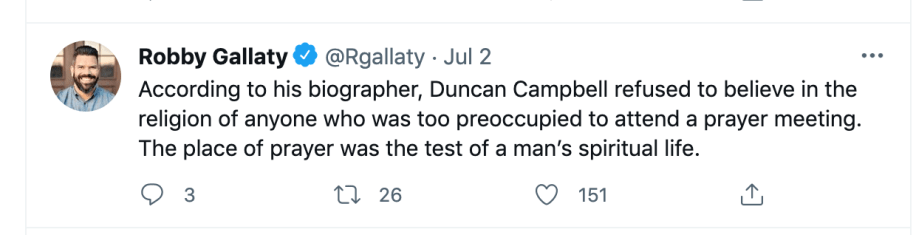
The Arrogance Of “Weight Loss”

Posted by Robby Gallaty:

“According to his biographer, Ducan Campbell
refused to believe in the religion of anyone
who was too preoccupied to attend a prayer meeting.
The place of prayer was the test of a man’s spiritual life.”

There are those who would like to make one area of Christian life and living the most important. Apparently, Robby Gallaty is one of them!

The Christian life is far more complex than any one area or Christian godly discipline. Those who seek to narrow it down to one area will have to twist the Scriptures to make Christian living the most important. “Shepherds” dishearten the sheep with such nonsense.

We can all pick an area that we are really good at in the Christian life, and exalt it to a singular and primarily place — witnessing, Bible reading, prayer, Bible teaching, discipleship, giving, missions-evangelism, service, faithfulness to church, hospitality, Bible study, morality, self-control, humility, et al.

It reminds me of those who have lost weight. They begin talking and acting as if weight loss is the foremost example of self-control. The more weight lost, the more condescending the words and/or attitudes towards those who struggle.

Some of the “singularly focused” become “Christian snobs!” They see others are inferior, not where they have concluded they ought to be. They overtly and covertly advertise their mastery of an area. At times, their advertisement is not so subtle as they chide others, and thereby imply they have it fully under their belt.

Sadly, such theological ideologues [1] have replaced “progressive sanctification” — The Lord working in individual lives, differently, and over time — with “duplicate sanctification.” You need to make the Chrisitan discipline or conduct, which I think is #1, your #1.

AND Do It NOW! — If you are struggling in an area, especially the specified area, you may not even be a Christian! Progress, struggles, mountains and valleys, dry and rainy seasons are reasons to question your salvation!

Robby Gallaty is one such example! Apparently, “virtue signaling” has moved into the pastoral tweet-o-sphere. Prayer is paramount, but evidently, humility is much further down on the list! [2][3]

. . . . .

P.S. Jesus got it down to . . . Love God and Love people! Doing that requires both a wide variety and a good number of actions, attitudes, areas of thinking, changes, and activity!

. . . . .


  1. “Theological Idealogues” are those who hold to a system of theological thought that regulates how and what they see in Scripture.
  2. Humility:  Check out the “numerous” tweets about his prayer life!
  3. Stay Humble!
    Thanksgiving, Christmas, & New Year’s day(s) are ahead.  Don’t get too confident that you are as self-controlled as you think or are today!  Many of us cannot even resist a “brownie,” and we think we have our weight under control — Just saying!

    Stay Humble!
    You don’t have it all together theologically or practically.  Today’s fad, trend, excitement, and/or personal “theological hobby horse” will be seen for what it is — the inability to balance out the biblical diet needed for a healthy Christian life, mixed along with a condescending attitude directed at those who are not where you are!

Note:  Told you so . . . . Link

What Happens When You Read The Same Books . . . .

If you read the same books that others are reading,
you will think the same thoughts that others are thinking!

One of the most recent and pervasive examples of that statement and of theological “group think” teaching is about today’s exhumed fad of . . .  Passive Sanctification (the link).

“The current debate about sanctification (does holiness come through personal effort, or is the best approach to sanctification to “relax” and trust God more?) is hardly limited to this age. J. C. Ryle fought the same battles over 100 years ago. Here are his comments on the idea that we are sanctified in the same way we are justified:

“I ask whether it is wise to speak of faith as the one thing needful, and the only thing required, as many seem to do nowadays in handling the doctrine of sanctification. Is it wise to proclaim in so bald, naked, and unqualified a way as many do that the holiness of converted people is by faith only, and not at all by personal exertion? Is it according to the proportion of God’s Word? I doubt it.

That faith in Christ is the root of all holiness; that the first step towards a holy life is to believe on Christ; that until we believe we have not a jot of holiness; that union with Christ by faith is the secret of both beginning to be holy and continuing holy; that the life that we live in the flesh, we must live by faith in the Son of God; that faith purifies the heart; that faith is the victory which overcomes the world; that by faith the elders obtained a good report—all these are truths which no well instructed Christian will ever think of denying. But surely the Scriptures teach us that in following holiness the true Christian needs personal exertion and work as well as faith. The very same apostle who says in one place, “the life that I live in the flesh I live by the faith of the Son of God,’ says in another place, “I Fight,” “I run,” “I keep under my body”; and in other places, “let us cleanse ourselves,” “Let us labour,” “Let us lay aside every weight.”

Moreover, the Scriptures nowhere teach us that faith sanctifies us in the same sense and in the same manner that faith justifies us! Justifying faith is a grace that “worketh not,’ but simply trusts, rests, and leans on Christ (Rom 4:5). Sanctifying faith is a grace of which the very life is action: it worketh by love,” and, like a mainspring, moves the whole inward man” (Gal 5:6)…

Without controversy, in the matter of our justification before God, faith in Christ is the one thing needful. All that simply believe are justified. Righteousness is imputed “to him that worketh not but believeth” (Rom 4:5). It is thoroughly scriptural and right to say, “Faith alone justifies.” But it is not equally scriptural and right to say, “Faith alone sanctifies.” The saying requires very large qualification. Let one fact suffice. We are frequently told that a man is “justified by faith without the deeds of the law” by St. Paul. But not once are we told that we are “sanctified by faith without the deeds of the law.”

. . . . .

. . . . .

Sanctification is progressive!
It is not the Lord or me. 
It is the Lord and me.
It is “Both-And.”

. . . . .


Other Information & Links:

One of MANY links warning about the idea of passive sanctification
https://headhearthand.org/blog/2015/10/21/five-attractions-of-passive-sanctification/

♦♦♦♦♦

Note: Men like John Piper confuse the issue further by playing games with the word “passively” — “You Can’t Passively Kill Sin.”  The article’s title makes it sound like he agrees that sanctification IS NOT passive, but he doesn’t! His “Calvinism” is part of what contributes to this twisting of the doctrine of sanctification. It is a highly nuanced article that clouds and confuses the issues even further.

If you would like to read John’s Piper’s position on Eternal Security, which is also just as nuanced, obscured, and twisted by his Calvinistic position, read this article, in Piper’s own words!

. . . . .

3 Suggestions To Avoid Sermonic Plagiarism

“Docent” [1] has become one of the focuses of the recent plagiarism scandal involving the new president of one of the largest evangelical conventions — the South Baptist Convention.

“Docent” is one of the organizations that provide preaching materials for pastors and the creation of sermonic content.

It has been rightly said . . . .

If you read the same books that others are reading,
you will think the same thoughts that others are thinking!

I might suggest that the same is true when it comes to using “sermonic/preaching services,” such as “Docent.”  This recent scandal has helped me to better understand why so many . . . .

  • sermons seem to reflect the same theological trends and fads [2]
  • preachers & teachers avoid certain theological truths
  • illustrations are retold [3] until they are worn and hackneyed
  • pastors repeat statistics that have no support in reality
  • preachers employ similar wording [4]

. . . . .

The reason is . . . .

They subscribe to these kinds of theologically inclined sermonic services!
They
all “read the same books.”

It should be pointed out that these services are theologically inclined, and that inclination is reflected in what is being said, taught, and preached (as well as seen & sung) across American churches.

. . . . .

Of course, preaching and sermonic preparation involve the use of other materials!  Commentaries are rudimentary to preaching and teaching.

I have at least three simple practical suggestions (outside of personal integrity) when it comes to preaching and the use of other preacher’s materials . . .

#1) A Course In Logic: A seminary education needs to include a course in “critical thinking.”  Too many read all kinds of theological and religious material with far too little discernment.  Too many pastors and ministry leaders lack the ability to critically evaluate what is being said, taught, or published.  [5]

#2) A Far Wider Read: Read the thinking of others and/or listen to the preaching of others, but read and listen to material from more than either contemporary writers, or from any other theological era.  The writers of the day reflect the fishbowl in which they and we all swim.   And, the church fathers, or the puritans, or . . . or . . .  were not right, biblical or accurate in all they taught or believed. [6]

#3) Work Harder & Then Smarter: Take the time it takes to make it your own!  The easy path is to “grab and run” with a good illustration, a headline statistic, or a great statement or sermonic thought.  Create some of your own unique material as you see what was done, and imitate it (not copy it.)

  • When you come across an illustration or story, do more reading and research so that you know more about that story than was originally stated.
  • Check out that statistic.  Statistics don’t lie, but liars use statistics.  Go back to the source and methodology used to arrive at the study’s conclusion.
  • Personally rework a statement (or often correct) to make it your own, or to ensure greater accuracy  — else give proper credit if used “wholesale.” [7]


  1. Links:
    https://capstonereport.com/2021/07/05/baptist-professor-accuses-former-sbc-president-j-d-greear-of-plagiarism/36499/
    https://reformationcharlotte.org/2021/07/05/jd-greear-admits-to-purchasing-sermon-material-to-make-himself-look-good/
  2. i.e. — One of the most recent and pervasive — Passive Sanctification

One of many links — https://headhearthand.org/blog/2015/10/21/five-attractions-of-passive-sanctification/

Another article:

“The current debate about sanctification (does holiness come through personal effort, or is the best approach to sanctification to “relax” and trust God more?) is hardly limited to this age. J. C. Ryle fought the same battles over 100 years ago. Here are his comments on the idea that we are sanctified in the same way we are justified:

“I ask whether it is wise to speak of faith as the one thing needful, and the only thing required, as many seem to do nowadays in handling the doctrine of sanctification. Is it wise to proclaim in so bald, naked, and unqualified a way as many do that the holiness of converted people is by faith only, and not at all by personal exertion? Is it according to the proportion of God’s Word? I doubt it.

That faith in Christ is the root of all holiness; that the first step towards a holy life is to believe on Christ; that until we believe we have not a jot of holiness; that union with Christ by faith is the secret of both beginning to be holy and continuing holy; that the life that we live in the flesh, we must live by faith in the Son of God; that faith purifies the heart; that faith is the victory which overcomes the world; that by faith the elders obtained a good report—all these are truths which no well instructed Christian will ever think of denying. But surely the Scriptures teach us that in following holiness the true Christian needs personal exertion and work as well as faith. The very same apostle who says in one place, “the life that I live in the flesh I live by the faith of the Son of God,’ says in another place, “I Fight,” “I run,” “I keep under my body”; and in other places, “let us cleanse ourselves,” “Let us labour,” “Let us lay aside every weight.”

Moreover, the Scriptures nowhere teach us that faith sanctifies us in the same sense and in the same manner that faith justifies us! Justifying faith is a grace that “worketh not,’ but simply trusts, rests, and leans on Christ (Rom 4:5). Sanctifying faith is a grace of which the very life is action: it worketh by love,” and, like a mainspring, moves the whole inward man” (Gal 5:6)…

Without controversy, in the matter of our justification before God, faith in Christ is the one thing needful. All that simply believe are justified. Righteousness is imputed “to him that worketh not but believeth” (Rom 4:5). It is thoroughly scriptural and right to say, “Faith alone justifies.” But it is not equally scriptural and right to say, “Faith alone sanctifies.” The saying requires very large qualification. Let one fact suffice. We are frequently told that a man is “justified by faith without the deeds of the law” by St. Paul. But not once are we told that we are “sanctified by faith without the deeds of the law.”

Later, Ryle added this, which again seems so timely:

I must deprecate, and I do it in love, the use of uncouth and newfangled terms and phrases in teaching sanctification. I plead that a movement in favour of holiness cannot be advanced by new-coined phraseology, or by disproportioned and one-sided statements, or by overstraining and isolating particular texts, or by exalting one truth at the expense of another…and squeezing out of them meanings which the Holy Ghost never put in them… The cause of true sanctification is not helped, but hindered, by such weapons as these. A movement in aid of holiness which produces strife and dispute among God’s children is somewhat suspicious.”

. . . . .

Men like John Piper confuse the issue further by playing with the word “passively” — “You Can’t Passively Kill Sin.”  The title of the article makes it sound like he agrees, but he doesn’t!

Rather, it is a highly nuanced article that clouds and confuses the issues even further.   His “Calvinism” is part of what contributes to this twisting of sanctification.

. . . . .

3.It is shocking painful to hear Ed Litton (new president of the SBC) repeat an illustration told by J. D. Greear, as if Litton himself experienced what Greear had stated.

4. Here are but a few examples . . . .

  • “Let me unpack this for you.”
  • “Are you tracking me?”
  • “Good morning, church.”
  • “Bookends”
  • “_____ is a heretic!”
  • “Let’s stand for the reading of the Word.”
  • “May the Lord add His blessing to the reading of His Word.”
  • et al.

5. I, like you, are sometimes shocked by the lack of logic or critical thinking by ministries and local church leaders — “Really, you read that or heard that, and you believe that / or repeated it?”

  • Sometimes, it is a theological ideology that short-circuits logic.  It may sound biblically unsound, twisted, counter-intuitive, or even crazy — but it fits one’s ideology.
  • Sometimes, what is said by this-or-that person is just accepted and repeated because — well, so-in-so said it – even if it goes against many passages of Scripture.
  • At other times, it is easy to just believe and repeat, than to take the time to realize how unbiblical and/or illogical it is.

6. While those church fathers and historical documents which were closer to the 1st century ought to be a starting point for thought since they were closer in time, and some of the issues of the Christian faith have been hammered out historically, that does not preclude thinking and rethinking some of their positions.  You would be surprised by some of the teachings of the early church fathers and churches.

7. There are many sermonic statements that can be and should be reworked in light of what you know and what you believe the Scriptures teach!  The original statement has the potential of kicking off — generating– other similar or different useful creative statements.  Often, that rework comes from the passage because the passage actually teaches something different — slightly different, significantly different, or vastly different.  The original statement doesn’t catch the fullness of the statement that you heard or read.

It Is Easily Detected!

In a bizarre event at a professional golf championship, an interesting and perceptive evaluation was made!

What: “what will likely stick in McIlroy’s mind is what occurred as he stood on the 10th tee (his first of the day) alongside caddie Harry Diamond and playing partner Jon Rahm. As the trio chatted, a man appeared out of the gallery, grabbed the headcover off McIlroy’s driver, and took one of his irons out of the bag. He then proceeded to make a couple of practice swings. All of which provoked a classic double-take from McIlroy and bemused looks from all concerned before a pair of security guards moved in to remove the intruder.”
— Golf Digest, July 9, 2021 —

Who: Rory McIlroy

Where/When: The second day of the 2021 Scottish Open at The Renaissance Club

. . . . .

The article goes on to say . . . .

“The players laughed it off,
saying
they knew he wasn’t a golfer when they saw his grip.”

. . . . 

You can tell when someone isn’t what they claim to be! 

√ There are tell-tale signs that give away that one is not what one claims to be.
√ There are visible indicators that what is said cannot be true.
√ There are markers that disclose that it is not what it states.
√ There are detectors that reveal something is not what the label says.
√ There are reagents that publish what something actually is.

. . . . . 

Interestingly, COVID-19 has been one of those reagents, signs, indicators, markers, detectors for many a ministry and/or local church ministry.

“The members and friends laughed it off,
saying they knew he wasn’t a shepherd
when they saw how he used his shepherd’s crook
with the sheep and with those who had wandered.” [1]

. . . . .

P. S. This post was motivated by yet another call this week — from my small local storefront pharmacist
—  Oh, did I tell you my pharmacist called us again THIS WEEK!


Other Information & Links:

  1. Note: In many situations, it is not that someone from the church has not called, though some have not heard from anyone on the church staff.  Yet, Praise the Lord, some members and friends cared and called because it really is about genuinely caring!

Far too often, the lead or senior pastor has not shown any personal interest in “calling” each and every member and friend of the local church ministry!  The lead or senior pastor passed off that responsibility to other pastors on staff or the “deacons.”  They excused themselves out by such a delegation with some explanation as to why they could not.  They failed to realize that the deacons and/or other church leaders cannot do what he should be doing, and what he alone could accomplish as the shepherd of the flock.  The lack of care, compassion, love and genuine concern stand in deep contrast to the claims that one is a shepherd and the local church is a “family.”

https://www.golfdigest.com/story/rory-mcilroy-fan-pulling-club-from-bag-on-tee-scottish-open-2021?utm_medium=email&utm_source=070921&utm_campaign=hitlist&utm_content=DM19235&uuid=b12bf3fbe8fb480bbe3244c1e7db1166

Train Wreck: Did No One Try To Talk To Him?

. . . . . 

Did No One Try To Talk To Him?

That’s what I often said after the story broke, or the obvious and therefore expected “train wreck” took place!

Whether it be RZIM/Ravi Zacharias, President Donald Trump, Paige Paterson, Tim Litton, Jimmy Swaggart, Jimmy Bakker, Bill Gates, numerous sports personalities caught up in all kinds of abuse or immorality, Dave Ramsey, and far too many ministry leaders and pastors — Did no one TRY to Talk to Them?

The answer is — YES, someone tried!  

At a point in time, someone tries to intervene! — perhaps early on, or when it was unintentionally too late —   because “Friends don’t let friends. . . . !”

So how is it that those friends are not able to convince their friends to change course?  Regrettably, the answer may be multiple, but surely one of the answers is . . .  They are “parochial” — “Narrowly restricted  in scope or outlook.”

Wrong-doers can’t see outside of their own vantage and thinking.  They are convinced, primarily self-convinced, that their vantage is the correct and even singularly correct viewpoint!  I say primarily self-convince because even without any external support, they would be convinced.  However, people outside and around them also feed into the desired “narrative” — a spouse, close friends, the ambitious, faint-hearted co-workers, and kind-hearted, gracious people — at least for a while! 

“They believed their own press.” The “press” is different, but the results are the same.

With President Donald Trump, it was and is the enormous crowds.
With Dave Ramsey, it was the office and staff workers who know their job was on the line.
With Ravi, it was ministry and organizational success.
With Bill Gates, it is his wealth and entitlement mentality.
With sports personalities, it is actually “press,” along with the absurd money.
With . . . 

As David Foster Wallace illustrated in “The Greatest Commencement Speech of All Time” . . . . .

“There are these two young fish swimming along, and they happen to meet an older fish swimming the other way, who nods at them and says, “Morning, boys. How’s the water?” And the two young fish swim on for a bit, and then eventually one of them looks over at the other and goes, “What [in the world] is water?

All of us live in the fishbowl of our own thinking — surrounded by “water” that is more often than not unrecognized and therefore unexamined.  A lack of self-awareness fuels that lack of examination!

Too often, the stated or unstated response, in word or thought, is —  “What in the world are you talking about.”

“Didn’t anyone talk to them about it?
The answer is, “yes.”  Sometimes obliquely, sometimes personally, sometimes simply, sometimes painfully and truthfully, and sometimes confrontationally — but someone spoke to them because “Friends don’t let friends . . . . “

The problem is not that friends did not speak up, but that . . . .
(We all know the rest of the sentence.  We know it all too well!)


7 Reasons Ministry Leaders Are Criticized

. . . . .

THERE IS a proper place for criticism!

Yes, there is a fine line between helping and criticizing.  Some criticisms are helpful, and obviously, some are not. That is true in many realms of life and living. A good marriage includes criticism between a husband and wife.  In a family, children have legitimate criticisms worthy of parental attention.  In a society, a dating relationship, an educational setting, the business world, perfecting a hobby or a sport, books, and films, and the operations of the church — criticism takes place because it is needed!

AND Yes, I know that there are those who find comfort in, and maybe even profit somehow from the failures of Christians and Christian leaders.  Nevertheless, while we are fully aware of the possibility of false accusations, many are not equally aware of the reluctance of those in positions of prominence and power to address the wrongdoing of ministry leaders and pastors.  The major cause of that is “relationships.”  Those in the position to address wrongdoing see themselves as protectors of the leader or pastor, rather than representing those who put them in that office.

By design and purpose, “All-Thing-Church” is critical of an anemic American Christianity, which is warned about throughout the Scriptures.  We ought to be the first to be willing to criticize sinful attitudes, conduct, decisions, behavior, and viewpoint in our own ranks! [1] That anemic brand of American Christianity is first and foremost the responsibility of ministry leaders and pastors, not the sheep. 

THERE IS a proper place for criticism because . . . . 

#1) Pastors are “part” of church problems.  Far more often than not, there are two sides to a problem.  No one bears 100% responsibility.  The pastor is in a position to come out looking like it has little to do with him or his leadership.  Pastors get to have “the last word” among the leadership on a matter.  Too often, their judgement of a situation is taken to be the case because — well, they are the pastor!  That is why there is good reason to make sure the leaders speak to all sides, personally and corporately — with the pastors!

#2) There may be, and indeed are, legitimate reasons why people leave a church that are directly related to the attitudes and decisions of the pastor and the church leadership.  Instead of giving some legitimate credence to such reasons, the reasons are just dismissed — because . . . well they left — so what is the reason?  Too often, there is a reluctance to probe any deeper since — “they left.”  The proof of that is found in the work of Julie Roys. It is again amplified by the newly revealed plagiarism of the newly elected president of the Southern Baptist Convention — but he apologized! [2]

#3) Some pastors and/or church leaders fail to appreciate and value each person who attends, serves, gives, and worships at their church — even if they attend for only several weeks, or sporadically throughout the year!   Some pastors label people because they have not reached their expectations, and the end result is tunnel vision towards that person. They can be seen as nothing else but what they have come to see them as.

#4) While most leaders say that they value criticism — that all changes when it is offered.  Some of the leaders who are the most averse to criticism — legitimate or illegitimate — are ministry leaders and pastors.  Where humility ought to be exemplified, pride, arrogance, and an unbiblical over-confidence exist.  Leadership improves with both legitimate and illegitimate criticism.  Discernment requires the input of critical thought and criticism.  There are many examples of legitimate criticism — and “thank God someone spoke up”–  throughout the Scriptures! 

#5) When people leave the church, they are typically characterized as troublemakers by pastors and leaders.  A narrative is constructed [3] as to why they left, and that becomes the explanation with little regard as to what the issues and concerns actually were.  That approach is an easy way to explain away real issues that ought to be addressed, and just kicks the can down the road, when the next person or family leaves.

#6) Pastors and leaders are too willing to discard “indigenous members” when they disagree.  “Indigenous church members and friends, those who have worked, served, given, supported, attended, invited others et al. FOR YEARS.  They are given little berth as soon as they voice their concerns — legitimate or illegitimate!  No matter how many times we said that we appreciate and are thankful for your ministry in the past, that was then!  No matter that we said that your gifts and talents matter — over your many years — feel free to leave.

#7) Some pastors and leaders utterly fail at seeing themselves in the censure by which they accuse others (more than is seemly with those who preach and teach humility).  “Them there church members are being . . . ” — when it is often equally true that “they themselves have been and are being . . . . .”  The points they make in characterizing others prevail in their own actions, decision, and attitudes.  [4] [5]

It is in the DNA of church members to give a wide berth to ministry leaders and pastors, and for good reason.  Nevertheless, may I suggest that there are far more people who are aware of verifiable church and pastoral wrongdoing who say little to nothing than those who are actually sowers of discord!  The discord has been misidentified.  It has been sowed by the wrong-doers!  Their lack of care, or self-serving decisions, or immoral actions, or power grab, or improper financial actions, et al., have created the discord!

Wrong-doing has to reach an untoward level of discomfort before it is addressed — (and a level discomfort far more than is fitting for the church).  In the end, some people leave, not because of the wrong-doing, but because of the cover-up and/or complicity of the leadership, which refused to comment and would not address it until it got obviously out of hand!

Our anemic brand of American Christianity
is first and foremost
the responsibility of
ministry leaders and pastors,

not the sheep.


1. It was the Roman Catholic Church that has been and still is unwilling to deal with wrong-doing in and among its own ranks, and the world sees that and “gets it.”  Are we different, or are we cut from the same piece of cloth! 

2. Tom Buck:  First, I’m grieved by those who are silent, minimizing, or justifying the actions of Ed Litton. I was stunned that one pastor spun it as an attack of Satan upon a man called of God to do great things.

You see, if you get permission to repeat someone’s sermon, it isn’t plagiarism.  If someone gives you permission, then you have not been unethical or immoral, even though those listening had the impression it was your message.  There are all kinds of sermon sites that allow you for free or for $$ to use a prepared sermon and/or outline.  So I guess it isn’t plagiarism to use them and leave the audience with the impression that you have worked on the passage and message for hours this past week in your study!
This is laughable twisted, and SAD!  — Ted Martens

. . . .

3. The narrative is typically a story of a single incident — “Well, they left because the pastor said / decided / changed / announced this-or-that.  I find that God’s people are pretty resilient when it comes to differences of thought, changes, and offenses.  There is no ONE or even TWO events or situations that caused the decision to leave.  That clearly must be true of those who are the “indigenous members” and have weather all kinds of situations over the years!  Most of God’s people are willing to give the benefit of any doubt to the pastor and seek peace and unity because we understand biblical truths and principles.  It probably was far more than one decision, comment, action, or offense.  RATHER it was a pattern.  Events, decisions, actions, comments began revealing a self-serving picture of leadership.

4.  When some read . . . “

But the end of all things is at hand: be ye therefore sober, and watch unto prayer.
And above all things have fervent love among yourselves: for love shall cover the multitude of sins.

When some read those words, they think of those who have been critical. Some never see that they themselves have failed at that very point in dealing with others!  It is “them there church members and friends” who ought to love and “cover the multitude of sins.” At the same time, the pastor and/or leaders have egregiously failed at that very admonition — egregiously because they are “the adults in the room” — the shepherd, not the sheep!

5. More and more, I find ministry and church innocence claims very difficult to accept out of hand.  The kind of dishonesty, duplicitous self-serving decisions, and man-handling of people is far too prevalent!  The problems which continually arise are due to both a willfull ignorance as to what is actually happening and/or self-delusion, which is bolstered by a gross underestimation by other leaders in a position to address it, concerning the ability of pastors to purposefully deceive through a variety of methods!


See maligning the truth-tellers:https://julieroys.com/harvest-leader-repent-maligning-truth-tellers/

“But apparently to Vanlaningham, it’s better to sacrifice the sheep and God’s reputation than expose the fraudulent shepherds. God will “sort things out”—eventually.”

The Next Test: Again, It Will Be Pass or Fail?

If you were convinced that another crisis was on the horizon, on par with that of 2020 (and 2021), what would you be doing as the leader of a local church?

Surely, you don’t believe that another one is not on the horizon.  The biblical projection of history is far from “better and better every day in every way.”

Might I suggest that . . . .

  • Many, far too many, churches were unprepared for 2020!
  • “Connectivity” (or lack of it) was improperly identified as the antidote and therefore went woefully unaddressed and deficient.
  • The next crisis, as this one, will only accelerate and amplify the direction and projections of Scripture.
  • More people will leave their local church, and only SOME will move to another church when the next crisis hits.
  • More and more sermons will become heavily littered with the political.

AND . . . .

  • Some (too many) will repeat the same failure, the failure to care about the sheep they say they shepherd!
  • Some (too many) will repeat the same failure, the failure to highlight the foundation of our faith, the blessed hope — the coming of Jesus — again — a second time.

    All kingdoms will fail, and the Lord will singularly set up the only kingdom of true righteousness.
    That is an essential biblical truth designed to guide the ship through the roughest of waters.

A Healthy Reminder: The Joy of Ministry!

I was reminded again by an email from one of the past members of Faith Baptist Church that the lasting memories of others are one of the rewards of ministry!

Greg sent me this email because he himself experienced that joy of ministry — the lasting memories of others that he had the opportunity to help forge.

. . . . . 

Pastor, I just wanted to share a neat story of how you always taught us that being involved in someone’s life matters and can make a meaningful difference even years later.  Sometimes, you may never realize it.  At other times, it bubbles to the surface and you get to see and hear it!  You may not know at the time what memories you are creating. Nevertheless, they seem to always remember those special times that somehow were important to them at that time in their lives.

Last weekend Devonna and I went to see Dave Pittman about possibly purchasing a car.  He’s been a salesman for about 10 years, knows what he is doing, and is trustworthy.  As soon as we arrived and saw each other, a big smile broke out on all of our faces. Dave was one of the teens we got to know during our many years of working in the youth ministry alongside Pastor Stiles.  That is where the relationship began and what those smiles reflected.

After we finalized the deal, Dave began recalling specific events and situations from those youth group days.  He just wanted to let me know how important it was that Devonna and I were his youth leaders and how we always seemed to make time for him.

As you often stated, the teens will long remember your relationship with them, far more than some deep theological lessons you thought were really important.  As you said, they will listen and seek to grow just because the leader who is talking to them loves and cares about them. You are so right — youth ministry and those teen years, are about their relationship with the workers and youth pastor.

When he began recalling several events and situations, I was reminded how times and events we might take as just common and ordinary, but were far more than that in the lives of others.

“I remember being at your house for hours and you never got tired of us or put a time limit on how long we could stay at your house.”
“Remember when Devonna went away for a teachers conference , and you came over my house and we played video games and just hung out . We even went out and bought a hamster and surprised Devonna when she came home.”
“Do you remember — I do — when you would just open your house to us teens to stop on over at the drop of a hat and you would barbecue food for us or we would order pizza and just spend time — a lot of time — talking.”
As we wrapped up the car deal, he looked at me and said — Thank you for investing in me all these years and always treating him like I mattered.
Pastor, he graduated from youth group probably 15 years ago, but he remembered days and events from those critical teen years — and it still was important to him!
We were on cloud nine — because Dave’s memories spoke to our hearts about the importance of youth ministry in the lives of teens.  We were there to buy a car, but walked away with a far more valuable possession — joy from realizing that working with teens matters.  Those teen years matter intensely, and we know that even more after being parents of teenagers!
. . . . . 

. . . . . 

Greg and Devonna had the joy of hearing but a small part of the memories of those who were affected by selflessness, by giving time and energy in ways that can only be read by teens as truly caring. [1]  There are many more stories from where these came from, just not presently known, and other memories from others who were also impacted during their teen years.

There is “Joy In Serving Jesus!”

There is joy in serving Jesus
Joy; that triumphs over pain
Fills my heart with heaven’s music
Till I join the glad refrain


  1. If COVID has caused a loss of volunteers in your ministry or local church, share some of the rewards of ministry — the joy of great memories of those you may never get to hear — and those few times that you do!  Perhaps the joy you have, or others have, in serving selflessly and genuinely will spill over to others!  Joy in serving Jesus is contagious!  While some are immune, those who love and care will “catch it!”

Did Henderson and Nieuwhof Say — Blame Covid!

I never cease to be amazed at how tone-deaf Christian leaders are!  Here is ministry advice by Jeff Henderson, reposted by Carey Nieuwhof, concerning recovering the pre-pandemic volunteers of the church . . .


DECLINING VOLUNTEER NUMBERS AND 5 STEPS TO REVERSE IT

By Jeff  Henderson

While there’s been a lot of conversation about declining church attendance numbers (even before COVID), the more concerning number is the decline in consistent volunteers. . . .

This Summer, the focus should be on volunteer recruitment for the Fall.

To help with this, save this list and discuss it among the team.

#1 — Blame COVID, Then Cut Back.

I love the advice John Maxwell gives leaders about the pandemic. John said it’s an opportunity to try new things and if it doesn’t work, blame the virus! 🙂

This isn’t reserved for trying new things, though. It’s also for eliminating current ministries in order to shift volunteers to “essential ministries.” [1]

Sounds “upfront” and “above-board” to me!
Surely, no one would think it is duplicitous!
This approach should promote pastoral credibility!  No?

SAD “advice”!

♦♦♦♦♦

Attention:  John Maxwell did NOT say “Blame Covid” — He did say that 2020-pandemic is an opportunity to try new things!  Henderson’s sentence falsely gives the impression that Maxwell concurred with or initiated the suggestion to blame covid.

He also said . . .

Crisis brings out the best and worst in people, says leadership expert John Maxwell, and the world-changing effects of Covid-19 have presented a proving ground to reveal who the true leaders are in workplaces across the country.

“A crisis separates the players from the pretenders,” said Maxwell, who is the author of dozens of books on leadership, the most recent of which is “Change Your World.”

Maxwell characterized the Covid-19 crisis as “a great time to find out who your leaders are, because you’ll never know who they are by what they say.” Rather, real leaders are revealed “by what they do in a very difficult time.” [2]

♦♦♦♦♦

A better answer to the ministry volunteer shortage:

Next time, care about the people in your ministry or local church!  AND now it is time to get honest with God’s people about how you failed many families and individuals!  Forget blame-shifting as a strategy for covering up the lack of heart by the under-shepherd!  Most of God’s people would forgive that failure if there was some level of genuine honesty!


1. https://careynieuwhof.com/declining-volunteer-numbers-and-5-steps-to-reverse-it/

2. https://thebusinessjournal.com/john-maxwell-covid-a-proving-ground-to-reveal-true-business-leaders/


Note:  The second suggestion is as disingenuous as the first . . . . 

2. What Is Essential In Your Ministry?”

Granted, telling one ministry area that it’s not as essential as another is never fun. But that doesn’t make it untrue. If your church wants to be FOR the next generation, it probably can’t have a senior adult ministry. And vice-versa.

What has actually happened is that COVID has become an opportunity excuse to shut down ministries that some leaders have been wanting to shut down but could not justify, such as evening services, Sunday school, mid-week services, outreach ministries and the like!  The cover story is CVID-19!