Author: tmart2007

Blogger on RhetoricandHomiletics.org

The Five Best Reasons To Attend A Funeral — Maybe Today

I am sure there are a good number of reasons to attend a funeral,
but I believe these may be
 the five best reasons,

. . . . .

#1) People “Never” Forget It:  There are acts of kindness and helpful deeds that people will long remember, but in times of pain and distress, such acts of kindness are just not forgotten.

I was reminded of that principle when my son shared how grateful a friend was because of his response in a time of a painfully personal and family juncture.  

Painful experiences are the very times when we need others just to be there. We all know that. Who hasn’t heard someone repeat something like this. . . . 

“There isn’t anything you can say, 
but just being there speaks.”

Being there during . . .

  • times of loss,
  • painful family experiences,
  • deep hurt,
  • times of relentless sorrow and regrets,
  • foreboding health information, or
  • passing — at the bedside of others who are processing the prospects of death (theirs or loved ones)

. . . . . MATTERS to people and leaves a lasting impression!

. . . . .. . . .

#2) It Is Loving:  Jesus purposefully delayed His coming to the funeral of Lazarus. Interestingly, it is repeatedly stated that He loved. He loved Lazarus, and he loved Mary, and He loved Martha. In fact, those around Him knew and even stated how much He loved Lazarus as “He Wept.” The point being made is that whatever the reason [and we are told the reason] for His delay, it was not a lack of love!

How sad that “selfishness” even creeps into our lives when people have died. Someone who was loved by and important to others, or us, has died! Isn’t that reason enough to attend the funeral?  

But our own schedules and time can trump selflessness! We can excuse our way out and give reasons why we could not make it. The truth is that we pretty much do what we want to do, if we want to do it! — at least in America.

Several pastors have said to me over the years that they are disappointed that God’s people are far too sporadic and careless when it comes to attending funerals. I have often responded . . . . “They have been sitting under your teaching!

Selfishness is too often the cause for not being there when we can and when we should! When we can’t figure out how to be there, it is because we don’t want to figure it out! We pretty well do what we want to do when we want to do it bad enough!

. . . . .

#3) It Shines A Light On The Name Of Christ:  Let your light so shine that they may see your good works and glorify the Father! That is what we teach and believe.  

There is a lot of “Twisted Theology” that is created and used to excuse people and pastors out of doing what is right. Who cares at what church the funeral is?! Not attending doesn’t strengthen the Gospel! Attending a funeral doesn’t mean that you agree with this-or-that theology. In fact, the lost world will attend a funeral even at your Bible-believing church.  

At times, it is just hypocrisy to talk about the truth of the Gospel, the need of a Saviour, the hope of the believer, and our love of others, and then not be present at a funeral when we can be and should be. It dims and darkens our testimony and the name of Christ.

. . . . .

#4) It Is A Wonderful Teaching Moment:  As Solomon states in Ecclesiastes — Better is the house mourning than the house of banquet, for there men take stock of life and living! The living will lay it to heart — even if the living are believers!

Attending funerals and churches that are other than one’s own is profitable and illuminative. It not only helps God’s people learn about other religions, but should clarify and strengthen what we teach and believe about life after death.

It is also a great opportunity to teach your children that it doesn’t matter how well you know/knew them, they matter — whether they be well-known or unknown to many, a remembered or forgotten believer, or someone in our proximate world (“Who is our neighbor?” — Those proximate to us on the road, as we live life ) and who was loved by others!

. . . . .

#5) It Is Good For Godly Fellowship:  It is good for God’s people to gather together and mourn and celebrate. There will be those who we haven’t seen for years. Some who have since changed churches will be there. Members of this-or-that family that we haven’t had the opportunity to connect with will be present. Hopefully, we will all be reminded about the Gospel, and the eternal hope of God’s people at death.

If there are stresses and strains among God’s people, in or outside of the local church, funerals have a way of relieving some of that tension. Differences are less significant when thinking about how life will end for all of us one day (if our Lord has not yet returned for His people).  If not, let me restate — “They have been sitting under your teaching!”

It is a great time for some kind words, caring conversations, and loving interaction within the community we call “the church.” A lot of good can be accomplished in such situations. To miss this opportunity to show the love of God to God’s people within and without is to fail at understanding ministry!


. . . . .


Silence Is Golden, But Sometimes It Is Yellow!

  • “It won’t matter.”
  • “It won’t do any good.”
  • “Others have tried.”
  • “Let the Lord take care of it.”
  • “It’s time to just move on.”
  • “Time will tell.”
  • “It will only hurt your name at the end.”
  • “Just stay out of it.”
  • “You will only be more frustrated.”
  • “That’s not a hill I am willing to die on.”
  • “Let someone else say something.”
  • “It’s not my battle.”
  • “You left, and it’s not your business anymore.”

That is what you will typically hear when you attempt to speak up and/or legitimately try to address a situation that needs addressing. They all have an element of truth to them, and it is not that the case cannot be made for any one of these oft-repeated exhortations.

Add to those exhortations the cover stories, words of censor, and the intimidations of those who have decided to protect the status quo. It all contributes to the all too common decision to just stay silent!

Both the exhortations of others, and the words of those in position & power, have the same aim and desired outcome, to silence people who . . . .

√ care about what is happening, and love those who are affected
and/or
√ refuse to allow the decisions, actions, and offenses to continue without someone speaking out

At times, I have been disturbed at the silence of theological friends, fellow-workers, leaders who were elected to a position to address issues, good members and friends of a ministry who by temperament just walked away quietly, and those who merely accepted the narratives and explanations provided.

If someone uses vulgar language, takes what is not theirs, tells an outright lie, swears, slanders another, speaks maliciously about others, or even impatiently honks their horn at the driver who is sitting at the green light, most would easily identify such as wrong and sinful — sins of commission!

But silence, failing to speak up when one ought to speak up, is not as obvious a sin.  Nevertheless, it is a sin of omission.  We should have done what we did not do!  We failed to at least speak out and apply whatever weight we have as a person to this-or-that situation.  That is why those who served on a ministry board, as advisors to a ministry leader, deacons, fellow pastors & elders who failed to speak up when they could have and should have, need to resign or be removed from office along with the wrong-doers.  They were also part of the problem!

Silence, not speaking out when you should have spoken up, is a sin of omission.  Sins of omission are less obvious, less accusatorial, and therefore more coverable.  It takes quite a bit of evidence to call someone out on this sin.  Rebuke for such a sin typically requires a person to be caught red-handed — “You stood there and saw-heard it, and said-did nothing!  You didn’t speak up?”

Nevertheless, sins of omission will be part of the standard of judgement when we all stand before the Lord.  If you were in a situation where you should have spoken up, if you were given a position to be a voice, if you knew about impropriety, self-serving decisions-actions, abuse, partiality, injustice, immorality, or wrong-doing and remained silent. There will be a day of accountability.  That day may be here on earth, but it will surely be part of that day when all of us will be challenged as to how we built upon the foundation — I Corinthians 3.

Such silence will be part of the wood, hay, and stubble — and on par the sins of commission, because . . .

Silence is Consent!


If thou sayest, Behold, we knew it not; doth not he that pondereth the heart consider it?
and he that keepeth thy soul, doth not he know it?
and shall not he render to every man according to his works?

— Proverbs 24:12 —

. . . . .

Let’s stop talking about courage, integrity, authenticity, et al.
when we can’t even speak up when we see wrong being done and we stand by silently!

Have You Seen It:  Sing Louder
Alternate Link: https://youtu.be/ofcs9Y7qL4s

When The Key Doesn’t Fit The Lock

I have learned, over years of occurrences,
that when “the key does not fit the lock,”
the resolutions become longer and hard (-er).

The needed time and the nature of the exchange always take more time and becomes heavier when there is an unwillingness to honestly deal with a matter. When someone says to me, “We were on the phone,” or “That conversation went over an hour,” I am reminded of that general truth. Typically, sincere apologies, genuine acknowledgment of wrong-doing, and/or honest exchanges over a matter are by far shorter.

I remember a deacon asking and even challenging me about what and why something was done. It was obvious that he believed that it was a mistake, wrong, unwise, or improper. My response was, “Looking back at it, John, I think that decision was a mistake on my part!” John, “I’m good; that is all I need to know.”

The amount of time and the nature of the exchange shift from minutes to “chunks of time” when there is a refusal to face decisions and actions “without guile.” When there is excuse-making, dishonest honest arguments, disingenuous deflections, and/or a refusal to deal with legitimate issues, the time needed and the nature of the exchange adjust if there is going to be any hope of resolution.

Some may not be familiar with the anacronym — DARVO — “Deflect, Attack, Reverse Victim Order.” It is a shorthand way of referring to what we as wrong-doers typically do when engaged in ungodly self-defense. We typically, and sinfully . . . .

  • Deflect: Deflect the discussion to an issue that is not the issue at hand. The subject being addressed now is not the issue at hand, and another issue is being interjected into the discussion that was not at issue at all.
  • Attack: Now, the person who brought the issue to the attention of others is the one who is under attack. His actions, motives, approach, words, decisions become the focus.
  • Reverse Victim Order: Now, the one who should have not what he did is the victim. He did the stabbing and is now saying that he is the one bleeding. The wrong-doer is the victim because he is being called out to his peers and/or is severely criticized.

When DARVO happens, the time and nature of engagement change because it now takes time to work one’s way through the jungle. Pulling the discussion back on track to the real issues, uncovering dishonest arguments, correcting the record, asking questions to reveal what actually happened, establishing the timeline which has been blurred, et al. — all takes time.

As Proverbs states . . . .

He that is first in his own cause seemeth just; but his neighbour cometh and searcheth him.”

Such is the basis of our judicial system. The case sounds far different when there is some searching out as to what actually happened when some questions are asked.

That is why there is a fairly consistent reluctance to have both parties get together with others in leadership positions. Once the searching begins, the questions are asked, the details fill out the story — the truth of the matter begins to appear. Those who speak the truth are not the ones who are unwilling to engage. Those who know that when questions are asked, and the details are examined, wrong-doing will be understood or even exposed, and unfortunately, to their embarrassment. Now those who are listening to the issue realize that they were not afforded the facts of what actually took place.

√ DARVO was taking place!

√ The Key Doesn’t Fit The Lock!

√ The story doesn’t fit the facts.

Why Is It So Often Tolerated?

Why do so many tolerate, excuse, defend, stand on the sidelines and/or remain silent when it comes to the terrible decisions and actions of those in positions of prominence and power in ministry or the local church?

It is disturbing to witness spiritual leaders engaging in and shameful relational behavior, and people remain silent. It is even more disturbing to witness those who are in positions that were designed to hold leaders accountable — remain silent.

I know that there are a good number of “reasons” that allow ministry leaders and pastors to repeatedly fail at loving God’s flock, and not be held accountable. One of the most obvious, and maybe on top of the list, is relationships!

Again, in recent days, I was reminded of unaccountable pastoral behavior. A member of a local church was marginalized. There was little to no love, kindness, or concern shown to them or the family. A brief phone call was made, words of concern were expressed over the phone, but any meaningful pastoral interest was totally absent!

There “always” seems to be an explanation, excuse, or plausible justification as to why what was done, was done, or not done. Nuanced wording, blame-shifting, or a justification of having passed off the responsibility to another member of the staff — is how it is handled and explained.

Pastors are the face of the church. It is the senior pastor’s God-given responsibility, as the undershepherd, to be the person who expresses genuine care. Yes, having other church members, deacons, or other ministry leaders express their sincere compassion and concern — MATTERS. Nevertheless, there is nothing more significant and better received than when the SHEPHERD of God’s flock expresses love, care, and kindness in a personal way — by being there himself.

When that doesn’t happen, and as others become aware of that failure, it seems just “acceptable.” Rarely does anyone speak up, “talk” to the pastor about it, or when resisted, press the issue and express how shameful it is to be identified as a shepherd and fail to take guardianship of the sheep.

May I suggest that the number one reason for silence, and/or for allowing such unacceptable behavior to go unaddressed, is . . . .

It wasn’t you!

One day, it may be you, and then you will be, like I am, standing on the sidelines, confused! Why is no one speaking up? Why is there no accountability, and maybe even outrage of the lack of care and concern for God’s people!

It wasn’t you!
It wasn’t one of your loved ones!
It wasn’t a dear friend!

With me — the difference is that I refuse to stand on the sidelines and be silent! Along with a few other willing and even courageous fellow laborers, I refuse to let it go by the boards! Calling wrong-doing out in ministry is not antithetical to the Gospel. And it is the Gospel, a Gospel which calls on us to speak up for the marginalized in this world and even in the church.

I want to tell my children (maybe even some of God’s people who were the recipients of such spiritual maltreatment), that when I saw it, I spoke up!

Though no one join me, yet I will follow . . . . the example set out by the Lord, to speak against those who are there to care, and who “could care-less-ness.”

Kids — I spoke up and spoke up LOUDLY!

. . . . .


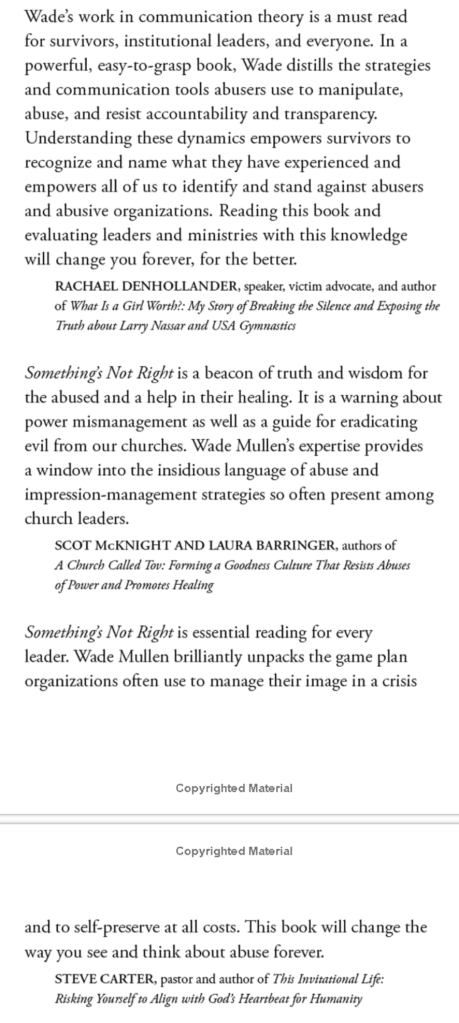
Rachael Denhollander

What Is a Girl Worth?: My Story of Breaking the Silence and Exposing the Truth 

♦♦♦♦♦

What is a little girl worth?  If it’s your little gorl — It is PRICELESS! 

What is a little girl worth if it is not your little girl?

The answer is still the same!

— Ted Martens —

Self-Defense: A Pastoral Art Form

  No — It is a fair criticism!

The heading reflects what is way too often a pattern of response to fair and just criticism.

Rather than humility, in response to what is legitimate criticism (and there is legitimate criticism), the ministry leader or pastor defends the undefendable!

There are a variety of “self-defense schools” and approaches. Nevertheless, they all thrive because of the lack of humility and the inability to give fair weight to the criticism and instead go after the person who offered it. Without listing them, we all know what that looks like and the typical words used to deflect from the failure — We used some ourselves!

Yes . . . .

  • Leadership does mean that there will be criticism. 
  • Indeed, if you are doing anything that matters, you will hit some roadblocks.
  • Without doubt, Satan is alive and well.
  • No one is perfect — What a cover story that statement is, and how often it has been used to hide behind!  We will all make mistakes — and some are serious and tragic ones (and then there is even more reason for humility).

But some mistakes and problems would require just some honesty and a little humility to resolve or make a difference. But, sad to say, as a retired pastor, they are in short supply when it comes to ministries and the local church. 

The proof for that statement, and my headline, is all too clearly on display over the past year and a half during Covid-19. Just peruse the numerous articles that speak about the decline in church attendance across the board of Bible-believing ministries.  It is jarring!  

Some terrible decisions, actions, and comments have been made.  Too often, following the criticism of those decisions and actions, there was little humility.  As so many posts and articles state, many are not coming back!  Not because of Covid-19, but because of the actions, decisions, or lack of action by ministry leaders and pastors during Covid, and an absence of humbleness!

Some problems in ministry and local churches are unforced errors. What happened didn’t need to happen! It happened because the pastor failed, and sometimes woefully failed in this-or-that decision or action. The situation would have been different were it not for the decision and action of the CEO of a ministry or the Senior Pastor.

 “You blew it!
You created the situation by what you said, did, or decided!
Stop blaming others, deflection, claiming you are the one hurt or injured!”

Accepting responsibility is replaced by going to the art form of self-defense. Disingenuous, shallow, and obviously defensive excuses are made to “explain” and excuse a terrible decision, wording, or action. [1]

Regrettably, the art form is more obvious to the listeners than most ministry leaders or pastors fully grasp.  Some ministry leaders and pastors actually believe that others believe what they are selling! [2]. No, those listening get it! [3] The explanation is strained, doubtful, flimsy, implausible, and/or absurd.  The action or decision is indefensible, while trying to be defended!

No, God’s people understand what is being said, and are not buying into the “explanation!”

√ Humility is what people buy into!

That is what they admire and respect.

Being humble is what is preached from the pulpit.

. . . . 

But that also takes honesty — with yourself and with others!


1. Yes — Been there — Done it! We all have. But have we grown up and out of it to where we can speak truth in our hearts — Psalm 15:2, and to where we can own our failures!

2. One of the most obvious and oft-repeated is something like this . . . . 

“We are not going to have services today-tonight-midweek because we want to give you an opportunity to spend time as a family.”

The fact is, just turning off the TV or spending less time on social media would accomplish that goal and have other benefits as well! We all know it is merely an excuse not to have another service and may even involve the leaderships’ desire to not prepare a message for probably such a small group of people who would still be there — yes, sad.

3. Those listening get it, even if they themselves find a justification in the excuse. They may have been part of the decision, failure, mistake, action, and rather than just saying — “We were wrong as well!” — and refusing to go along with the excuse-making, find some comfort in the explanation or excuse!  But most still know it is an excuse — and wince a little when it is repeated!

Or, they themselves may recall the failure in their own lives in the past, and instead of pointing the finger at themselves for such a tragic error in judgment or action, they find some solace in the explanations.  We all like to think more highly of ourselves than is true!  We are not as good as we think we are — as husbands, dads, parents, children, or pastors!

No, we need to come to grips with those failures and mistakes and admit we should have and could have gone at it differently than we did. There is a name for that — it is the word “confession.”

We Really Need Some Afghanistanian Pastors To Start Blogging!

I’m sorry, but this is getting to be too much!  I just read a pastoral blog  — and my response was — SAD [1]. Pastors who talk about how hard it is to be in the pastoral ministry are so self-deluded — That is — those who minister in AMERICA!  And, I am speaking about AMERICAN ministry leaders and pastors!

We need some pastoral bloggers who have far more clarity about what ministering in difficult situations and countries really means!  Whatever is difficult, it isn’t anything close to the norm of American ministry life.

You may believe that such a day is coming, but that day has not yet arrived!  If it ever does, it still will be better than those in third-world countries, and/or places that persecute and kill God’s people and pastors for only their faith.  And, the people who will be affected first may well be those who work in the world, those who are outside of the sheltered walls of a ministry and a church.

Such blogs and articles that seek to excite the compassion and sympathies of God’s people for those in ministry need to be unveiled.  Like the tailors of that king’s kingdom, who tried to convince the king and others as to the beauty of the invisible garments they had designed and woven, there are writers who weave a narrative about the stresses and strains of ministry.  Those writers will “always” find a believing audience, primarily composed of many ministry leaders and pastors.

Those writers have woven a narrative that is as unreal as those invisible garments.  It is not only believed by ministry leaders and pastors who have lost perspective.  The writers (and the ministry leaders who buy into the weave) are also seeking to convince others of its reality — primarily trying to convince those who sit in the pews.  The fabric is composed of such threads as . . .

  • Your pastor works hard.
  • They have a very difficult task!
  • You need to encourage them!
  • Make sure you pray for them, above all others!

The role of the sheep and the shepherd has flipped.  Instead of the shepherd carrying the sheep or lamb on his shoulders, we now have the lambs carrying the shepherd — “It will be okay pastor!”  “We love you!”  “Don’t be discouraged, pastor!”

Everyone” works hard!
Most people have a very difficult task, D-A-I-L-Y!
God’s people need encouragement as they walk in this world!
Pray for God’s people who are out there in the real world of temptations, above all others.

Some ministry leaders and pastors need to go out and get a job in this world and . . . .

  • to understand what it means to work in this fallen world
  • to work hard — a long week, many times 6 days
  • to listen to the language and attitudes of a lost world around them
  • to feel the fears of losing one’s job if they speak up, and they really want to speak up
  • to navigate the world of strained relationships at work, because of their faith
  • to lack the financial resources needed to pay all the bills
  • to have but a few weeks off for vacation
  • to have someone controlling their day and schedule
  • to work 40-60 hours, and then work another 10-20 hours at church

Some need to stop singing . . . .

  1. Am I a soldier of the cross,
    A follow’r of the Lamb?
    And shall I fear to own His cause,
    Or blush to speak His name?
  2. Must I be carried to the skies
    On flow’ry beds of ease,
    While others fought to win the prize,
    And sailed through bloody seas?
  3. Are there no foes for me to face?
    Must I not stem the flood?
    Is this vile world a friend to grace,
    To help me on to God?
  4. Sure I must fight if I would reign;
    Increase my courage, Lord;
    I’ll bear the toil, endure the pain,
    Supported by Thy Word.
  5. Thy saints in all this glorious war
    Shall conquer, though they die;
    They see the triumph from afar,
    By faith’s discerning eye.

. . . . . 


1. Someone, please ask some pastors to turn in their Bibles.  Come on — turn it over!  You don’t understand what you repeatedly preach from the pulpit.  Serving Jesus satisfies.  There is about J-O-Y in serving Jesus.  So now, “Turn it over!”

This is one of the far too many examples of pastoral complaining in AMERICA!

. . . . .

Something’s Not Right! — or When Gaming Seeps Into The Leadership Of The Church

If you haven’t read “Something’s Not Right,” you might find it insightfully helpful. [1]

While it deals with far more serious situations than many experience (primarily sexual abuse), I am reminded of one of the points below . . . .

“It’s a “mega-church” thing, not really present in smaller ministries and churches.
(No, it is just more obvious in mega-larger churches.).”

I thought it might be helpful to formulate a list of “game-playing” moves & approaches of ministry leaders and pastors as they defend their own wrong-doing and/or seek to marginalize those who have called them out.

This extensive list is the result of reading a good number of insightful comments from various writers over the past months.

  • Using the pulpit ministry to address & defend one’s words and actions
  • Change the by-laws and/or constitution to fit and/or cover-up the wrong-doing, pastoral abuse, and/or dishonesty.
  • Selectively communicate information to members of the congregations so that some and not others know what is going on.
  • Selectively withhold information to members of the congregation so that some and not others don’t know what is going on.
  • Selectively communicate and without information to fellow leadership members so that it all gets so confusing.
  • Wield discretionary levers of power used to encourage some people to support them
  • One particular form of crazy-making in dysfunctional Christian orgs is to accuse you of being unforgiving of things they strenuously deny ever having done.
  • Pass the buck to others who were only doing what they believed was what the leader or pastor wanted to be done.
  • When criticized or questioned, point to something incredibly small that was done right — “Well, at least I . . . .”
  • Twist the Scriptures to defend one’s actions — “Spiritual abuse twists the Scriptures into a sword.” (i.e., Proverbs 17:9 used as an argument that their a wrong-doing should not be revealed.)
  • Off-balance the Scriptural truths or principles by avoiding what the Scriptures also teach the balance.
  • Fail to provide a safe place and safe people in which one can speak freely.
  • They darken the windows, rather than allowing or adding light into the room.
  • “Abuse is when people are willing to do harm for their own self-serving benefit. Sorrow is feigned, and confession is partial, forgiveness is exploited, restitution is an afterthought, and reconciliation is an illusion as long as truth remains unnamed.” — Wade Mullen
  • When we do not understand a leader’s capacity for deceit, we make it easy for the offender to continue.
  • Allowing error to go unchallenged is not “grace.”
  • “NDA’s” (non-disclosure agreements) are relabelled as “covenants” by ministry and church leaders.
  • Many times, getting at the truth is difficult because they fall just short of outright lies.
  • Intentional omission, ambiguous statements, clever deflections, nuanced statements, redefining words all become means of avoiding the truth and are means of propagating a lie.
  • False “apologies” — I am sorry you feel that way (or aka — I did nothing wrong.)
  • Intimidation and humiliation of revealing private information.
  • Willful ignorance as a tool of defense — could have known, should have known, but avoided knowing.
  • Counting on the silence of others to further the justification of what you said or did.
  • The shunning, and the promotion of shunning, of those who have called a leader or pastor out for wrong-doing — (when that person should have been thanked).
  • Silence and/or refusing to address an issue can be used as a defensive tool and even portrayed as a virtue.
  • Being in charge of a ministry or church, and refusing to accept the responsibility that comes with that position, is typically the standard operating mentality.
  • Empathy becomes a vice, not a virtue, since “emotions” and feelings are deemed as biblically suspect — “They are just being emotional.”
  • It’s not a “duck.”  I know that it looks like that, but it isn’t.  Trust me on this.
  • Double-speak:  “I am not saying.” while he is saying. (This allows one to say, “I said that . . . “)
  • Three painful responses when you call out wrong-doing:
    They don’t believe you
    They believe you, but won’t do anything about it.
    They believe you, but choose to actively oppose you.
  • It’s a “mega-church” thing, not present in smaller ministries and churches. (No, it is just more obvious in mega-larger churches.)
  • Consistently cite and interpret Scripture that reinforces and/or legitimizes their authority.
  • Change the meaning of biblical words and terminology to fit the unbiblical, dishonest, and/or abusive behavior of the pastor and leadership. (i.e. The words “the church” no longer means “the church.”  It now means  “the pastors and/or the leaders of the church.”)
  • Talk about “legal” / legality, not what was right and ethical.
  • Require more than one witness before something is to be believed as true.
  • It looks like the top guy in the organization doesn’t know, but the top guy in the organization does know. (If they are ignorant, then they should be removed from that position, but they won’t be.)
  • Inaction, because it is only one person who has spoken out.
  • Far too often, “relationships” make the decisions.
  • Loyalty trumps integrity all too often.
  • God’s people want to believe those in ministry and their pastors.  Talking to them about a problem/issue will probably result in you being distanced from them.
  • One tactic is to label you as “bitter.”  That label means that they need not address the issue.
  • Apathy generally hovers over most members of a ministry. (It’s not them and, therefore, not their problem.).
  • Most members of an organization do not see themselves as partakers of wrong-doing by their silence.
  • God’s people will allow some people to be dealt with harshly. (Though everyone is not treated with dignity and respect, they should be.).
  • Some Christian organizations or church members assume that someone else will do something about it and that they need not speak or act.
  • Tactical Words & Phrases To Evaluate: opinions, sowing discord, unity, submission to authority
  • You will be told that “You don’t have all the facts,” but it is actually because the facts are being suppressed by others, and/or have been under unnecessary leadership seal.
  • Most people who have tried to help will only try once if it becomes so unpleasant to step up and try to help.
  • Paying a price for helping or for exposing wrong-doing is usually one of the intended outcomes by the wrong-doers.
  • Most people do wrong for three reasons (Artistotle):  They believe they won’t be caught.  If caught, they will not pay a price.  If they pay a price, it will be less than the desired gain.
  • “One doesn’t have to operate with great malice to do great harm.  The absence of empathy and understanding are sufficient.” — Charle M. Blow, journalist

. . . . .

“Baptists believe authority resides in individual members filled with the Holy Spirit.  That’s why ‘the base’ cannot pass the buck.  To forgo the responsibilities of autonomy while taking its privileges would multiply injustice . . . .

What we consent to, what we allow, is who we are.”
. . . . .


1. https://wadetmullen.com/somethings-not-right/

Note Rachael Denhollander‘s endorsement.  She has authored the book, “What Is A Girl Worth.”  That book has fueled the uncovering of pastoral abuse in SBC churches across America!

A New Description: The De-churched

I would have thought that his church would have been experiencing a great deal of political disruption,
but he said that they have been free from such controversy and division!

Located in the hear of Washington, D.C., you would think that Capitol Hill Baptist Church would find themselves torn by the political and social issues of our day, but one of the members stated . . . “Not at all!”  He indicated that Pastor Mark Dever has always kept the church’s focus where it needed to be, and that was not on politics, but on people and the Gospel.

In contrast, many churches are deeply embroiled in political and social division, where you have to be selective about who you talk to about what you talk about.  Below the surface, there is real division on so many different levels.  Add to that the “de-churched.”

“The De-churched” is a new description of those who are probably not returning to their “church of origin.”  They have been pushed away from their church by the sermons, statements, prayers, insensitivity, pastoral “could care-less-ness,” and strained conversations that have disquieted them emotionally and spiritually.  They are believers, but they have been alienated by the words, actions, and attitudes within the church — left and right and everywhere in-between.

They would say . . .

“I have not left my church; my church has left me!”

And perhaps it has, and so they have left the church as well.  They are no longer comfortable in their home church, and attending church is no longer a pleasant experience [1] — for a variety of different reasons . . . .

Rightfully – – – – – – to – – – – – Questionable – – – – – to – – – – – Bad – – – – – to – – – – – Terrible.

I would suggest that a radical shift is taking place in church attendance, ranging from “changing churches-to-leaving the church.” — from . . . . .

“re-churching- – – – – to – – – – – -dechurching.”

Politics, A Lack Of Pastoral Care or Concern, Vaccinations, Masks, Social Issues, Foolish & Ungodly Racial Comments, Party Affiliations, President Trump-Biden, Small Groups, New Calvinism, Change of Sunday Services. . . .  have all been contributing factors for those who used to attend regularly.  These past “members and friends of the church” now feel like they are walking through a minefield of issues.  They believe that they cannot speak to others without making “disclaimers” (“I know that not everyone agrees with . . . “) because they are now walking through a field of divisive landmines — of which some have already exploded! They must now be very cautious as to what they say at church, to even their brothers and sisters in Christ!

Add to that, those who were members of a church which was focused on outreach, and now there seem to be little to none.  There is no effective outreach into the community, just the language of personal evangelism and community concern!  It’s all too obvious that it is just talk.  Few, if any, have been reached for the Gospel, and it is the “elephant in the room.”  Where is the fruit of personal AND corporate evangelistic efforts by “my church?”

Worse yet, they believe that their church is alienating large swaths of people away from the Gospel by bringing these issues into church life and pulpit attention. To invite a guest is to face being embarrassed by “the pulpit.”  The pastor is going to make some partisan comment or degrading assessment of a political personality or party — or worse!  They will now have to do some “damage control” after the message!  And — No — It isn’t worth inviting someone to go through that experience a second time!

It’s not the criticism of others or the evaluations about the value and purpose of this-or-that decision, program, or policy.  Instead, they themselves have been personally disillusioned about their church’s Gospel purpose, their pastor’s love of them and others, and/or their fellow worshippers’ Christlike attitudes —  because of what they have now personally experienced!

We have moved into a new era.  The era of the De-Churched!

“I have not left my church; my church has left me!”


1. Please, do not say or take the position that attending a local church should not be a pleasant experience.  Let’s not lose all common and biblical sense!  — Psalm 133

. . . . .

“Sometimes we simply feel insulted by the de churched, and so we judge them. How dare they come to our churches, get involved and then declare themselves disinterested or unimpressed. Clearly if they were more committed, more godly or simply more pleasant, they would have stayed. And so we dismiss them.” — Brian Harris

Churched, Un-churched or De-churched

Four Practical Benefits Of Congregational Rule

There is clearly and subtle increase in the move away from congregational church governance and a move towards “Elder Rule.”

Without getting into the biblical and/or theological argument about this area of church polity — “Congregational” versus “Elder Rule”[1] — here are some simple and beneficial factors that operate in a congregational form of church governance.

#1) Congregational Governance Cuts Through Self-Severing Goals, Ambitions, And Selfish Desires. In a fallen world, composed of sinners and the best of saints, there is ALWAYS the underlying problem of selfishness. In fact, it would be simple to make the case that the essence of our sinfulness is exactly that — selfishness. “Men” do what they believe to be in their best interest over the interests of others. That is why all the commandments can be summed up in loving God and loving others as much as you love yourself!

There is a very obvious and historical reason that the political governance of nations by a single or relatively small group of individuals produces oppression and exploitation. While “democracy” is not an inherently Christian form of government, it is the most compatible form of government since it considers men’s sinfulness. As the cross-purposes of many individuals intersect each other, self-serving decisions and selfish ambition can be and are suppressed by other self-serving and selfish individuals.

The Scriptures repeatedly identify “selfish ambitions” as a real obstacle in effective ministry! We would like to believe that “selfish ambition,” ego, pride, jealousy, narcissism, unrecognized self-importance, etc., are not part of our ministry’s leader(s) or local church pastor(s). Unfortunately, the reality is that all men struggle with selfish decisions and actions — flowing between victory over and falling into self-serving decisions and actions.

That is why . . .

Baptists have consistently maintained a congregational church government. Independent, democratic congregations suffered under the domination of Roman Catholicism until the Reformation, when these same kinds of congregations suffered under the Reformers. When the modern Baptist movement began (identified by this author as the time when Baptists began to call themselves such), Baptists continued to insist on a voluntary membership of true believers who held tenaciously to the conviction that each church member had an equal voice in the governance of the church. [2]

When an organization operates under the rule of an individual or a small group of individuals, the checks and balances on the powers in operation will continually slide to what is best for “them,” not “the others.”

Throughout the book of Acts and in the epistles, the apostles, elders, brethren, leaders, and church members had to check their self-interest “at the door.” [3]. Just like the human body, it was unity, but midst diversity. Like the human body, they were all parts of the whole — “if the whole body were an eye.” “The church”[4] is no one individual or small group of individuals.

“Lone Rangers” need to be challenged. When the smell of that “Lone Ranger” spirit is detected by other believers, when a self-seeking, rather than a church-seeking, decision or action is being proposed, it needs to be graciously questioned as to what is best for all the members affected and involved.

Good congregational governance tends to counter and/or expose selfish directions, actions, and decisions by its joint participation. And it is important to counter or expose self-serving proposals or decisions before such become embedded and accepted as “Well, this is how we have always operated.”

The best of men are still men at best!

. . . . . 

#2) Congregational Governance Promotes A Healthy Disagreement.

√ Yes, there are unhealthy disagreements.  That does preclude healthy, honest, fair-minded, and needed disagreements.

√ Yes, some snares come with healthy disagreement, and that is another reality. Just pan the book of Acts, and you will notice that there were real pitfalls that surrounded the needed and necessary times of disagreement — Acts 6:1; 15:2; 18; 28. Nevertheless, they were able to navigate around those pitfalls and come to a healthy outcome.

Nonetheless, there are healthy disagreements that lead to “better, best, and good” decisions, actions, and policies.

Who hasn’t been part of a limited discussion, only to hear an idea suggested from outside of that discussion and revised or even changed course? That happens all the time. A thought that wasn’t considered in a limited setting is interjected by someone in an expanded setting results in a fundamental and crucial change of thinking and direction.

There is a very practical reason that there were a number of apostles, that the apostles came from very different backgrounds, and that decisions were made after the input of both apostles and non-apostles. No one man, or small group of men, has a corner on what is the best way to proceed forward.

There is a very practical reason for the differing of gifts within the body called the church.  Because each of those gifts “motivates” differently, they cause people to respond from different motives which are naturally connected to this-or-that gift. Those gifts produce differences — a healthy diversity of viewpoints, with unity of purpose.

It is okay that a fellow believer, who you appreciate and respect, disagrees with you or me. It is healthy to hear ideas that are not your own, never entertained before [5], and/or even radically cut across your won thinking.  Humility of mind requires that we hear and take into account the ideas and thinking of others — as is the need within a family. That “clash of ideas” produces a far healthier church than a top-down model that announced decisions, not to mention decisions that never considered a critical idea or thought that was so obvious to others.

The fact is, disagreements will arise in ministries and local churches — “It’s Not If – It’s Just When.” Learn to deal with differences in a healthy way early on in ministry, and that willingness and openness to addressing differences will serve you well for years!

As a leader or pastor, you may learn that you were wrong, short-sighted, or incomplete in your thinking! You may even realize more clearly that this was your personal agenda! You may even have to admit to being wrong in your thinking by radically changing course!

There is a term for this interplay of ideas — “Healthy Relationships.”

Healthy churches allow for healthy disagreement!

. . . . . 

#3) Congregational Governance Promotes “Buy-In.” “It seemed good” [6] is an interesting biblical phrase. There are other ways to make a declaration about a conclusion in a more authoritative way.

The use of the biblical phrase, “It seemed good to us,” implies that there was a “buying in” to what was being proposed by another.

Acts 15: Even where that specific phrase is not used, such as in Acts 15, the purpose of the church council was to make sure all understood what was happening in God’s plan of inclusion of the Gentiles. The apostles and elders came together to consider this matter.

James then summarized where he was after Paul, Barnabas, and Peter had spoken and then sought agreement — “Wherefore, my sentence is. . . ” or — “Are we all on the same page?”

Then the apostles, elders, and the church came to an agreement, wrote it down, and delivered it to the local churches — and “signed it” as from the apostles, elders, and the brethren.

Those in attendance were making sure that they were all on the same page. And they were seeking to have the Gentiles “accept” or “buy-in” to their conclusion when they state in that letter — “It seemed good to us.” And the church did “buy-in” . . .

they came to Antioch: and when they had gathered the multitude together (not just the leadership), they delivered the epistle: Which when they (the multitude )had read, they rejoiced for the exhortation.”

Even more interesting are the words in Acts 15:28. It is not that the Holy Spirit spoke or said, but “For it seemed good to the Holy Ghost, and to us,” the idea is that the Holy Spirit gave no indication that it should be otherwise.”

Having others help you towards a goal helps leaders and pastors reach that goal. Surely, “delegating” involves more than calling on someone to perform a task. Undeniability, calling on individuals who want to contribute and understand the role their contribution(s) plays to the outcome is what makes it productive and effective delegation!

When you find yourself doing it all, and few others are joining in to help, it may be because others have not bought into your vision, just asked to contribute!

There are examples of “persuasion” through the Scriptures — seeking to get another to “buy-in” to the idea or program, rather than commanding it! [7]. Persuasion Is Superior To Commandment. The most well-known example is Romans 12:1-2. That same principle operates in the family — “Listen, my son.”

Persuasion Is Superior To Commandment [8]

. . . . . 

#4) Congregational Governance Develops Patience. As most all who have worked with a large group, it is often not very efficient. Primarily because of the time it takes to work with and through a group of individuals, “individual individuals,” and “baptist individual individuals.”

Typically, it is a slower process.

I might add that some of the slowness is because a proposal, decision, policy, plan, idea, project has not been well thought through, and there has been little input from others. Springing an idea on a congregation does not speed up the process if you sincerely want them to be involved and committed to it.

But yes, still slower!

However, the trade-offs are often immense. . . .

  • joint understanding
  • shared responsibility
  • clarity of aim, plan, intent
  • less 20/20 hindsight criticism
  • less second-guessing / “I told you so.”
  • belonging & individual ownership
  • joint support — service and financial
  • learning patience by all members of the body.

I would suggest that the human body, acting together with all of its members, is slower than it would be were the different members not saying — “Whoa – Whoa — That is going to burn me if you are not careful. Think this through again!”


. . . . . 

1. It should be noted that not all “congregational rule” churches are that. Some are CRINO’s — Congregational Rule In Name Only! While the church constitution delineated the church as congregationally ruled, the pastor, or a small group of pastors/deacons, actually make the decisions. The members-only “raise their hands” and “write the checks” — as asked.

2. https://www.proclaimanddefend.org/2016/03/11/a-theological-basis-for-congregational-government/

3. From the above article:

“There are numerous Scriptural passages that argue for congregational government in the local church. Matthew 23:8 introduces the idea of a single level of church membership— all are brothers. Jesus’ teaching in Luke 22:25–27 indicates that the leaders of the coming church are actually to be servants. The congregation elected the deacons in Acts 6:3–5 and elders in Acts 14:23;1 the entire church sent out Paul and Barnabas in Acts 11:22 (and compare Acts 13:1–3 with Acts 14:27, when they returned to the church as a whole to give a report) and Paul and Titus, according to 2 Corinthians 8:19. The congregation then received Paul and Barnabas (Acts 14:2715:4). The entire church was involved in the decisions concerning circumcision (Acts 15:22–25). Discipline was carried out by the entire church (Matt. 18:15–171 Cor. 5:122 Cor. 2:672 Thess. 3:14). All the members are responsible for correct doctrine by testing the spirits (1 John 4:1), which they are able to do since they have the anointing of the Holy Spirit (1 John 2:20). . . .
1. The word “appointed” is particularly interesting; it means to “choose; elect by raising hands.” BAGD”

. . . . . 

Also, one must address I Timothy 3, where Paul writes to Timothy about the church’s operation and goes from the singular to plural, from the “bishop” to the “deacons.” What did Paul have in mind when he wrote to Timothy about the local church? Why would he not say “bishops” if that was the typical structure of local church leadership?

. . . .

4. “The church” is exactly that! — The Church –Matthew 18;  Acts 11:22;13:1-3; 15:4; Col. 4:16;  The body of believers who have covenanted together for worship, fellowship, and service.

If you want to use the words “the church” to mean anything other than
that body of believers, you will have to come up with a different term.
The meaning of that term —  “the church” — has already been taken!

. . . .

5. Sometimes, you can hear different perspectives, before you “go on record” or take a position, if you seek out different perspectives from outside of the “leadership bubble” in which you operate. Hearing a different opinion/vantage before it comes up in a more public context is better for both parties!”

6. Acts 15:25, 28; Luke 1:3

7. For example, Paul uses the word “beseech.” The whole book of Philemon is an attempt to have Philemon “buy into” what he is saying, rather than commanding such. Jonathan seeks to persuade David to “buy into” his plan concerning his father’s (Saul) intent. Mordecai seeks to persuade, not command Esther.

8. Persuasion is superior to commandment, but when commandment is made, it matters not whether one is persuaded — Romans 12:1


Something Is Terribly Broken When Pastors Begin Cautioning 

It is absolutely amazing to me, that pastors are cautioning God’s people about empathy!  Since “empathy” is a far more demanding behavior than compassion, care, concern, sympathy, beneficence, sensitivity, et al., those lesser behaviors are also thrown into question.

What has “the church” evolved devolved into that we,
of all people, can talk about the hazards of ministry care and concern!

Is that really the problem of ministries and local churches? — showing too much empathy! [1]

It has been the lack of care, compassion, concern, sympathy, beneficence, sensitivity, and empathy that has too often damaged relationships in the ministries and local churches, no less marked this COVID and political year.

If you are unfamiliar with this discussion, check out Daniel Kleven’s posts.  Daniel has recently resigned his position with BC&S (Bethlehem Baptist College & Seminary, all associated with John Piper notoriety), as well as four other pastors of Bethlehem Baptist Church in the past four months.

Link:
https://biblioskolex.wordpress.com/2021/09/12/emotional-blackmail-and-the-sin-of-empathy/

Something Is Terribly Broken When Pastors Begin Cautioning God’s People About
AND THEREBY
Justifying Their Failing To Personally Exhibit Empathy!

Romans 12:15
“weep with them that weep.”

#Daniel Kleven
@danieleleven32


1. I would suggest that you ask those who were marginalized, no less discriminated against for decades, and even today by pastors and local churches, whether there is any substantive reason for caution!


See the following

This is how twisted it gets!  Rigney has to redefine empathy to some twisted definition, a definition that would appear nowhere.  Why? — to explain an absurd position.

Others respond and reveal they understand this disingenuous game Rigney is playing.