Two Trends – Left Unchallenged

Two preaching-teaching trends seem to be repeatedly showing up in our day. They are found in local church ministries and subtly appear in online Bible studies, magazine articles, books, or podcasts.

Two reasons they are so subtle are congregational discernment and pastoral duplicity! [1].

√  The theological nuances and subtleties within a sermon are often lost on the average layman-laywoman. Fellow pastors easily pick up on the subtleties and nuances. What is artfully promoted or subtly being preached and taught is readily recognized by those who live full-time in ministry.

√  Secondly, pastor-teachers can be duplicitous. They can be teaching something that is not generally accepted by the congregation. What he is preaching-teaching is cloaked in a way that precludes it from being clear, transparent, challengeable, and/or even creating ministry problems — such as unemployment.

I believe that this is what is happening when it comes to these two new theological trends.

Theological Trend #1: A “One Size Fits All” theological axiom.

After decades of repetition, one of the most damaging theological aphorisms has been left unchallenged, accepted, and/or reiterated by many pastors-teachers . . .

“God is most glorified in us when we are most satisfied in Him.” — John Piper —

Anytime you make a single theology axiom the focus around which all other truths revolve, you are bound to end up in a theological ditch. The obvious damage that this theological ditch creates continues to emerge. [1]

God is not only “most glorified” when we are satisfied in Him.

God is most equally glorified when we . . . .

  • obey His commandments,
  • share the Gospel,
  • read His Word,
  • meditate on His precepts,
  • love our spouse, neighbors, enemies, the lost,
  • suffer for His name,
  • come to Him in prayer,
  • worship Him on His day,
  • sacrifice for others,
  • train up our children in the fear of the Lord,
  • in all our ways acknowledge Him,
  • separate from ungodliness,
  • serve Him in ministry,
  • tithe,
  • go beyond our tithe,
  • behave selflessly,
  • reflect the fruit of the Spirit,
  • obey His call on our lives,
  • resist temptation,
  • are humble,
  • walk in the Spirit
  • confess our sins,
  • repent daily,
  • sing hymns of praise,
  • intercede and pray for others,
  • are compassionate
  • work hard without eyeservice
  • pray for the “king”
  • forgive others
  • trust Him through the toughest trials of life
  •  . . . . . .

Piper, and others, would like to stuff these (and any others) under being “satisfied in Him.” He would like to link all these to being “satisfied in Him.”

That is how “one size fits all” theology works, whether it is Piper or another theological fad of our day. A single truth becomes the sole focus, and a “new religious crowd” is born and identified by that singularity — Seventh-day Adventists / Ruckmanites / Holiness church / Free-will Baptist / etc.

However, one could do that kind of cosmetic linking with many a theological concept such as “loving” (Him & others), “sacrificial” (no greater love than a man lay his life down for another), “spiritual” (walk in the spirit), pride (the original sin of Lucifer),or “obedient” (if you love me, keep my commandments).

Let’s make “obedience” the “most glorified” link!
— “God is most glorified when we are most obedient.” —

First of all, Piper’s overstated principle dilutes the biblical instructions for each and every one of those specific areas of Christian living.

For instance, while “acknowledging Him in all thy ways” CAN spring from being satisfied Him, and does glorify Him, there is far more specific biblical instruction about following God’s will than only being satisfied in Him — i.e. reading His Word, seeking the wisdom of others, waiting on Him, praying for wisdom, observing (I went by the field of a sluggard), be not hasty, staying humble (for He resists the proud), etc.

Second, it is overly simplistic. Not every area of Christian life and living is addressed by extolling — “be satisfied in Him.” If it was, there would no need for much of Scripture.  It may be one answer, but it is not the full biblical response.

For instance, when facing temptation, being satisfied in Him is not the whole of God’s instruction. There is far more than the application of one axiom.

The Scriptures includes . . .

  • putting on the armor,
  • putting on and putting off,
  • turn from that path,
  • abstain from fleshly lust,
  • make no provision to fulfill the lust of the flesh,
  • take heed,
  • walk circumspectly,
  • pray without ceasing,
  • He will provide a way of escape,
  • “Resist the Devil, and he will flee,”
  • “Listen my son,”
  • “add to your faith,”
  • die to self
  • etc.    

Piper offers one solution to all of life and living — find your satisfaction and pleasure in Him.

Third, obedience is expected whether or not it comes from a heart of satisfaction or pleasure. As stated, let’s make “obedience” the “most glorified” link! “Obedience” might be the more foundational issue — from the beginning — in the Garden.

Fourth, it misstates temporal and/or secondary avenues of satisfaction and pleasure that the Lord has provided. There are many avenues of satisfaction and pleasure that the Lord has provided and included as part of life and living. All of them are legitimate pleasures and satisfactions of life! They all come from His hand and plan. And even the lost world share in these God-ordained pleasures and satisfactions of life, even though they may have no interest in glorifying Him — the rain falls on the just and the unjust!

^

Piper’s singular solution produces aberrated answers for life and living!

For instance, John Piper teaches that even when your husband abuses you verbally and physically, a wife is to accept it, and loving pray and tolerate such abuse, to be satisfied in Him, to find her satisfaction in Jesus and for what He has sovereignly allowed to be part of her life (I can assure you I am not overstating his position.). [1]

♦ As if the Lord did not provide marriage to be just the opposite, a place of security, peace, fulfillment, and warmth — which are all part of the pleasure that He has planned for us through godliness.

♦ As if stoically tolerating and/or willingly declining those avenues of satisfaction and pleasure is being Christlike — while desiring the satisfaction that ought to flow out of a godly marriage is not being satisfied in Him.

♦ As if refusing to accept such spousal abuse, and demanding some level of decency and godlines, is deemed not being satisfied in Him — or worse yet, is a rejection of a husband’s leadership!

♦ As if renouncing the ungodly abuse, and desiring the satisfaction and pleasure that the Lord has essentially designed for marriage, is an unspiritual response.

There is satisfaction and/or pleasure that God has ordained in the temporal, the here and now. Such pleasure and satisfaction would have been part of our daily living were it not for the Fall and will be part of life and living in the new heavens and the new earth.

There is, and we find, satisfaction and pleasure in knowing that your spouse loves us.

There is, and we find, satisfaction and pleasure in seeing your children follow the Lord.

There is, and we find, satisfaction and pleasure in watching the sunset, the mountains, the trees in Fall, and the snow blanketing the ground.

There is, and we find, satisfaction and pleasure that comes out of living in a safe and secure environment — as will be the case in that eternal and holy city.

There is far more in the Scriptures than one axiom that seemingly and dangerously frames all other truths.

Theological Trend #2: (TBC)


^

1. Check out John Piper’s most recent absurd position, which is ideologically driven — fresh off the press!

It is Piper’s position on spousal abuse.

“If it’s not requiring her to sin, but simply hurting her, then I think she endures verbal abuse for a season, she endures perhaps being smacked one night…” (John Piper)

Link: https://baremarriage.com/2022/06/john-piper-tells-women-with-harsh-husbands-to-basically-do-nothing/

“If we keep reading the same books,
we will keep thinking and saying the same things”

Sorry, It May Not Be Exposition!

I believe it is beyond dispute that there is scarcely a pastor who would not claim to be an expository preacher-teacher. Midst all the different personalities, speaking styles, and even “denominations,” surely today’s preachers want to be considered expositional in their handling of the Scriptures from the pulpit.

However, the same pastors realize that such is not the reality. While they are, they would tell you that many other preachers are not engaged in Bible exposition. [1] That is why pastors make that very point by periodically announcing such to their congregations.

  • “We go verse by verse through the Scriptures to make sure we are preaching and teaching what the Word actually says.”
  • “This church is marked by expository preaching.”
  • “We exposit the Scriptures in our ministries.”
  • “If you want to hear what the Bible says, not what men say, then you are at the right place. We tell you what the Bible teaches.”

After such pastoral assertions, you may hear a hearty “Amen” from the congregation (even from those who rarely say “Amen”). 

In today’s Bible-believing churches, the congregations have been taught that such is the standard and that their pastor meets that criteria. When the preacher announces that he is committed to that, God’s people are again convinced that what they are hearing from the pulpit is Bible exposition.

The primary reason some preachers-teacher are not considered expositional is the belief that topical sermons are not expositional. Another second reason, perhaps ranking right under that, is the all too common abuse and misuse of Scripture — preaching on a single verse and taking it out of its context. Using the Bible to say things it does or does not say in that particular passage is “INposition,” not EXpostion.[2]

Nevertheless, the failure to be expositional is far wider than those two typical allegations.

^

Five Types Of Sermons That Are Not Expository Preaching

#1 — Systematic Theological Preaching:

For some, a passage of Scripture is merely a place to find a word or prevalent theme to form the basis for a general theological study.

If the verse or passage . . . .

“But as it is written, Eye hath not seen, nor ear heard, neither have entered into that heart of man, the things which God hath prepared for them that love Him.”

 . . . is talking about — our future, or future inheritance, heaven, God’s love, God’s preparation for His people — then the sermon is marked by a systematic study of that doctrinal truth. [3]

It is not that anything said is not biblical, but that the passage is merely used as a repository of words or themes that allow one to teach biblical doctrines. Teaching the doctrines found in the passage is not exposition. The preacher is merely drawing out of the passage the biblical doctrines that are found within the verse and/or passage. The marker of such an approach is that the preacher is turning to a host of different passages that all relate to that particular doctrine(s).

It is not that teaching on a particular doctrine is an illegitimate approach to Bible teaching. In fact, that is why classes in “systematic theology” are typically part of a seminary education. Those entering the ministry are shown the unfolding of a biblical doctrine across the pages of Scripture. 

Nevertheless, it is not exposition if the “How” or “why” the writer calling up this-or-that doctrinal truth in this passage is left unexplained. That is the hard work of exposition.

It is not sermonic exposition if it is not used to expose how that particular truth or doctrine within the passage further’s the argument of the passage.

^

#2 — Skyscraper Preaching:

Skyscraper” . . . . because it is story upon story. 

Who hasn’t heard this kind of sermon? The Scriptures are used to give occasion for telling a story. The preacher highlights various verses, stories, illustrations, and examples that form the bulk of the sermon. The sermon’s stories are the focus and far more remembered than the passage. The sermon is littered with stories about how . . . .

  • that has happened in one’s life or the life of another
  • that truth works in life and living
  • someone who violated that truth faced serious consequences
  • spiritually minded the speaker is in understanding and apply this-or-that truth
  • etc.

The sermon is not so much about what the verse or passage teaches, but the building of interesting, shocking, amazing, and/or frightening examples, one after another, story upon story. It is all designed to move the emotions and leads one to believe that what the speaker is saying is found in the Scriptures or that passage. The story is reputed to be the point of the verse or passage.

Again, the stories may illuminate or illustrate biblical truths, but it is not expository preaching. It is story-telling, accurately or inaccurately, supposedly making a point that is reputed to be what the biblical writer is teaching.

^

#3 — Old Mother Hubbard Preaching:

I say, “Old Mother Hubbard” because I think about that poem as an example of such preaching.

“First of all, notice that she was “old.” She wasn’t young, middle age, but just “old.” The word “old” just says it all. This was a woman who had a lot of years behind her.

Her name was “Mother Hubbard.” That is what people called her. When you wanted to refer to her, everyone knew who you were talking about when you said “Mother Hubbard.”

Now the word “Hubbard” comes from the Greek language, and it means . . . . “

Just about every word of the verse or passage is examined. This sermonic format features “word studies,” and biblical cross-referencing, or at times resembles an “Amplified Bible” (though the value of such a “translation” is often disparaged.) 

This approach spends its sermonic time making sure that the listeners understand every word or phrase that can be explained. The meaning of every word or phrase is carefully squeezed out (sometimes beyond its need, and/or legitimate meaning and expositional understanding within the passage). [5]

While fully understanding what the words of a verse or passage actually mean is basic to exegesis, and should take place in the pastor’s study to ensure that the preacher understands what is being said by the author, the audience is now brought into the self-same process. 

The study has moved into the auditorium. 

The kitchen has become the dining room.

Most of the message becomes pedantic, academic, and literary.

The trees and not the forest becomes the focus. 

One begins to wonder, “Do any of the words, when put together in a sentence and/or added to a paragraph, make a primary point that God is declaring about life and living?” What is the argument or point that the writer is pursuing and accomplishing? [11]

Yes, there is a place for clarifying the meaning of this-or-that word or phrase. Nevertheless, “Keil and Delitzsch” or “Vine’s Word Studies Of The Bible” are not designed to become the main course of the sermonic journey, as God’s people get lost in the theological weeds. 

“Commentaries” are designed for the study, not the pulpit.

Being a “coming to you live commentary” is not expositional preaching.

^

#4 — Abracadabra Preaching:

This dates back to the days when only the clergy could understand the Bible. The belief was that the laity lacked the ability to grasp what was being said. It took a “man of the cloth” to help someone understand this Book! The preacher was that individual who alone can really tell you what that verse or passage is actually teaching.

With this form of sermonic composition, the pastor’s unique insights, discovered by his in-depth and consummate study of the Scriptures. It is marked by pastors who love the “novel.” They gravitate towards and latch onto unique and unusual meanings of a verse or passage. 

It is almost as if without such insightful and novel points, the pastor has not earned his salary or used his time in the study to dig out such wisdom. He must be considered the most perceptive and knowledgeable since he is the preacher.

Had the typical Bible reader read this-or-that passage, he would have never seen it or grasp “the real meaning” of the verse or passage.  

The “pastoral conjurer” can find so much more in the simple and plain meaning of the passage — words that match, meanings that would allude the lay reader, connections that few would have ever made, and truths that few have thought of until now. 

Of course, there are some difficult passages and even books (The Revelation of John, Ecclesiastes, et al). Of course, there are times when we read a passage of Scripture and come to realize that more is being said in a verse or passage than we have seen before — people and preachers.

But time and time again, the conjurer finds “insights” that the average reader of the Bible would have never realized When that happens over and over, there is something other than “exposition” happening. We are dealing with a biblical conjurer, an “expository conjurer.” He finds truths and principles that few, if any would have ever seen in the passage. [6]

And that is the real point. We sincerely believe that God’s people can read the Scriptures, and understand what is being said. We believe that the Scriptures are simple and clear enough, that when people even hear it read, they can understand what is being said — as was the case in the oral culture of early Bible days. That is why we encourage daily Bible reading.

A “Bible Magician” engages in “eisegesis” (puts in meaning that was not there), not “exegesis” (pulls out the meaning that was there). He pulls things out that are not there, or were put in before he pulled them out.  

He makes “coins” appear out of nowhere. But really, he put them in place, and then he suddenly discovered them to the wonderment of all — walla! [7] [9]

The typical response is “appreciation & praise” — “I would never have gotten that out of just reading the passage! He is amazing! Are we fortunate that we have a pastor who is so intelligent and learned!”

^

#5 — Self-Promotional Preaching:

This type of preaching is marked by a preaching approach is primarily exhortation and application, more than exposition. It exhorts or challenges God’s people to live and live out biblical and spiritual standards and always implies that the preacher-teacher himself has reached those standards.

The argument of the passage is not as important as the general biblical topic of the passage to which the preacher can so clearly exhort and personally connect with. 

Topics such as prayer, passionate godliness, glorifying God, putting to death the sin nature, selflessness, et al. are the exhortatory focus. The sermonic task is to subtly imply (and sometimes not so subtly) how God’s people need to reach the level of spirituality and godliness that the preacher has reached. The exhortations and admonitions are for those listening, delivered by one who has attained such.  

The stark contrast is the kind of sermons that are so purposefully transparent that you struggle with respecting your pastor because he opens up the doors and reveals his ungodly shortcomings and spiritual deficiencies. [8]

The antithesis is preaching that clearly implies that there is little-to-no spiritual struggle. That sanctification is not progressive. The exhortations and admonitions of the Scriptures are for thee, not me. The argument of the passage is not as important as making certain that you realize that the preacher-teacher has himself arrived regarding the general topic of the verse or passage.

^

#6 — Springboard Preaching:

The verse or passage is merely a repository of possible theological words or phrases that the preacher-teacher can springboard off to talk about whatever he desires. Makeup whatever three or more points you want.   

You only need a word or a phrase to make it seem like you are using the passage as the basis of your message. Just quote the passage which has the word or phrase, and jump in and paddle anywhere you want to go.

The argument of the passage, or how the verse and verses fit into that argument as a whole, is not essential to those who springboard. It only takes a “word” or “phrase” from the passage to invent whatever sermonic points the preacher would like to make up.

i.e. “Paul, an apostle of Jesus Christ by the will of God, according to the promise of life which is in Christ Jesus.”  

“The will of God” — that is what guided Paul in life. First, the will of God is different for every one of us, as it was for Saul-Paul. Second, The will of God may mean that we will face some very difficult events of life, as did Paul. And third, the will of God for you often includes other partners who can encourage you, as was Barnabas to the Great Apostle Paul.

^

i.e. “Abraham looked up. . . . ” that is what we need to do! We need to “look up.” First of all, for the return of our Lord . . .

Again, it is not that what is being said or even may be said is biblically inaccurate, or even taught in other places in the Bible, but it does not come out of the passage! One could springboard off the same passage with another set of main points that are entirely different.

What you are saying may be biblically founded, but it is not an expository message.

^

#7 — Simulated Expository Preaching:

Preaching through a passage “verse by verse” is almost the definition of “expository preaching.” That phrase, “verse-by-verse” is the catchphrase for those who tout that they are being expositional — “Amen preacher!”

Actually, it is merely a running commentary on the obvious. The preacher is merely reading and expanding on what each of the verses is teaching, with little-to-no regard as to how the verses build on each other and build into the argument being made.

The listeners can see what the verse says. They have read it with you, probably read it prior to hearing today’s sermon, and understand what is being said. Nevertheless, we will go through the passage verse by verse and explain its meaning unconnected to the argument being made.

To read each verse, offering some expanded elucidations, verse after verse, is not exposition, but a running commentary on the obvious. I know that is what the passage says, I see the words, but how do these words and truths advance the argument being made”? [9]

i.e. “The Lord is my Shepherd, I shall not want.” The Lord sees us a flock of which He is the Shepherd. Like any shepherd, he is there to meet the needs of the flock.

“He maketh me to lie down in green pastures: he leadeth me beside the still waters.” The picture is one of sheep lying down in abundant pastures of green grass, grass enough to meet every need and then to also provide waters, still waters that don’t frighten, but calm.

“He restoreth my soul: he leadeth me in the paths of righteousness for his name’s sake.” David now moves to the obvious application to us as God’s people and speaks about restoration, restoration of the soul. . . . and not only restoration but direction and leading. The Lord only leads His sheep in paths that are godly and honor His name.

^

However, David is making a far greater and broader argument by such a Psalm. These verses are designed to contribute to that all-embracing argument and purpose of the passage — That There Is Good Reason For Trusting The Shepherd During Some of Your Most Difficult Days.

^

^

Unfortunately, most congregations do not understand the actual nature of the sermon they are hearing. While they are instructed to value expository sermons, they have little-to-no idea that such is not what is being presented. They are told and believe that this is exposition and what they should learn to appreciate.

They will give a hearty “Amen” to such a pastoral claim even if they have no idea that what they are hearing is far short of an exposition of the passage. The listeners have been taught and believe that this is exposition. 

However, the sermon never helps them understand the argument of the passage.

What is the writer’s point, and how does the other content contribute to that point? [10]

It is an expository sermon when the argument of the passage is understood, revealed, and the implications of that argument are applied to the lives of those listening.

^

^


1. “. . . there is so much preaching today that is not expositional. . . . most of the preaching in pulpits today is far from expositional.”

https://g3min.org/why-expositional-preaching/

^

2. Whether or not topical sermons are expositional is a discussion for another time. Let me just say that a topical sermon, a sermon on any biblical topic, can be as expository as a sermon that deals with a singular passage. it merely requires that you deal with the each of the topical passages as you would a singular passage.

Some would also point to preachers who take verses out of context — “There are countless examples of biblical texts preached out of context.” [1]

^

3. “Systematic Theology” is a standard approach to the study of the Scriptures in a seminary education. The 10 or 12 major doctrines of the Bible are examined across the pages of the Old and New Testaments. For instance, the doctrine of “God” (sometimes called “theology proper”). From Genesis to Revelation, there are passages on who God is. God’s creation of the world, attributes of God, the plan of God, the trinity of the Godhead, etc., are all followed by a list of various verses to establish the biblical doctrines of Scripture. If you look at a church’s statement of faith you will see those various doctrines supported by such biblical citations.

^

4. One present-day example is “Chiasms.” As Dr. Svigel, of Dallas Theological Seminary, stated, he was certain that he could create a chiasm out of any portion of Scripture.

^

5. “Paul, an apostle of Jesus Christ by the will of God, according to the promise of life which is in Christ Jesus”

First of all, notice “The Person” — it was Paul speaking. Paul was originally was named Saul. He became an Christian on the road to Damascus. When he was persecuting the Christians, and was on his way to arrest them, a bright light . . . . .

Second, notice “The”Position” — he calls himself an Apostle. Now, to be an apostle, you have had to seen the risen Christ. There is no where in the Gospels where you find that “Saul” saw the risen Christ. Had he, he might have been persuaded. But he was confronted by the risen Christ on the road to Damascus. . . . .

Third, notice “The Permission” — “by the will of God. God’s will is what guided him and is what guides us in life. When we talk about the will of God . . . .

Fourth, notice “The Promise” — There was a promise, a guarantee, a surety given in the Gospel . . .

Fifth, notice “The Patronage” — Jesus Christ is who Paul now serves.

“Our practice of preaching from texts has accustomed people to try what they can discover in single sentences, and even single phrases, of the Bible, and to disregard the general current and structure of the argument or history: the minute exposition of clause after clause will confirm their evil habit. They seem to think that the best way to get a right conception of the Rhine, or of the Falls of Niagara, is to examine separate drops of the water under a microscope. The expository method which I have followed for some years past is likely, I think, to lead people to read the Bible as they read other books, and to look not merely at separate thoughts and fragments of separate thoughts, at isolated facts and the most insignificant circumstances connected with isolated facts, but at facts and thoughts in masses, and as they are grouped by the Scriptural writers themselves.” — R. W. Dale Yale Lectures, 1876

^

6. “I always think of the tricks of those ingenious gentle men who entertain the public by rubbing a sovereign between their hands till it becomes a canary, and drawing out of their coat sleeves half-a-dozen brilliant glass globes filled with water, and with four or five goldfish swimming in each of them. For myself, I like to listen to a good preacher, and I have no objection in the world to be amused by the tricks of a clever conjurer; but I prefer to keep the conjuring and the preaching separate: conjuring on Sunday morning, conjuring in church, conjuring with texts of Scripture, is not quite to my taste.” — R. W. Dale Yale Lectures, 1876

^

Sometimes the “unique insight” involves a ‘number,’ or the repetition of a word, or a matching passage of Scripture that repeats a phrase, or a so-called literary pattern (chiasms [4]), or a word that could be translated far differently, or a new and unique way to translate the verse, a new take on a well-known and understood passage, et al.

i.e. “Look at this pattern. In chapter 1, then in chapter 2 the same word is used. In Chapter 4 we see that word again, and it appears four more times in the first 7 chapters.”

i.e. “Now this word can be translated and should be translated ‘family guest room’ not ‘Inn.’ Joseph and Mary found that there was no room in the family guest room to lay down Jesus, and therefore they laid him in a manger.” [link].

i.e. “The same word is used in Hesitations 3:2. Here it highlights the point that when you pray . . . “

i.e. “The word is used 20 times by John in his Gospel.”

i.e. “The same grammatical construction is used in I Peter, and there it speaks of . . . . .”

^

Many might forget that during Bible days, the oral reading of the Scriptures was how most people heard the Word of God. They did not have a “Bible” or “book of the Bible” in hand. They could not do all the linguistic gymnastics that pass for exegesis and exposition today, and reading the Bible was sufficient for life and godliness.

^

7. “the conjurer, when we hear the congregation declaring was that amazing what he got out of that we should not immediately assume that the news is good for the little I know about magic, I’m forced to conclude that the rabbit was in there before he pulled it out of there and the reason I got in there is because he put it in there so that he could pull it out. There are some tremendous sermons where the reason he got it out is because he had previously put it in.” — Alistair Begg

^

8. I have heard some pastors speak about how they struggle in their marriage, with various temptations, or even with pornography. It is like “social media” at times. Some sins need to be personally battled, not publicly announced!

^

9. After 2000 years of Bible history, writers, teaching, it is more than probable that one’s novel understanding of this-or-that verse or passage is questionable. Go back to some of the early church fathers, who were much closer to the life of Christ and the birth of the Christian faith, and determine how they understood the Scriptures.

“Some preachers choose texts with apparently no other purpose than to display their own wonderful ingenuity.” — R. W. Dale, Yale Lectures, 1876

^

10. I Corinthians 8 is an ideal example.

A contention is made in verse 1 — “knowledge puffeth up.” That is followed by a series of verses about what we “know.” We know the truth about who God is and, therefore, the meat offered to idols that are not gods. Then, the point is made that not every man has that knowledge as he seeks to make the argument that we are not to let our knowledge puff us up and disregard our brother and cause him to stumble.

An expository sermon should show how the verses build the argument which Paul makes about Christian liberty.

Other Articles On Expository Preaching

Rhetoric & Homiletics: Expository Preaching? Hardly!

Rhetoric & Homiletics: Why Are We Still Talking About Expository Preaching?

Rhetoric & Homiletics: 10 Ways To Describe Expository Preaching

Rhetoric & Homiletics: Undermining Expositional Preaching


“Desiring God” — It Is Getting Bizarre-errrr!

If you think the previous article by “Desiring God” ministries was a one-off, let me resolve any doubts! [1]

Listen to or read — Episode 1830,
So much could be said but let me make two simple points.
#1 – Dissembling:
“I want to say loud and clear that there is grace — there is great grace — for that situation. Even grace for flourishing in it, not just coping with it. And there is great reward forever and ever for those who endure in a godly, Christ-exalting way the disappointments of this life. Now, that’s not what she’s asking, but I felt it’s important to say it. She’s not asking how to cope with disappointment, but rather what strategies are permitted or encouraged for a godly wife to seek change in her husband who’s living in sinful ways. So, let me offer a few clarifications of what I hear in this question.”
While Piper states, “that’s not what she is asking,” that is still what he says in response!  Why? Because for some obvious reason, Piper says he “felt it’s important to say it.”
Likewise, Piper cites I Peter 3:1-6; 4:17, and while he states that it is not applicable to her situation since her husband is a believer, he still references I Peter.  It is obvious what is being done since, later on, he specifically cites I Peter 3:7 to support “submission.”
It is a way to exonerate oneself — “Look, I stated that it did not apply.”
But it was still purposefully stated and/or applied to make a disingenuous point about submitting to your husband, regardless of the length of time and/or the continued reasonableness of further inaction.
Piper set up the context for his advice which is to adopt “a meek and quiet spirit,” to be like Sarah, who called Abraham lord — “but I’m not saying I Peter applies to this situation!”
^
#2 – Tortuous Ideology: 
Piper repeatedly states and connotes in his answer that the wife has a responsibility to submit to her husband’s leadership.
“What strategies are permitted or encouraged for a godly wife to seek change in her husband who’s living in sinful ways.”
Piper’s advice — You should address the situation again with your husband and ask if he is willing to get some meaningful help. [2] [3]   If not, live with it and represent Christ in the marriage as you suffer for God’s glory!
“Submissive Confrontation”

“speaking to a husband about her concern she would necessarily be acting in an insubordinate or unsubmissive way. She might be if her attitude is wrong, but I think a mature, godly, Bible-saturated woman knows the difference between nagging a husband in a pushy or insubordinate way, on the one hand, and humbly and wisely bringing to the husband her concerns and seeking with him a way forward toward relational health that would make both of them and the children holier and happier. . . . .

If they can’t seem to make progress together, then it might mean seeking the husband’s agreement that they would bring a wise biblical counselor into their lives.

^

That is what the Scriptures teach about the covenant of marriage after seeking to address the issue, with a little-to-no reasonable response by her husband after 20 years?  — “seeking the husband’s agreement.”

Have we gone mad! [4]

This “Tortuous Ideological Complementarianism” imprints what has happened at BC&S, many a ministry that has unquestionably adopted the thinking of John Piper, and so many of the teachers/preachers who follow  Desiring God writers!

Some have left their biblical sensibility and sanity!  Others have gone over the cliff with Piper by failing to challenge such teaching/preaching.  Piper’s positions are ideologically driven and flows out of a commitment to an unbiblical principle that “God is most glorified when we are most satisfied in Him and ‘His will’ for our lives.”  For Piper (and many other Bible teachers and preachers) all other Scriptural truths and principles revolve around that stated ideological hub. [5]

“Satisfied in Him,” seemingly means that a wife submits to and ultimately accepts all that happens to her in her marriage.  Apparently, calling her spouse to account, directly speaking to her pastor or a counselor with or without her husband’s knowledge or permission, is not being satisfied in His will and way.

After 20 years of her working through and living with this situation, my advice as a pastor is far different! Sin, selfishness, wickedness, and unrepentant evil are not something you allow to continually uproot the covenant of marriage.

It is consequences that are designed to humble, and when the consequences are removed, there is little hope for any humility and change.  What no consequences do produce is hard-heartedness. [6]

Check out “Loammi” Hosea 1:9-10, 2:23

^


^

2. By the way, what a pathetic description of 20 years of pornographic addiction by your husband — “. . . a long-term marital disappointment. . . . . !”
To even use those words to describe what this wife is experiencing in her marriage in the same category is shocking — at best!
“Disappointment” in marriage is when your spouse has you mow the lawn, fails to wash the dishes, vacuum the carpet, or share in the household tasks that come with living together.
3. How about this statement as well — “but that she may be empowered at any given moment for some perfectly suited gift from God for what that husband needs.”
4. I remember talking to a member of the Jehovah’s Witnesses.  As most realize, the Jehovah’s Witnesses will not serve in the armed forces, give allegiance to the United States flag, or be involved in law enforcement.  In our talk, I asked him what he would do if someone broke into their home and was attacking his wife or his daughter — assaulting them physically or sexually.  His answer was — “I would pray.”My response to him was . . . .

If you are saying that you represent what the Scriptures teach as the righteous and proscriptive will of God, as found in the Bible, then I have good reason not to believe anything you say as being biblical.  If you can so twist the Scriptures to allow for that kind of response — “I would pray” —  then you have the ability to twist Scripture to mean anything!

I remember talking to an individual who was a pastor/Bible teacher/reformed theologian/and-or Calvinist who repeated that God is most glorified when we are most satisfied in Him and that such should be the principle that guides the response of a wife to 20 years of her husband’s pornographic addiction. . . . .
[You can finish it!]

5. Tell the families of Uvalde, Texas, whose children were killed, the parents of a young five-year-old child who was sexually molested, the wife whose husband has shattered their marriage, and the friend of mine who is dying of cancer (likely due to the unsafe environmental factory conditions) that what they are going through is a blessing, a blessing FROM God!

The underlying ideology of this kind of thinking and such statements has led to all kinds of passivity and inappropriate actions.  Poor-to-terrible counseling, wrong-doing, social injustice, and horrific abuse have been left unaddressed (and even justified as biblically appropriate and justified) because of this type of thinking — “We need to see this as from the hand of God.” [2]

Yes, I understand that God uses sin, sinlessly.  That God can still bless us, and does, midst our sin and the sins of others.  But the sin was sinful, it is not therefore acceptable to be left unaddressed, and it is not a blessing from His hand.  Any attempt to promote some passivity towards the sinful actions of men is but an argument to allow it to be more acceptable and/or for it to continue unaddressed!

6. Moses allowed divorce a writ of divorce because of the hardness of men’s hearts!

Alistair Begg Probably Has It Right . . . . But

With my love in the Lord Jesus,
Alistair Begg

^

A great short read by Alistair Begg, and he probably has it right.  Notwithstanding, his sermons on the Sabbath and this post probably aren’t changing the practices of most believers, pastors, or churches.

Why?

Perhaps because we are not as spiritually malleable as we think and say we are!

As a matter of fact, many churches have canceled the evening service,  with the “shepherd’s approval,”  if not instigation!   The Lord’s Day now becomes “Our Day” around noon!   And then some pastors decry what is happening in our culture and society — shamelessly!


1. From Begg’s Sermon . . . 

Now, we can highlight this in a number of ways. Let me do so by quoting from the Civil War. I think it’s the Civil War, isn’t it? Stonewall Jackson? General Jackson is a legend in American history. Any of you who have read of Jackson will know that he was a man of extreme principle and character. At the very heart of this was his conviction of faith in Jesus Christ. And his extreme rigorous character attached itself also to the observance of the Sabbath. And writing in his biography, his widow says,

And writing in his  biography, his widow says,

Certainly he was not less scrupulous in obeying the divine command to “remember the Sabbath day to keep it holy” than he was in any other rule of his life. Since the Creator had set apart this day for his own, and commanded it to be kept holy, he believed that it was … wrong for him to desecrate it by worldly pleasure, idleness, or secular employment, as to break any other commandment of the decalogue. Sunday was his busiest day of the week, as he always attended church twice a day and taught in two Sabbath schools! He refrained as much as possible from all worldly conversation, and in his family, if secular topics were introduced, he would say, with a kindly smile, “We will talk about that to-morrow.”

He never travelled on Sunday, never took his mail from the post-office, nor permitted a letter of his own to travel on that day, always before posting it calculating the time it required to reach its destination ….

One so strict in his own Sabbath observance naturally believed that it was wrong for the government to carry the [mail] on Sunday. Any organization which exacted secular labor of its employees on the Lord’s day was, in his opinion, a violator of God’s law.[2]

And so his life was marked by a rigorous obedience to the law of God.

Now, loved ones, here’s the question: Is this quote from Jackson an anachronism? In other words, if Jackson was right, where does that leave us? ’Cause if we’re right, most of us, he was wrong. But one thing is for sure: we’re not both right. So we need to go to our Bibles, then, and determine who approximates to the instruction of God’s Word closely. Is it us, in our libertine rejection of the Lord’s Day, or is it Jackson, in his rigorous obedience of it?

The Three Real Reasons That Cause People Not To Come Back . . . . Though Often Unstated

All of us may have given secondary reasons for not coming back after visiting a local church —  “It’s a little too far away from where we live.”  For many, distance is a secondary factor!  We all know that finding a good church ministry is worth the drive.

In fact, I might well suggest that many of the smaller factors are crossed off the list of reasons not to return when these three factors are resolved.

#1 – Mediocre Sermonizing:  People stand in long lines, sometimes for hours, if they are convinced they will experience a good meal. When the sermon is mediocre-to-terrible, they ain’t coming back.  While other factors may cause them to come back a second time to see if the sermon was representative, it is over and done if there is little-to-no significant difference.

I have often asked pastors if they think they can grow a church on good preaching.  My answer was “ALMOST.”  While other factors can enter into people joining a local church ministry, the “meal” matters most — “All-Most.”

After spending a week in the real world, people want a hearty “meal.”  They come to be fed, and blaming the listeners [1] for not enjoying a “weak-to-poor-to-terrible” meal may make some pastors feel better, but it doesn’t lead to church growth.  It sure doesn’t work in the real world.

^

#2 – Pastorally Aloof:  I have known, attended, and seen churches with “average-to-above average” pulpit ministries thrive and grow.  Over the years, my observed read has been outstanding relational contact with God’s people.

In contrast, there are pastors who . . . .

  • are uncertain of the names of members and family members
  • fail to know names of repeated visitors over a period of weeks
  • do not take the time before and/or after a service to sincerely show interest and concern
  • do not know if a member or family is or is not in the church service
  • unwittingly imply that they know little or nothing about a family’s situation
  • unwittingly communicate that they were not listening the last time they interacted [2]

“Well, some are just good at the relational!”

No, relational pastors work at it, and they genuinely care! 

They work at remembering names, and that is why they remember.

They sincerely care about what is being said, and that is why they ask about it again.

They personally visit God’s people and talk and pray with them so that they model and reflect the love of our Lord to God’s people.

They don’t just care for some, but instead genuinely try to show care for all and any! [3]

They set aside their schedules, agendas, free time, “like to watch or attend a social/sporting event,” and personal aches and pains to be present when God’s people are present. [4]. They care and are naturally “highly visible” and present for all the various parts of church life!

^

#3 – Unremarkable Ministry & Outreach: God’s people know, and have been taught to know, that the mission of the church is others, not them.  When a church’s focus is inward and not outward, the events and activities of the church reflect that.

“A Dead Chuch” means that they are doing “little-to-nothing” regarding Gospel ministry.  Few people, and surely not God’s people, want to identify with a self-absorbed and/or dead church.  We want to, personally and corporately, accomplish something that is meaningful, a ministry that matters and makes a difference.

^

^

While kinder and/or smaller reasons may be given for why this-or-that family is not revisiting or has decided to leave, the reality may be that . . . .

  • the preaching is mediocre at best; it fails to lift up those who lived in the real world this past week
  • the pastor is self-absorbed; he reflects a lack of personal care and interest in others, or
  • the church is dead in the water; it seems to be going nowhere.

^


^

1. Pastors are known for pointing to God’s people when they say they are not being fed.

  • “If you are not being fed, then it is probably you.”
  • “I just preach the Word, and the rest is up to you!”
  • “We just lay out the truths of God’s Word, and whether you listen and follow what the Bible says is your responsibility.”
  • “There are two sides when preaching, and the radio needs to be tuned into the right frequency to hear what is being said.  They need to get their hearts right!”

While all such statements may have a kernel of truth to them, the reason some churches are well attended is because of the “meal” that is served.

It is counter-intuitive to believe that the same-old week after week builds believers. The same, predictable, or “down-in-the-pits” sermon, week after week, attracts few and edifies fewer.

There are “Great-Very Good-Good-Average-Mediocre-Weak-Poor-Terrible” preachers!

And, not all pastors are effective and/or successfully work at improving!

P.S.
Reading your sermon is like serving a frozen TV dinner on a dinner plate!

2. Have you heard this said?

  • “Are they here this morning?”
  • “I haven’t talked to them about it over the last week or so.  Does anyone know?”
  • [Baby dedication] — “How do you say your name?”
  • “I think it was her grandmother . . . . or was it his mother-in-law.”
  • “Oh, you are here today.  It’s good to see you here.”
  • “That’s right; you did tell me that last time we talked.”
  • “I haven’t heard if they are getting out of the hospital this week or not.”

3. Let it become obvious that you only know and care about a small circle of people, and see how that plays out over time.  Some pastors unwittingly and unknowingly communicate just such a message by who and how often they reference and recognize them.

4. If you don’t get to know God’s people before and after the services of the church, you won’t get to see most all of them during the week.  They are at work, not church!  They truly want to know their pastor and desire to know that their pastor knows them!
P.S. Thank You “Pastor Dan Gelatt”

“Desiring God” — It Is Getting Bizarre!

Here is the link to the article, put out by “Desiring God,”  one of the ministries of John Piper. Read it yourself if you have doubts about how bizarre this is becoming!

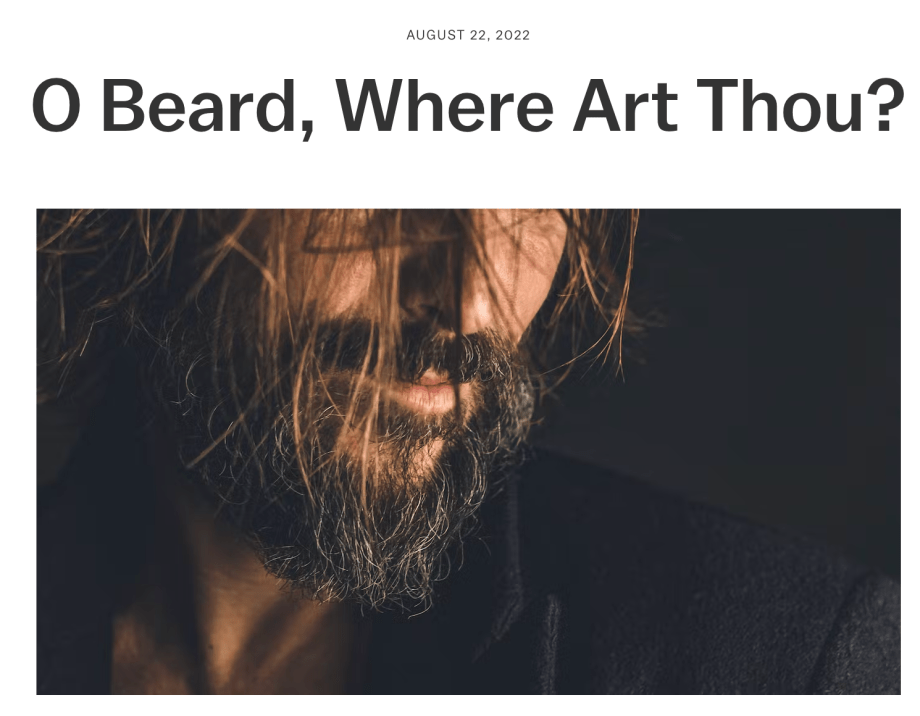
LINK: O Beard, Where Art Thou — August 22, 2022

 #1 – Saying it, but not saying it: That is the way these kinds of articles protect themselves from legitimate criticism.  They are really saying it, but they make sure they include caveats that they can then point to in order to argue that they are not saying it — “Look, I said in the article that . . . . ”

Make no mistake; the article is making a point and saying it while denying that they are saying it.  No, growing a beard is not God’s will for all men, but it is the way God created men, in contrast to being a child, or a woman . . . .

“Why did God make men with the capacity to grow beards? Why grow beards at all, or why not give them to children and women. . . .”

I’m not saying that beards are God’s plan for all men, some men have difficulty growing a beard, but God did put it into your created DNA . . . .

“He shaded the man’s face with his pencil from the very beginning.”

“What ecstasy of Adam observing the beautiful and smooth face of Eve.”

I’m not saying you have to don a beard — but look at all these Bible verses (for whatever reason?) I have cited! [1]

^

#2 – Lost Credibility: Regardless of the fact that the Scriptures nowhere (nada — zippo — zilch — zero)  makes any argument for or against facial hair, such “theological scholars” will find verses in the Bible that address that issue for an application today.

There is no doubt that there were ways to shame men by shaving their beards, stripping them naked, mocking them publicly, or pointing out one’s inconsistencies. [1].

Nevertheless, to call up various biblical references about facial hair and then seek to apply it to God’s people today is ludicrous — at best!  At worse, it reveals one’s ability to make the Bible stay whatever you want it to say.  Such articles only bear witness to how easily they can contort the Scriptures!

^

#3 – Shameless Motivation:  The motivation of such an article is clearly stated by the author . . . . .

That makes literal beards, in my opinion, worth having. Beards protest against a world gone mad. In other words, beards beard. They testify, in their own bristly way, that sex distinctions matter, that manhood will not be so easily shaven, shorn, or chopped by the Hanuns of this world. Its itchy and cheeky voice bears witness, “Male and female he created them” (Genesis 1:27). [3]

This is an attempt to use the Bible . . . .

  • to provide a “biblical” and useful line of argument [4]
  • to encourage the use of facial hair as a means of protest in our world [5]
  • to be scripturally, AND politically and culturally relevant [6]
  • to counter the political and cultural trends of today [7]

^


^

1. Per the citing of the movie “Braveheart,” he had no beard, but he did have very long hair!  Even though the author states that “Rome’s men were clean-shaven in biblical times,” in the movie “Gladiator,” as cited, he has a very short and sleek, styled shadow beard.

Also, I have never seen a picture of a bearded John Piper.

Also, in the ’60s, a beard was considered “nada” for God’s people.

Yes, this is how twisted it gets in reformed circles!

2. Paul even publicly shamed some of God’s people for their biblical ignorance, hypocrisy, or inconsistency — I Corinthians 6:5; 15:34; II Thessalonians 3:14-15

3. Again, I’m not saying you should don a beard, but hey, if you want to stand and protest in support of God’s design, you should think about this, but don’t misunderstand me since I did say that you don’t have to be bearded to be biblical.

4. This “biblical” reasoning will be repeated and repeated “to say, but not say.”  Whatever the issue, this handling of the Scriptures, and this duplicitious approach is being taught by example to ministry leaders and pastors across the reformed spectrum!

5. Rather sad, isn’t it?  That is how we counter our culture — “by this shall all men now that you are my disciples?”

6. It is all part of the distorted view about the “sufficiency of Scripture.”  You see, the Bible even addresses facial hair and cultural protest.

7.  As stated, these kinds of articles are part of today’s evangelical church life, which desires to weigh in on just about any and all political, cultural, economic (i.e. student debt forgiveness), or sociological issues on the front pages.

^

P.S.   This “I’m not saying, while saying it”  is how the argument is made on other issues that are just as questionable, such as eternal security.  Caveats are included to protect, not to clarify.  In fact, they fog the issues by saying what they really believe and then adding that they are not saying what they just said.

There Is A Different Way To Look At It . . . And It May Make A Difference!

There are different ways to view an event, a situation, or an experience.

That is obvious when we speak to our doctor about a problem we have been grappling with for a period of time.  We have a vantage from the inside out, and the doctor looks at it from the outside in.

Often, a patient’s thinking is dismissed, immediately corrected, or even silenced when offering his/her perspective on what has been happening.  They are the patient, not the professional.  “Did you see my sign?”

Warning:
Patient will be charged EXTRA
for annoying the doctor
with self-diagnosis.

It is clear that there are times when we look at what is happening from a different vantage, and many who are in the medical profession have little-to-no interest in what we think is happening or causing the symptoms.  We are not the “professionals.”  What is happening can only be known and understood by those who are the specialists.  There is little room for the layman to offer some possible insights from a different vantage.

The reality is that we will identify problems dependent on our vantage.  The value of different viewpoints is acknowledged in a number of ways . . . .

  • Outside consultants are paid big dollars to look at an organization or business to evaluate what is actually happening.
  • Questionnaires are given to new customers or visitors to get their perspectives.
  • Feedback emails
  • Suggestion boxes at retail stores.
  • “YELP”
  • Outside executive hires are considered because they bring a new vantage, instead of the same institutional perspective.

Sometimes it is said this way . . . . “We need a fresh set of eyes to look at this.”  Because over a period of time . . . .

  • We begin to “believe our own press.”
  • An “echo chamber” develops where we hear back what we have been saying.
  • Other leaders begin to “drink the cool-aid” and fail at providing the needed controls.
  • Relationships become more important than speaking the truth about what is happening.
  • The “same-old” is the “same-old” because there are no fresh eyes looking at the situation.

While the value of seeing a situation from another vantage is acknowledged, the fact remains that discordant or “non-professional” vantages are often dismissed or immediately refuted with professional jargon.  Outside opinions — and they must be considered non-professional OPINIONS — may be given a nod of possible consideration, but they carry very little meaningful attention or weight!

Laymen vantages are often labeled “annoying”  . . . . and such people “will be charged extra for annoying” the leader with their vantage.  The “charge “is usually a relational disparaging, a cavalier indifference, and/or even the rude and ungodly ghosting of brothers and sisters in Christ.

The Results: The results are a combination of a steady decline in attendance, weak finances, low morale, little real outreach, and/or the loss of that ministry’s influence and reputation.  The professional viewpoint controls and the patient’s health declines further.

A better diagnosis of what is actually happening is squashed, and/or the “prescriptions” for the needed changes are never written.

The patient takes the “professional advice” only to return with the same problems for the next visit — and again he/she attempts to suggest his/her insider viewpoint.

Like was said by Hemingway . . . .

How did you go bankrupt?
Two Ways . . . .
Gradually, Then Suddenly

If You Think Who Your Pastor/Teacher Regards Doesn’t Matter . . . . .

If you think who your pastor/teacher regards, follows, imitates, promotes, admires, emulates, or reads doesn’t matter, you might not grasp how it impacts a ministry!   How it can and does change a church’s DNA.

Here is but one example!!!! — and I mean but one example — from one of the most prolific leaders in “reformed” theology.

^

This article is based on . . . .

Husbands, love your wives, as Christ loved the church and gave himself up for her, that he might sanctify her, having cleansed her by the washing of water with the word. (Ephesians 5:25–26).

Let me just point out that the article is hardly an exposition of what this passage teaches!

It is BIZARRE Theology that will be repeated by others of the same stripe and thinking!
And some wonder why we have lost our platform and influence!

One of the appropriate responses was . . . .

^

There are pastors and teachers across America who have been following the writing, preaching, teaching, books, conferences, and publishing of DesiringGod ministries and John Piper for decades!  It is his theological-ideology that undergirds such a bizarre statement!

How’s that been working out?

Church Been Growing? [1]

Part of what we are seeing in many local churches — a continued decline in growth — is the product of a “renewed” emphasis on an extreme Calvinistic ideology propagated for decades!

As recorded in the book of Acts, the early church never got caught up in this extreme theological-ideology, and souls were “added to the church.”[2] I know, “numbers don’t matter,” even though the repeated mention was part of the inspired record for a reason! [2]

God causes His work to GROW.

GROWTH has been part of His DNA since the Creation of His world.

^


1. Yes, there are many other factors to examine in church ministry, and all of them should speak of a growing church!

  • Believers marked by increasing faithfulness & service?
  • Greater separation from the things of this world?
  • Teens and young adults staying connected?
  • More outreach?
  • Are disciples effectively sharing the Gospel?
  • Discipleship resulting in consistent personal evangelism?

2. The most obvious are Acts 2:41 (3,000) and Acts 4:4 (5,000).  However, the Scriptures repeatedly speak about the many who responded to the Gospel!

Acts 4:4 —  b
Acts 6:7 – and many
Acts 9:42 – and many
Acts 11:26 – a great many people
Acts 12:12 – where many were gathered
Acts 13:48 — and many followed
Acts 14:21 – had made many disciples
Acts 17:4 – a great many
Acts 17:12 – and many believed
Acts 18:8 — and many heard, believed, baptized
Acts 21:20 — and many thousands

♦♦♦♦♦♦♦♦♦♦♦♦

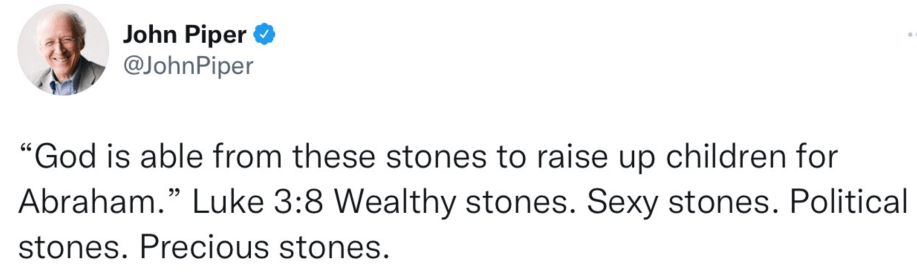
How about this one . . . .   Yep — this is what “precious stones” means!

3 Indicators Of “Church Stall”

In the field of aerodynamics, an airplane “stalls” when it can no longer produce lift. It has nothing to do with the engines but with the wings. The engine or jets can exert full power, but the wings are no longer properly cutting the air and producing lift. In fact, in commercial airlines, an alarm goes off when a stall takes place or is about to take place. [1]

You see a stall take place at an air show when a small aircraft begins to pull up in a sharp climb, and at a point, it begins wobbling in that upright position. The air is no longer breaking across the wings properly. It begins to fall out of the sky like a rock. No aerodynamic lift is exerted on its wings. Now, the pilot’s job is to regain lift by navigating the airplane into a position, so the wings cut through the air at a forward “angle of attack” and again produce lift on the wings.

When I took flight lessons, one of the most important parts of the training was understanding “lift.” Flight instructors would purposefully put the plane into a stall, and your job was to regain lift. Actually, most all flight instructors put the airplane into a moderate stall because of the dangers that a serious stall poses, especially when you lack the altitude needed to recover from a serious stall. Instructors have died at the hands of student pilots who made the test stall worse because the flight instructor lacked the time and altitude needed to recover.

Churches stall as well. They lose lift and begin wobbling. The leader’s job is to regain lift by navigating the ministry in such a way that it doesn’t crash. 

Many do crash and have crashed in the last two years. The crashes do look very different at times. Sometimes the “passengers” survive the crash and seek a new pastor. Other times, the church closes or merges under another “pilot.” Sometimes the pastor learns quickly and is able to do an emergency landing, all to fly another “day.” Far too often, the “pilot ” walks away from a crash unharmed and begins piloting yet another aircraft. It wasn’t his fault. It was the “craft,” the “crew,” or the “passengers.”

Many churches experience an “aerodynamic stall” over time! It is part of learning and the immense time “in the air.” It is just part of reality, and pastors ought to be taught what to look for when it is about to happen or happens.

^

 There are “alarms” that will go off.^

#1 – Interest Wains: There are ways, legitimate and creative ways, to build and grow a church ministry ( no less a school in today’s culture, but that’s another issue). The proof is found in the local churches around an area that are doing it. 

The handful of mega-churches across America is not the issue or concern. But the many area churches that are experiencing growth are! When interest in visiting, attending, faithfully attending or joining a local church ministry wains, an alarm ought to go off. 

Sporadic attendance is also part of the lack of interest. If members and friends of the church are not consistent, why? Why have those who are “connected” lost interest, commitment, or appreciation?

Attendance and giving are legitimate independent indicators of where a church is in flight. Both are legitimate indicators of care and concern of a ministry! Pointing to one over the other is a way to ignore the alarm that is sounding.  

Unfortunately, most also realize that a meaningful drop in “giving” will be the loudest alarm alert given due attention. 

^

#2 – Reality Is Ignored Or ^Denied: “How did they not see what was happening?” Probably, you have heard that said or said it yourself. It was obvious what was happening, and no steps were taken to address it. 

  • Attendance dropping, or 
  • Finances getting tighter, or
  • People leaving, or
  • Weak Gospel outreach, or
  • Few visitors, or
  • Fewer new members, or
  • Long-time supporters left, or
  • More difficult to find lay help, or
  • Sporadic attendance, or
  • Lost “excitement” about our church, or
  • Any number of the above . . . . 

I understand the language that accompanies the disregard of the alarm — “We are growing deeper, not greater.” One might argue that deeper and greater work hand in hand. Depth should also result in breadth.

The language of failure is invoked and used to explain or divert what is actually taking place. This may be the first alarm that goes off when what is happening is avoided or denied. “We are not interested in numbers but faithful followers!” “We want to see disciples made, not just people who attend church on Sunday” — as if it is “either-or.”

The wording changes to divert attention away from what is actually happening.

^

#3 – The Cost Of Staffing Overrides The Budget: You may have heard it said this way . . . . “We are too heavy on administrative costs.” The organization is top-heavy. A high percentage of the income covers salary, benefits, and supporting staff. What is a “high percentage” or “top-heavy?” 

You may find out the answer to that question when the “overhead” costs begin to weaken ministry, when money gets tight, and the ministry struggles to do what it was called to do. 

An alarm ought to go off when you total the cost of salaries, support staff, and various elements of compensation far exceed the total of all other monies used to minister to and through God’s people and the programs in which they serve. 

^

Churches do stall, and some crash because they lack the altitude needed to recover.

There is a reason that long-term Sr. Pastors are able to avoid a fatal crash. It is not that they don’t find themselves in any “stalls.” Rather, they don’t ignore the alarms.  They adjust and are able to navigate back into forward flight. 

Those who have been in the position of Lead Pastor for only several years, and ignore the alarms that accompany a “stall,” are likely to walk away from a crash, leaving the passengers to deal with the wreckage — an unfinished building program, financial troubles, hurt and damaged believers, a failing school, a bloated staff, struggling ministry programs, fewer members, low morale, poorly supported missionaries, dwindling bank accounts, etc. 

Yet others will continue to stay seated in the cockpit while the alarms sound, offering a very bumpy ride and maneuvering to stay aloft.

There is a “reality stall wall” that a church will hit when the alarms are ignored. When the alarm can’t be ignored or denied any longer, then, suddenly, everyone sees what has been happening and may even profess having had prophetic ability — “I saw what was happening and I should have said something.”

C.S. Lewis

^


1. https://simpleflying.com/aircraft-stalls/

Perseverance of the Saints

There is a broad spectrum of beliefs and positions when we talk about “Calvinism.”

While few, if any, would ever accept the label of being a “hyper-Calvinist,” such a category exists!  There are those who are theological-ideologues and are on the EXTREME edges of Calvinism.

Typically the “extremes” revolve around the “L” and the “P” of “T-U-L-I-P” — “Limited Atonement” and (more damagingly) “The Perseverance of the Saints.”

The damage is caused by a fogging of the biblical truth that one is secure in Jesus.  That fog is the result of stating that one cannot lose their salvation, that they are secure, and then implying that one can lose their salvation.

The damage is that God’s people are continually shaken in their confidence that the Lord saves and keeps them!

Here is an example of just that from one of the most prolific writers of our day, and an extreme Calvinist.

“It follows from what was just said that the people of God WILL persevere to the end and not be lost. The foreknown are predestined, the predestined are called, the called are justified, and the justified are glorified. No one is lost from this group. To belong to this people is to be eternally secure.”

That statement is followed by this . . . .

“Our faith must endure to the end if we are to be saved. . . . Nevertheless, we must also own up to the fact that our final salvation is made contingent upon the subsequent obedience which comes from faith.”

(If you want to read these statements in their full context,
here is the link to the total statement of faith.)

How does he put together “eternally secure” and the words “if” and “contingent?

(If you read the whole statement of faith,
you will see that fog & tension throughout!)

D. Martyn Lloyd-Jones does a masterful job of revealing the extreme nature of this Calvinistic position and, as he states, the ridiculous nature of such a position!

Here is an audio clip taken from Lloyd-Jones’ message on eternal security.

AUDIO CLIP

As Lloyd-Jones indicates . . . .

“The main purpose of salvation is the glory of God, the vindication of His glory, and the sovereignty of the character of God. This ultimate purpose, says Dr. Lloyd-Jones, changes everything, namely the assurance of the outcome of God’s glory. Moreover, there are opportunities for pride as those who deny the final perseverance of the saints are forced to deny that it is ultimately God who causes endurance until the end, and instead must affirm that there is some quality inside those who are received into glory that is different from those who fall away.”

“The glory would have to go to you for holding on!”

It is to our glory if holding onto our salvation is up to us!


Link To Lloyd-Jones’ Full Message

External Link To Lloyd-Jones Full Message

https://jameslau88.com/2020/05/10/the-doctrine-of-being-saved-eternally-by-martyn-lloyd-jones/

♦♦♦♦♦

D. Martyn Lloyd-Jones on Eternal Security . . . .

“If this doctrine (Eternal Security) isn’t true, well then if you ever find yourself in glory, the glory will have to go to you for holding on.

The position would be this — that you like a number of other people, have been given the same gift of salvation and eternal life — They foolish didn’t hold on it, but that you did.  And therefore the glory goes to you for holding on.

But that’s a blank contradiction of the teaching of the Scriptures everywhere. . . . Man has nothing to boast of at all.  And when you and I arrive in heaven — my dear friends — we realize that we are there not because we held on while others gave up — but because He held on to us. . . . and we’ll give Him all the praise, the honor, and the glory.”