Category: pastors

Let’s Make It Simple: The Christmas Angels & Bible Translations

The key question that must be resolved concerning translations is what “Greek Text” or manuscripts do you rely upon for the translation (into the English language, in our situation).

#1 – Do you rely on the TR (Textus Receptus / the Majority Text)

or

#2 – Do you rely on the CT (Critical Text / the Sinaiticus – Vaticanus) manuscripts?

The Critical Text is called the “Sinaiticus – Vaticanus” because the name indicates locations.  One was found in the Sinai (in 1844), and the other was discovered in the library of the Vatican.

In 1881, two prominent scholars, Westcott and Hort, declared and dismissed the Textus Receptus as inferior and created a new Greek text based on the Critical Text.

If you do not rely on the Textus Receptus, then you must explain how God allowed this set of Greek manuscripts to be the basis of all New Testament translations for almost two thousand years (until 1881 and after).

So until 1881, God left the Greek manuscripts that Westcott and Hort decided were superior, hidden in the Sinai and tucked away in the Vatican?

For 1881 years, Bible scholars, church fathers, pastors, and God’s people relied upon the TR, which was an inferior set of manuscripts?

Joe Shakour provides another prime example of what happens when you abandon the TR / Majority Text and use a translation that is dependent on the Critical Text.

The Path To Pastoral Corruption

The ministry continues to be littered with examples of pastoral failure — moral, criminal, ethical, and personal.  What are the dynamics that are playing out that are producing this?

When people say that so-in-so is “living in a bubble,” or they are working in an “echo chamber,”  They are referring to an isolation that occurs between the average and ordinary person in their world and those in positions of leadership.  They are referring to an isolation that repeatedly occurs when leaders and pastors no longer live with an understanding of where the people are.  They are living their lives in and among those who occupy the same “offices” and “offices” they occupy.

There is a self-governance and individualism that walks alongside leaders who believe that they are leaders because they are at least slightly, if not significantly, superior to those they are leading.  And while they may have some skill sets that have propelled them into leadership, they begin to believe their own press clippings.

In the ministry, these press clippings come from those who sit in the pews.  God’s people compliment and share their appreciation of the pastoral staff.  No matter how poor a sermon is, there will always be someone who offers words of appreciation to the pastor or other members.

There is an environment that surrounds a ministry and the local church. God’s people attend the services and honor their leaders because they want to support their pastoral leaders.  No one wants to be critical.  All want to believe the best of their pastoral staff.  A great deal of grace and kindness is extended when mistakes are made.  Forgiveness is quickly and easily extended to church leaders.  It is all part of the biblical environment that we all believe in and seek to emulate.

However, leaders are also complicit in promoting that environment. That world of self-governance allows little to no room for any criticism — legitimate or illegitimate. Criticism is knocked down by such biblical concepts as “back-biting,” “gossip,” “disrupting the unity of the church,” etc. Church by-laws and constitutions are more than a church’s statement of faith and some general structure on its operation.  The church constitution becomes a protective handbook. and self-serving changes are made by the leaders.

The church constitution can be a means of protecting the pastoral staff from criticism as well as dismissal.  Most pastors never face dismissal.  As is generally known, pastors spend about 3-5 years at a local church before THEY decide to leave. While a pastor may be reading the tea leaves and decide it is time to move on to another ministry, they are rarely fired outside of moral, criminal, or ethical issues.  You can throw in a few cases where pastors decide to move on because of a terrible decision or event that will follow them for years to come.

Now, add to all this the genuine reality that the church by-laws and constitution may delegate more power and self-governance to the Sr./Lead Pastor. He may be given the authority to recommend the removal of staff or pastors. Even though the church voted to hire, the Lead Pastor can, for all practical purposes, be dismissed.  If that staff is not dismissed, he may suggest to the staff member or pastor that it is time for them to leave.

Some Lead Pastors even have the sole power to dismiss another member of the pastoral staff without congregational or board approval! Some Lead Pastors will even have the church constitution rewritten to give them this power and more!  That is not a hypothetical but a reality that could easily be demonstrated if needed.

All of this feeds into the self-governance or autonomy that leaders and/or pastors experience, and that self-governance becomes the means of their ineffectiveness or, worse, their downfall.  They do not have anyone who can talk to them.

Those on the payroll have an interest in currying the leader’s favor. That favor means opportunity, promotions, salary increases, as well as job satisfaction. You compliment the Sr./Lead pastor, and he will support your employment and standing. Which feeds into the danger even more!

The members are at work all week, and they have little idea of what takes place in ministry.  They believe that the Lead Pastor is taking care of everything! In fact, they are counting on him to hold the staff accountable. Those in the “pew” also believe that the staff’s support of the leader is born out of agreement or approval.  Those closest are satisfied and supportive, and therefore, all must be well. The dynamic of self-governance is playing out.

√ When you as a leader do not have people in and around you who can honestly and candidly talk to you.

√ When you do not encourage those around you to speak up.

√ When you do not have people who have no vested interest and/or drive to curry your favor.

√ When you do not give people who don’t work for you a place at the table.

. . . . ineffectiveness and/or worse damage will ultimately result.

While there are other mitigating factors that can be in play (and there are), self-governance is a killer.  Anyone who has taken the time to read the accounts of so many Lead Pastors and ministries that bear out this assessment knows how truly dangerous and damaging self-governance / autonomy is.

Another by-product of “autonomy” is unchecked ineffectiveness. One might think that “ineffectiveness” is far less a concern compared to  ethical/moral failure.  “Ineffectiveness” when leading a local church or ministry is only less of a concern because it leaves the leader’s reputation untouched.  While men like RaviZ, the SBC, Dave Ramsey, James MacDonald, Matt Chandler, et al. have been severely damaged personally, their effectiveness was diminished long before it all came apart.  Others around them lack the courage to graciously speak up about other smaller practical concerns.  Those smaller concerns were not moral or ethical, but revolved around the practical.  Things said or left unsaid. Things done and undone.  They all ate away at the effectiveness of the ministry as a whole.  Visit were not made.  Comments from the pulpit were unchecked.  Programs were less effective than they could have or should have been because of no one wanted to say anything to damage their relationships.

When leaders and pastors have no one who can speak truth into their lives, the ministry or church loses its effectiveness.  When staff members, fellow pastors, church officials, or members are compromised by their need for employment or their desire to find favor, and they say little to nothing because of those and other factors, then what could have made a difference, and even a significant difference, is lost.

The answer to “self-governance” is accountability.  While that word is in the mouth of most “autonomous” leaders, it is knowingly compromised.”Accountability” is for others.  We are slightly or significantly superior to others.

There are ministry leaders and pastors who are not fit to lead because they cannot even lead themselves.  They make self-serving decisions and know that they will not be checked on because those who work in the “King’s Court” will support them, or they will find themselves on the way out of employment or a church office.

They do not have people who will tell them what they need to hear but what they want to hear! The voices that need to be heard are ignored, muffled, or dismissed.  That damages and kills ministries, if not ultimately the leader himself!

Oh, I know that right now, in many, or even most cases, there is no need to be concerned. Nevertheless, not one of the above examples (along with many others) thought they were in danger of making a terrible decision, as others around them remained silent (and complicit).  But the “Hemingway law of motion” is clearly at work, given enough time, with far too many church leaders . . . .

“How did you go bankrupt?”
“Two ways. Gradually, then suddenly.” 1

♦♦♦♦♦♦♦♦♦♦♦♦♦♦♦♦♦♦♦♦♦♦♦♦♦♦♦♦♦♦♦♦♦♦♦♦♦♦♦

  1. Hemingway makes the point that things happen slowly, and then the collapse takes place suddenly. That “Hemingway Law Of Motion”may also explain what happens with some ministries and local churches.

After a series of actions and decisions, over a long period of time, suddenly an action or decision is made that precipitates a sudden collapse that “no one” saw coming. The avalanche was building over the months and days of winter, and finally, a snowflake landed on the accumulation, and the vast movement of snow was triggered.

That might describe what takes place in ministries and local churches. It is not this-or-that event or decision, but the building of events and decisions that finally result in a sudden avalanche or collapse.

WHEN Some Calvinists Argue In Favor Of Free Will

There is a time when some, and indeed many, who are ideological-Calvinist, talk about the free will of men and women.  They are willing and able to briefly discard their Calvinistic ideology because it provides space for excusing their failure.  Suddenly the “free will” of fallen humanity comes into play.

I use the term “calvinistic-ideologues” because their Calvinistic ideology reinterprets passages that get in the way.  They are theological extremists and, therefore, will find a way around the clearest of passages that in no way can be understood as supporting their ideology.  “For God so loved the world” is now the “world of the elect.”  “Whosoever will” does not mean whosoever — et al.

However, this situation is kind of a reverse gear.  Instead of redefining words, some decide that maybe there is a place for free will in their theological manual after all!

When confronted with their own failure in the home and unable to even persuade their children of the truth of the Gospel, some suddenly call up their child’s free will!

They haven’t failed at training (Proverbs 22:6).  They are still qualified to be in the ministry even though they do not have “faithful children (Titus 1:6).  Surely, they are not like Eli, who failed in his home!

The cause of their child’s rebellion (and worse) is . . . .

 “Well, you know, children have to make their own decisions at a point in time.  In the end, you need to realize that they have a free will.  They can walk away from all that has been taught them in our home!”

How many times I have heard that from pastors who have failed to raise faithful children! [1]

Another alternative is that they have miserably failed in their most important and primary responsibility while preaching to others about godliness.

For some, children now have free will, and it was their child’s decision to walk away from the faith.

There is only one other alternative, and it isn’t very sellable — God has ordained that my child will not receive the gift of faith, (that has been given to others). Before creation, The Lord Himself determined that he/she was destined to be a child of Hell. [2]


1 – Sad to say, but John Piper is a prime example of such failure as a father.  If you would like to read his explanation of that failure, here is the link. Piper speaks as if what we do as parents influences the outcome…huh?  Piper never mentions the reality that his theology dictates….that the Lord has determine not to give them the faith too believe, as He has others.

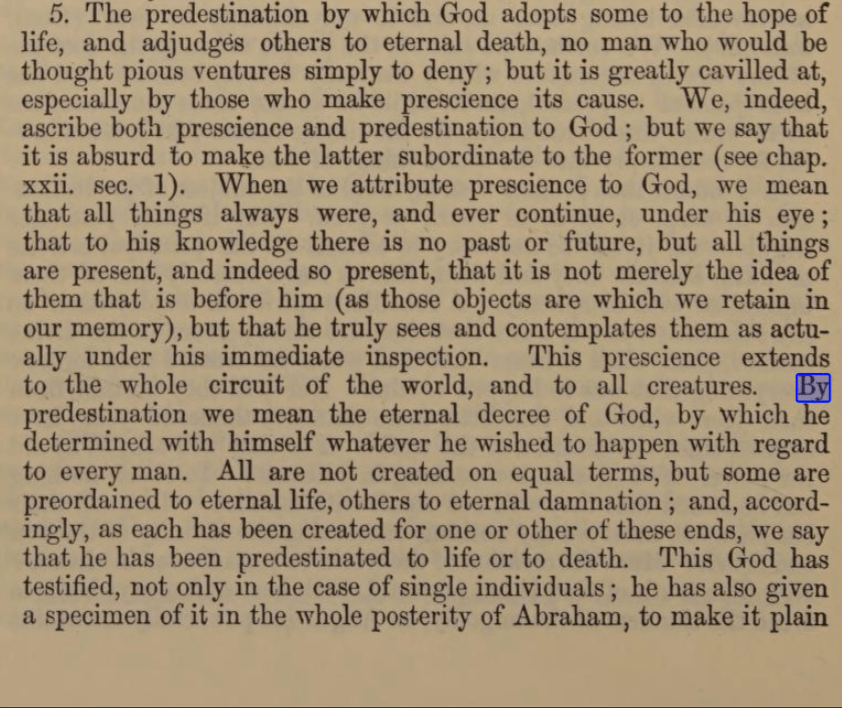
2 – “By predestination we mean the eternal decree of God, by which he determined with himself whatever he wished to happen with regard to every man. All are not created on equal terms, but some are preordained to eternal life, others to eternal damnation; and, accordingly, as each has been created for one or other of these ends, we say that he has been predestinated to life or to death.” John Calvin, Institutes of the Christian Religion — 3.21.5

How Is “Hyper-Calvinism” Being Redefined?!

It has become all too evident in the socio-political world that if we can change, stretch, or twist the definition of words, we can control the conversation. . . . . and this is also true when it comes to theological discussions!

“Hyper” means “to go beyond. ”  Outside of “hypersonic,” “hyper-anything” is generally not meant as a compliment.
“Hyper-Calvinism” means that one has gone beyond what John Calvin taught.

  • “You are more Calvin than John Calvin!”
  • “Not even John Calvin taught or believed that!” [1]
  • “You have taken what Calvin taught and are running it off the tracks.”

“Hyper-Calvinist” is recognized as an unattractive description, and the easiest way to avoid being called a “hyper-Calvinist” is to redefine the term.

In order to dodge the charge that one is a hyper-Calvinist, the term is redefined in a way to exempt those who are, in fact, on the extreme theological fringes.

AND what is even more advantageous is that by changing the definition, there is no need to change one’s theological-ideology.

√  Change the meaning so that the definition avoids theology and focuses on some supposed after-effects!
and
√  Change the meaning by setting up a “strawman,” a caricature that exempts most everyone . . . .

. . . . . and the problem is solved.

Here is how “hyper-Calvinism” is being defined today . . . .

“It is a teaching that downplays evangelism, church-planting, and going to the nations, on the basis that God is sovereign.  God is in control, and God has elected his people, so he’s going to save his people whether we speak the truth or not, whether we give our money to foreign missions or not. . . . Hoax-Calvinism . . . mimics Hyper-Calvinsim by never putting the boots on the ground, never befriending unbelievers, and only begrudgingly, at best, telling people about Jesus.” [2]

Sorry  — this is not “hyper-Calvinism,” but a strawman that seeks to distract from legitimate biblical issues.  IT is the “Hoax-Definition” of hyper-Calvinsim!

Such a definition moves the focus away from the genuine theological issues that surround Calvinism and hyper-Calvinism, by repeating this well-known historical extreme parody. [3].

The author’s strawman is disingenuous and duplicitous!

What biblical ministry or local church does not . . . .

  • believe that God’s sovereignty also includes instrumentality?
  • understand that God’s Gospel program includes sharing the Word of God, praying for the souls of men, and living godly before them?
  • financially support foreign missions?
  • encourage telling others about Jesus — putting the boots on the ground?

What biblical ministry teaches or believes that . . . .

  • We should NEVER befriend unbelievers?
  • We should ONLY begrudgingly — and at best begrudgingly — talk to people about Jesus? [4]

These “strawman” definitions are merely an attempt to redefine hyper-Calvinism by calling up some fictional side-effects, without touching the real theology that underpins both Calvinism and hyper-Calvinism!

Calvinism and Hyper-Calvinism are about doctrine, not these “fabricated strawman” behaviors! [5]

Hyper-Calvinism primarily revolves around doctrinal issues of “sovereignty,” “limited atonement,” “the perseverance of the saints,” and the push to make grace, along with repentance and faith, all part of God’s gift. [6]

Hyper-Calvinism is NOT “hyper” because it spawns the behaviors cited in its strawman-camouflaged definition. [7]. It is “hyper” because of doctrinal issues that revolve around what is typically called — “The Five Points Of Calvinism.”  Those “Points” are all doctrinal, not behavioral strawmen.

Extreme or “hyper-Calvinsm” results when . . . .

  • Calvinistic-ideology takes precedence over all the other doctrines and truths of Scripture.
  • There is little willingness to balance out the doctrine of God’s sovereignty with human responsibility.
  • Clear biblical passages are marginalized because they “disturb one’s doctrinal consistency & peace.”
  • The demand to be intellectual consistency refuses to allow the doctrines of God’s sovereignty AND human responsibility to co-exist  — unresolved in our minds, but divinely resolved in the mind and plan of God.
  • One downgrades passages that call on believers to pray for, witness to, and live godly lives before those who are without Christ, rather than abandon, amend, and/or temper their doctrinal positions. [8]
  • There is an unwillingness to give room for divine “mystery” – for the fact that there are unknown and unrevealed truths that are not part of God’s revelation to men, that there are truths that are unknown to us and that would resolve our lack of understanding if known.
  • Preachers and pastors are unwilling to invite people to come to Christ because their “doctrine”  holds them back from calling on all men to trust Christ for the forgiveness of their sin.
  • Words no longer mean what words mean (whosoever will, God so loved the world, not willing that any should perish, all men) because it disrupts and disturbs one’s theological ideology.

Calvinism and “Hyper-Calvinism” are doctrinal issues, and there are real-life implications to those doctrinal beliefs! 

If it is biblical accurate that . . . .

  • even lost men, dead in their trespasses and sins, can see and understand that there is a Creator God (Romans 1)
  • the Good News / the Gospel is good news
  • that the Gospel is for all men
  • the “gift” is not grace or faith, but our salvation [9]
  • whosoever will” can take of the water of life freely, [10]
  • the Lord calls on all men to repent
  • God is not willing for any to perish
  • that . . . . .
  • that . . . .

. . . . then this is not about two equally tenable positions, and the souls of men and women, adults and children, are at stake. 

And that has real-life eternal repercussions! [11]

Theological-ideology matters!


1 – Interestingly, John Calvin did not teach that faith is a gift!
“Many persons restrict the word gift to faith alone. But Paul is only repeating in other words the former sentiment. His meaning is, not that faith is the gift of God, but that salvation is given to us by God, or, that we obtain it by the gift of God.” — John Calvin

2 – Humble Calvinism, by Medders, pg 120

3 –  “At a meeting of Baptist leaders in the late 1700s, a newly ordained minister stood to argue for the value of overseas missions. He was abruptly interrupted by an older minister who said, ‘Young man, sit down! You are an enthusiast. When God pleases to convert the heathen, he’ll do it without consulting you or me.'”

As the author notes, “such an attitude is inconceivable today,” and it is!

Do not let such a strawman distract from the real theological issues that surround both Calvinism and “hyper-Calvinism.”  There are legitimate and relevant theological issues that surround both, and the proof is found in the many articles that attempt to argue that Calvinism does not dampen evangelistic zeal!

4 –  Using the word “never” and “only begrudgingly” reveals the true nature of this strawman!

Sadly, “Hoax-Calvinism” is not the strawman that explains the excesses that pervade the theological world today.  “Hoax-Calvinism” is a distraction!  “Calvinism,” “Extreme Calvinism,” and “Hyper-Calvinism” are theological movements that deserve serious conversation and examination.

5 – Obviously, one could find a church or ministry that believes and/or practices such absurd positions, but that hardly makes such a strawman anything less than disingenuous!

6 – One could easily include “God’s granting of repentance,” which is also taken out of its context.  The passage is focused on those who have stubbornly, and to their own spiritual demise, hardened their hearts.   Interestingly, Paul states that it will be by our patience and demeanor that we might perhaps soften their hearts to the truths of the Gospel.

7 – It is worth noting that both Calvinism and “hyper-Calvinism” have historically, presently, and repeatedly precipitated some very real practical repercussions.  They include a general lack of evangelistic zeal, the paucity of sermons that preach a clear and direct Gospel message, the unwillingness to give public invitations to call on Christ, a portrayal of “a God of judgment” more than a God of love, grace, and reconciliation, and a general coldness towards Gospel winsomeness and persuasion.

I taught at Baptist Bible College, Clarks Summit, Pa.  I was moving from Tennessee Temple to BBC in the late 70s.  During my 2-3 hour interview at BBC, I was asked if I had any questions or reservations about joining the faculty.  I indicated that I did. . . .

“I am struggling with the reputation that BBC has about its Calvinistic / hyper-Calvinistic position, and I have had some compare BBC to an evangelistic dustbowl.”

They responded that the reputation was due to “poor press” and that they had failed to make the case that they were evangelistic.  In fact, they stated that one of the reasons they were interested in having me join the faculty was that I taught at Tennesse Temple College and Seminary.  They wanted some men and women on their faculty who had taught at such evangelistically recognized schools.

Let me assure you that it was not just “poor press.”

I recall a chapel message by the President of BBC – Mark Jackson.  He exhorted the students about the historic tradition and position of Baptists as it relates to Gospel preaching and the giving of invitations.  After that chapel service, a faculty meeting, President Jackson was challenged by the Bible faculty and others about that chapel message and, even more specifically, about giving public invitations.  I was taken back that the President had to defend that position.

8 – How absurd are these comments if both are not true — #1 – That God is sovereignly working, and #2 – that men also have some level of “free will” that can be appealed to by preaching.

“Knowing therefore the terror of the Lord, we persuade men; but we are made manifest unto God; and I trust also are made manifest in your consciences.”

And the servant of the Lord must not strive; but be gentle unto all men, apt to teach, patient,
In meekness instructing those that oppose themselves; if God peradventure will give them repentance to the acknowledging of the truth.”

9 -The implications are significant if it is God who gives them “faith” to believe.  Making “faith” the gift is far different than making grace or salvation a gift.  As soon as you make the agent of salvation, “faith,” the gift of God, you now make God the sole person responsible for one’s salvation.  If He alone can give “faith,” and that “faith” is now a gift to whosoever He wills, you now have Him as the one responsible for whether a person does or does not believe and accept His Son as their Saviour!

10 – “And the Spirit and the bride say, Come. And let him that heareth say, Come. And let him that is athirst come. And whosoever will, let him take the water of life freely.”

11 – Unlike the “camouflaged strawman attempt” used to deflect from the real doctrinal issues, the real-life implications of hyper-Calvinism carry with them potentially damnable consequences. 

Fortunately, there is a lot of inconsistency in “theology” and “practicology” — between what Calvinists/hyper-Calvinist say they believe and what they actually practice and/or allow!  Those who need Christ still come to know the forgiveness of sin, even when men twist biblical truths to fit their ideology!

A pastor’s Calvinistic-ideology is often dismissed as unimportant because the church still engages in significant evangelistic endeavors.  
“Whatever our pastor believes . . . . what does it matter . . . . we support missions and engage in outreach ministries.”

At other times, a pastor’s Calvinistic-ideology is hidden from plain sight by weasel words and biblical statements that seem to imply that they are not on the extreme fringes of Calvinism.
“Our pastor talks about reaching the lost, salvation by grace through faith alone, and the need to share Christ.”

For “calvinists” who claim Spurgeon as one of their own!

While Spurgeon is read and cited by many who believe him to be a “Calvinist” after their liking, most do not realize that he faced the same theological backdrop that exists today.

Outside of his speaking and writings around what was called the “Downgrade Controversy” (near the end of his life’s ministry) [1],  Spurgeon wrote and spoke extensively against the extreme Calvinistic movement that was infecting the theological culture.

Appropriately, Iain Murray chose to devote one of his multitudinous books to make known the historical legacy of Charles Spurgeon’s battle against the Calvinism of his day. [2]  Murray’s book is just as relevant today because the same battles continue to surface and resurface.  As Murray well understands,  . . . .

“To confine our view of the church to a few short and passing years (would be ) a serious mistake.
We need to see and remember the big picture.”

While Spurgeon repeatedly identifies himself as a “Calvinist,” his definition of that term is far more “Gospel general” and is primarily in distinction to those of the Arminian camp.

“And I have my own private opinion that there is no such thing as preaching Christ and him crucified,
unless you preach what nowadays is called Calvinism.…
It is a nickname to call it Calvinism;
Calvinism is the gospel, and nothing else.”

If you want to understand where Spurgeon stands on this issue of his day, read Murray’s book, or even some of the extensive reviews [4] that lay out Spurgeon’s case against extreme Calvinism.  Spurgeon’s argument against and utter rejection of the position that “faith is a gift of God” is devasting!

Here is a taste of Iain Murray’s book, and Spurgeon’s refutation of the extreme Calvinism that also marked his day . . . .

“All men,” say they; “that is, some men”: as if the Holy Ghost could not have said “some men” if he had meant some men. “All men,” say they; “that is, some of all sorts of men”: as if the Lord could not have said “All sorts of men” if he had meant that. The Holy Ghost by the apostle has written “all men,” and unquestion­ably he means all men. I know how to get rid of the force of the “alls” according to that critical method which some time ago was very current, but I do not see how it can be applied here with due regard to the truth. I was reading just now the exposition of a very able doctor who explains the text so as to explain it away; he applies grammatical gunpowder to it, and explodes it by way of expounding it.  I thought when I read his exposition that it would have been a very capital comment upon the text if it had read, ‘Who will not have all men to be saved, nor come to a knowledge of the truth.’  Had such been the inspirited language every remark of the learned doctor would have been exactly in keeping but as it happens to say ‘Who will have all men to be saved, his observations are more than a little out of place.  My love of consistency with my own doctrinal view is not great enough to allow me knowingly to alter a single text of Scripture.  I have great respect for orthodoxy, but my reverence for inspiration is far greater.[3]

“The final conclusion has to be that when Calvinism ceases to be evangelistic, when it becomes more concerned with theory than with the salvation of men and women, when acceptance of doctrines seems to become more important than acceptance of Christ, then it is a system going to seed and it will invariably lose its attractive power.” [5]


1 – https://www.spurgeon.org/resource-library/blog-entries/what-was-the-downgrade-controversy-actually-all-about/

2. Spurgeon v. Hyper-Calvinism : the battle for gospel preaching by Iain Murray, pgs. 70-71

3 – Iain Murray — Pgs. 150-161

4 – A Three Part Review Of Murray’s Book, By Sharper Iron Links:

https://sharperiron.org/article/spurgeon-and-battle-for-gospel-preaching-part-1
https://sharperiron.org/article/spurgeon-and-battle-for-gospel-preaching-part-2
Link: https://sharperiron.org/article/spurgeon-and-battle-for-gospel-preaching-part-3

TGC Article Reviewing Murray’s Book Link

Stephen Unthank (MDiv, Capital Bible Seminary)  –“I don’t remember how I came across the book but I do remember the warming light of its content breaking into my immature thinking when I started reading it. I couldn’t put it down. And it seemed like after I finished each chapter I found myself repenting and praying, “Lord, help me to love those who are lost like Spurgeon did. No, help me love the lost like you do!” (Link) 

5 – Murray, pg. 120

6 – D.A. Carson Link

Imitation X 5


We live in an age of theological and ecclesiastic imitation or mimicry.
Let me point to some common examples . . .

.

√ Let’s Stand For The Reading Of God’s Word: Church upon church has now convinced God’s people of the need to honor God’s Word by standing during the reading (and even some preaching while reading) of the Bible. 

Apparently, the church has failed to honor the Scriptures throughout the past generations of congregants.  In fact, apparently, during many of the previous decades of the same pastor’s ministry, God’s Word has been dishonored by him. 

Having your Bible in hand, with the Scriptures on your lap, underlining, and/or taking notes is no longer a sufficient indicator that we honor and value God’s Word. 

Interestingly, while we “stand and honor the Scriptures,” many do not even carry a Bible with them to church but read it off of a screen.

.

√ Liturgical Statements:  They come in all forms, but the rote nature of such comments is obvious – “May the Lord add His blessing to the reading of the Word.”  “This is God’s Word.”  “The grace of our Lord Jesus Christ be with you.”

There is nothing amiss with the words, but there is something wrong with the formulaic sound of such pietistic acclamations. 

It is much like — “We ask this in Jesus’ name” — at the end of prayers!  It is tacked on, repetitively, with the same tonal detachment from any real meaning or sincerity — shallow and vain repetition.

.

Small Groups: Seemingly overnight, churches are promoting the newly found significance, importance, and necessity of “Small Groups.”  It is elevated as the biblical pattern, and it is promoted as vital to the growth of God’s people and the effectiveness of the church.  

Small Groups are biblically validated by using such passages as Acts 2:46 — where house churches were the common practice of the early church.  Of course, there were small house churches during the earliest days of the church. However, these biblical examples are now prescriptive and not descriptive.  

“Small Groups” are not merely a different name for Sunday School and/or Adult Bible Study classes, but are based more on a group counseling model.  The focus is inward, and the members are encouraged to share their intimate struggles and questions publicly with other members of the church.

While the worth of small groups is now proclaimed, it is worth recalling that there was a time when small groups did not exist. In fact, some pastors failed to understand that during decades of their own ministries — at least until now!  Apparently, the biblical nature and importance of “small groups” was not understood for centuries, and only now that the local church grasps the importance of such intimate groups.  [1]

.

Pastoral Practices:  How many have tried to follow the actions and activities of Jim Cymbala and the Brooklyn Tabernacle Church? 

That approach to ministry has been repeatedly employed by imitating other successful ministries, conference speakers, bloggers, and authors.

A ministry leader writes a book about what he/she is doing, his “deeper life,” a sought-after spiritual discipline, and/or how successful this-or-that has been in ministry, and pastors are ready to imitate and implement!  They are going to bring the thinking and/or activities into the life of their church because they believe in them and them!

The question being asked is,  “So how did you do it?  How have you been able to . . .? What is the “Secrets Sauce?” 

Some believe that what worked for another in this-or-that location, in his/her spiritual walk, at this time in the life of his/her ministry, with that group of people, is what the Lord has for them!  

.

“Theological Echoes:”  Someone comes out with a new interpretation, elucidation, or explanation of a passage of Scripture, and you begin to hear it repeated over and over!  Some love the novel, and others may believe it gives them some kind of intellectual credibility!

Someone preaches, teaches, or publishes a crazy theological position, and it is repeated by other ministry leaders and pastors years later —  (check out these two recent ones within reformed circles [2]).   

There is much more than can be said on this kind of imitation. . . . . but that’s for another day!

.


.

1 – We called this “personal discipleship,” and it was done “one-to-one” because there were sensitive areas and discussions that were between a pastor (or mature & wise church leader) and a new believer.  There are qualifications for a deacon, but rarely for a small group Bible teacher.

2 – Two Examples:  How does John Piper link to an insane post by Curtis Chang?  Worse yet, there is no pushback when Piper writes this article biblically defending accepting vaccinations!

Or, in recent days, an even crazier book by Josh Butler has been published by TGC, with endorsements by well-known reformed teachers, leaders, and preachers!  How does this escape notice from the publishers and those who wrote a public endorsement of it?

Tom Buck/SBC: “I was just shown that John Piper linked to this video in the article he wrote to encourage people to get the Covid vaccine. The linked video teaches the Covid vaccine is like Jesus’ work of redemption. It even redeems abortion. “The vaccine may have a distant origin story in abortion” but it serves as a metaphor of Jesus’ redemptive work on the cross. “What began in death could be reworked into life.”
desiringgod.org/articles/a-rea
Link From Piper’s article:  “You have thought hard about the implications of fetal cell lines in the production and testing of the vaccines.”

The Gospel Coalition: Josh Butler’s New Book: 
https://churchleaders.com/news/446148-the-gospel-coalition-under-fire-comparing-christs-love-sexual-encounter.html


Ideology Matters!

In response to the Biden administration appointments of judges to U.S. 9th Circuit Court of Appeals, Law School Dean Erwin Chemerinsky stated . . . .

“We all know that there are many cases where the ideology of the judges makes all the difference . . . . As a lawyer, the first thing I want to know, as soon as I can find out, is who is [on] my panel.”

Chemerinsky understands that the law is not always what you think the law is, but laws are interpreted through the ideological glasses of the judge adjudicating the matter.  Just like in politics, facts do not dictate actions when an ideology prevails.  “Ideologies” is why your mind spins when trying to figure out the thinking that explains decisions and actions.  Sometimes you say, “That sounds (or is) crazy!”  It is because the decision or action is ideologically driven.  It doesn’t compute because the ideology dictates the response, not the “real world.”  “Trust the science” goes by the wayside if an ideology is the guiding rule.

That is also what happens theologically!  There are strong theological ideologies that color how one reads the Scriptures.  Those theological ideologies also color what is preached and not preached, taught and not taught, from the “pulpit,” among the staff, and in discipleship.

When ministries are driven ideologically, they emphasize verses and passages that support their ideology.  They fail to provide the counterbalance that other verses and passages provide, losing the Scriptural balance.

I have often said that when we read about “the beauty of the Lord” (Psalm 27; 90), “beauty” includes the idea that everything is in proper proportion.  All of us probably have something about our appearance that we wish were different.  Cosmetologists and plastic surgeons make a living off of that fact.  Maybe it is a strong chin, a large nose, big ears, skinny or heavy legs, deep-set eyes, a big mouth, wild eyebrows, long legs, short fingers, or a balding head.  A beautiful person has everything in proper proportion!

Theological ideologues lose that proportionality.  A “single” truth seems to override all other truths.  Most everything they read in the Scriptures somehow ends up revolving around that truth!  When that happens, things can get ugly!

Ideologues are prone to bypass the fact that some truths are enveloped in mystery — the inability to reconcile the fact that two truths are equally presented and cannot be harmonized except in the mind of God.  We just won’t be able to put them together without some uneasiness.

Ideology drives one into theological ditches.  The ditches may be “left” or “right,” but they are ditches.

After a period of commitment to an ideology, the ditch begins looking like the main road!

The idealogues limit their consideration of other “maps.” Their ideology is bolstered by other “theological cartographers” who support their theological-ideology.   Their study desk is replete with old and new commentaries written by those of the same ideological persuasion.  Reading a commentary or religious book that significantly challenges their ideology “is a waste of time, no less money.”

The result is a ministry or church that learns to ride the ditch — all with his map in their hands!

No matter what the realities — few saved, fewer baptized, little-to-no outreach, a slowly dwindling overall attendance, financial concerns, et al. —  the ditch is now believed to be the main road by all who are still aboard.

“Ditch managing” is the solution, as one seeks to convince other map holders that we are not where we obviously are!

Regardless of the realities that coincide with “ditch riding,” the solution is to purposefully select messages to explain away the realities that naturally come with “riding in the ditch” — “We are standing on what the Bible teaches no matter what the impact on our church or church ministries!”

Yes, theological-ideologues are a clear and present danger in law, politics, and ministry!

Typically, just as in judicial appointments and politics, someone new will come along and assume the leadership after enough damage is done.

How does it all end? Most ministries survive such theological-ideologues.  After a period of time of slow erosion, a new ministry leader will assume leadership, and he will try to re-map God’s people out of the ditch that they have come to believe was the road.


Is It Really Biblical Stoicism When . . .

The personal testimony of April Farmer was stirring and heart-wrenching!

It was well worth the listen and reminded me about what life is really like for many who live life outside of our awareness.

As I listened, I was moved by her aspirations to reach the place of “forgiveness.”

Nevertheless, I left her testimony with great ambivalence as to whether or not her view on forgiveness was actually biblical — once again!

The word “forgiveness” faces the same defining headwinds as other biblical words.  Like the word “love,” there are those who grossly misuse that word.  “Forgiveness,” like “love,” may be far removed from its biblical meaning.

Let me offer a series of 4 questions that reflect my ambivalence.

^

#1 – Does the word “forgiveness” have different biblical meanings?

Is it one size fits all?

The answer is obviously, “no,” and the reason is equally obvious.  While Jesus was being crucified, He uttered these words — “Father, forgive (“aphiemi”) them for they know not what they do.”  If the prayer of Jesus was answered, forgiveness was granted!

Does that mean all those who crucified Jesus that day had their sin of rejection and crucifixion canceled?  Not according to Peter in Acts 2:23, as Peter calls on them to repent!

The word “forgive” (aphiemi)is the same word used in Matthew 6:14, 15 (“For if ye forgive men their trespasses, your heavenly Father will also forgive you.”), Matthew 9:2, 6, 12:31, 32; 18:21, 27, 32, 35; et al! [1]

The word is legitimately, properly, and most often translated “suffer.”  Permit it to be, suffer it to be.  The words of Jesus to His Father were a call to suffer it to be.  Had not Jesus prayed that, all involved might well have been struck down straightway.

The word “forgive” (in the sense that we popularly use the word) can mean that, but it does not always mean, nor should it be translated as such!

^

#2 – Is there “forgiveness of sin” (in the sense that we popularly use the word) without confession or repentance?

Does God “forgive” or “cancel the debt” without any confession that what was done was wrong.  Does God expect a repentant heart that seeks to make it right?

The Scriptures state that “If we confess our sins, He is faithful and just to forgive us our sins.”  What if we do not confess them?  Are they forgiven by God? “Biblical forgiveness” requires confession.

In fact, it requires confrontation.  How do you even know if someone actually sinned against you if you do not confront them?  What if, in confronting them, they indicate that this-or-that is not even true!  It never happened.  That is why we are instructed to go to someone who sins against us. [2]

^

#3 – What is a biblical response to wrongdoing?

If confession took place, forgive!
And if it happens again, and confession is made, forgive — 70X7.
The only requirement is a confession of wrongdoing.

Without confession that any wrong was done, there is no biblical forgiveness.  [3]  Nevertheless, there is the requirement of love, and that showing “love” may look very much like forgiveness.  I Corinthians 13 says you are to . . . . .

  • suffer it
  • show humility as an equal wrong-doer in life
  • not act unseemly — inappropriately
  • find no pleasure in one’s calamity
  • bear it
  • believe the best
  • hope that one day it will be made right
  • endure it

Are we to carry a grudge / offense?  Are we to go through life requiring that the “debt be paid.”

No!

We are to suffer it to be for now and maybe for all of our lives.

But there is no biblical forgiveness without confession/repentance.

Wrongdoers will have to deal with unforgiven sin in eternity, because it was never confessed to man and to God!

^

4 – “What does it matter? Just forgive them!”

After listening to the testimony of April Farmer (and others before her), I am primarily concerned that we are being taught to be “spiritual stoics.” [4]  That we are to smother our sense of wrong and wrong-doing, to douse wrong-doing with the word “forgiveness” and “act like” it no longer affects us.

If you doubt me, listen to the testimony (and that of others) as April shares how she has forgiven him yet betrays that she still has those feelings of anger and hurt.  Because you cannot wave the “forgiveness wand” over veritable wrongdoing. [5]  That betrayal of one who was your friend and even closest friend (Psalm 41:9), abandonment (or worse) by your covenantal spouse (II Samuel 11:3), seeing another unfairly mistreated (and worse) (I Samuel 20:34), friends who fail to stand in the hard days (Matthew 26:40,71) hurts and hurts deeply.

While one can suffer all things, one still suffers – bears -endures it!

To deny such hurt and pain is to deny the reality of who we are, and not sinful reality, but human reality!

We have been created as social-relational-emotional beings that feel hurt, anger, betrayal, insult, exploitation, injury, and more!

That does not mean we carry it around for life, but that over time, as we suffer all things and bear all things, we work our way through it.  Sometimes, working out way through it happens very slowly — and that is okay as long as we are on a path to that end.

“Just bear with me, I am trying to get there!” is real life and living, not the fake words of some kind of stoic “arrival.” Those words are the Christian’s reality in life and living in a fallen world and broken people.  It is the reality that I think even April Farmer states — though unwittingly.

^


1 – Matt 6:9-15; 18:21-35; Luke 7:36-50; 11:1-4; Eph 4:31-32; Col 3:12-13
Two other words are translated “forgive.”

  • “charizomai” – which most realize comes from the word translated “grace”
  • “apoluo” – only two times translated “forgive” in one verse Luke 6:37

“charizomai” and “aphiemi” are used interchangeably in Luke 7:42, 43, 47, 48

^

2 – “Take heed to yourselves: If thy brother trespass against thee, rebuke him; and if he repent, forgive him.”

Let me assure you that one day what is going to be judged and condemned by God —  is not the sins of a man, but the man for his unconfessed sins!

^

3 – There is a lot of self-righteous forgiveness when one states that they have forgiven another(s), or repeatedly forgiven so-in-so, when they do not even know if they have been sinned against.

^

4 – John Dryden:

And none can boast sincere felicity,
With equal mind, what happens, let us bear,
Nor joy, nor grieve too much for things beyond our care.
Like pilgrims to the appointed place we tend

“Accept it and take it as from the hand of God for your life.  He brought this into your life, and you are to praise Him and rejoice in that He has allowed this!” — is just another one of those theological ditches that lacks the balance of Scripture!

^

5 – Yes, there is real/veritable wrong-doing, and there is perceived wrong-doing.  All of us have been wronged — real or imagined.  But when there is veritable wrong, confession is necessary for biblical forgiveness.  Nevertheless, we are commanded to still love — and to biblically love even our enemies!

^

Audio Link: Her personal testimony

Look For These Two Church Trends!

Calvinists are correct when they state that their theology has significant practical implications for life and living. [1] It is far more than just a set of theological beliefs revolving around the doctrine of salvation or delineating of the word “T-U-L-I-P.”

It has some significant and serious implications regarding pastoral counseling and care!

This is most apparent and pronounced when dealing with two groups of individuals within the local church — those who have been abused and those who are struggling with their assurance of salvation!

#1 – Those who have been abused physically, emotionally, psychologically, or sexually are all too often given a “theological schematic” to interpret what has happened to them. After experiencing a devastating emotional and psychological experience, he/she is told the Lord is in control of everything. Nothing crosses His desk that He has not stamped with His approval. He loves us, and He is sovereign in all the affairs of life!

“The Scriptures teach that ‘all things work together for good for those who love God.'” Therefore, this horrific experience will redound to your good after all is said and done! No matter how painful it may be, you are not to rely on our feelings and/or how it may seem to look, but you need to rest in Him.

The minimum outcome of such counseling is spiritual dissonance — trying to couple God’s love for us and the atrocious actions of others against our personhood. “Conflicted” is an understatement. The victim cannot understand such teaching and refuses to believe that it has come from a God who loves them.

Nevertheless, they now believe that they must always be joyous and thankful for what has happened since this is part of God’s plan for their life.  Sadly, this trend should be called what it is — Christian stoicism!

The shame and guilt that comes with not being able to thank, praise, acknowledge it as coming from His hand, and/or accept it as “good that is working together, only deepens the pain. Then some wonder why these people, and those who hear about such counseling, leave the church!

^

#2 – “Coincidentally,” it also has some significant and serious implications regarding a believer’s assurance of salvation!

Those struggling with doubts and fears will find little to no comfort from those pastors and ministry leaders who traffic on the extremes of Calvinistic thinking (or even those far less than the extreme edges).

The lack of pastoral care in these situations is far removed from the words of Jesus to Peter, after his blatant denial of the Lord — Peter, who, after three years of personal ministry and contact with the Lord, who was warned that such a denial would happen, who adamantly denied the possibility of such a denial!

Nevertheless,
“But go your way, tell his disciples and Peter that he goeth before you into Galilee.”
and
“Jesus saith unto him, Feed my sheep.”

The first and natural impulse is to conclude that one is not a believer. Rather than seeking a sincere and meaningful discussion about what is causing such doubts and/or fears, far too often, the road taken is to readily confirm such doubts. The doctor’s first diagnosis, with little or no sincere inquiry, is a confirmation of the worst of all possible conclusions — he/she is a child of Hell!

That is followed by calling up passages that cause consternation for any and all believers. Who hasn’t read this-or-that passage and felt the weight of such words? [2] Nevertheless, the very fact that one is sincerely and meaningfully concerned about their soul and eternity is of little-to-no import to such “doctors.” He/she must not be a true believer!

Instead of recognizing that assurance is a privilege given to those living for Christ, the theological momentum is toward “lostness.” The tendency is to put more of a burden on the back of believers rather than inquire about one’s devotional life, spiritual activities, friendships, prayer life, interest in the things of God, reading, music, social media, amusements, etc.

The cause of one’s doubts may be poor decisions and choices. The Holy Spirit is a noisy resident, and it may well be his residency that is causing the doubts. It may be one’s dissatisfaction with one’s growth, stagnation, progress, or a life experience that is causing the doubts!

It is just another form of “theological abuse,” as is the theological-ideology that allows marital abuse!

The doctrinal fountainhead [3][4] of this pastoral-ministerial approach is the belief that one can lose their salvation, that one must persevere to be a true Christain, and/or a practical denial of progressive sanctification.  Some can affirm their belief in “eternal security,” while also repeatedly creating doubt as to whether one is a believer based on some behavioral failure.  The theological term is “doublespeak.”  [5]

^


^

1 – If you believe that such teaching is but a strawman, then take time to read what Tom Hicks of “Founder Ministries (headed by its president, Tom Ascol) has to say about marital abuse.

“The Bible teaches that God works “all things after the counsel of His will” (Ephesians 1:11) and “all things work together for good, for those who are called according to His purpose” (Romans 8:28). People often feel anxious or fearful because they’re trying to control things that are outside of their control (Luke 12:25).

But Scripture teaches that God works all things for the good of His chosen people which means we have no reason to be anxious. We can know that everything which comes to pass is God’s love to us, no matter what we feel or how things seem. We, therefore, can quiet our fears because God governs all things for the good of His people . . . . But the Bible says that God controls everything, and that means He rules over all the results of our obedience. As we obey Him, He will certainly keep all His promises. While obedience will often bring suffering into our lives, that suffering cannot destroy us because God sovereignly guarantees that it will not. “For everyone who has been born of God overcomes the world. And this is the victory that has overcome the world – our faith” (1 John 5:4).”
https://founders.org/2017/05/11/some-practical-implications-of-calvinism/

Survivors also struggle deeply with God’s sovereign purpose in their lives. . . . Doctrinally, they often know the right answers to these questions, but emotionally and experientially, they struggle profoundly . . . . Christian spouses who are abused are suffering for Christ and are being persecuted for righteousness sake. God the Father spared not His only begotten Son to accomplish the redemption of poor sinners. And Christians who are abused share in His sufferings. Therefore, the church must be very tenderhearted and supportive toward abuse survivors. The Lord Jesus Christ does not crush the bruised reed or extinguish the smoldering flax.
https://founders.org/2019/04/24/how-your-church-can-serve-survivors-of-domestic-abuse/

2 – Before quoting Matthew 7 about “fruits,” check out its aim! It is about how to recognize false prophets who prophesied   (7:15, 22)!

While Christians should bear signs of being a believer, and there ought to be fruit that reflects what has happened in the heart, there is more to “fruit” than a definition that doesn’t touch one’s own life. Let’s talk about our prayer life, or who we have shared the Gospel with recently, our self-serving spirit, materialism, gluttony, pride, ego, etc.

3 -The practical fountainhead is a lack of self-awareness about one’s own sinfulness.

4 – Link To Lloyd-Jones’ Full Message

External Link To Lloyd-Jones Full Message

https://jameslau88.com/2020/05/10/the-doctrine-of-being-saved-eternally-by-martyn-lloyd-jones/

♦♦♦♦♦

D. Martyn Lloyd-Jones on Eternal Security . . . .

“If this doctrine (Eternal Security) isn’t true, well then if you ever find yourself in glory, the glory will have to go to you for holding on.

The position would be this — that you like a number of other people, have been given the same gift of salvation and eternal life — They foolish didn’t hold on it, but that you did.  And therefore the glory goes to you for holding on.

But that’s a blank contradiction of the teaching of the Scriptures everywhere. . . . Man has nothing to boast of at all.  And when you and I arrive in heaven — my dear friends — we realize that we are there not because we held on while others gave up — but because He held on to us. . . . and we’ll give Him all the praise, the honor, and the glory.”     

Let’s Kill Some Of These Disingenuous Arguments!

As a past pastor and college professor, let’s call out some of the terrible arguments that “explain” why church services are canceled this coming Sunday. 

#1 – “Christmas is not biblical.” — You are right! Christmas” is the artificial day of celebration, not the Lord’s Day.  If you would like to cancel Christmas as a day of celebration, go at it.  It has no biblical basis.  The Lord’s Day has biblical, historical, and experiential support!  Churches aren’t canceling Christmas celebrations, but the established service(s) of God’s people on the Lord’s Day.

#2 – “Few will attend.” — Decisions on whether one should have a service on the Lord’s Day are not based on whether all or some of God’s people attend or don’t attend.  Those who would like to worship and praise God during “Sunday School,” Sunday Morning, Sunday Evening, Mid-week, et al . . . .  should have that opportunity provided to them by their pastor.  In fact, the pastor should want to provide such opportunities for those who are the most “committed.” 

#3 – “Only doing it one day this year.” — Christmas is a recognized religious “holyday” celebrating the incarnation!  Remarkedly, it is the most likely day that people who are not church-going people – go. (along with Easter/Thanksgiving / Mother’s Day).  Many non-church people may not attend on Christmas Sunday evening, nor do they throughout the year!  Nevertheless, over the years, we have had hundreds attend our Christmas Sunday evening drama and because it was on Christmas Sunday. Pointing out that the culture is removing Christ from Christmas while removing Him from your regular Sunday services, is just duplicitous!  And then we wonder why fewer attend church or trust their pastor’s pulpit ministry.

#4 – “We are replacing/moving it. — “Saying that you “replaced the Sunday evening service with a Saturday candlelight service, fellowship time, singspiration, etc. is an abuse of words at best and deceptive at worse.  Call it what it is!  You didn’t “replace” or “move” anything!  You canceled the Sunday evening service because it fell on Christmas!  You are allowed to have both and/or more than one seasonal service, without canceling another.  Such statements are underhanded!

#5 – “Romans 14” — Romans 14 isn’t about having or not having the regularly scheduled services on the Lord’s Day when Christmas Day falls on a Sunday. —  talk about expository preaching and properly exegeting what the Scriptures teach!  No more of this talk about what others believe and teach when we ourselves can make the Scriptures say what we want them to say to justify a bad decision!

#6 – “It is legalism to judge.” — It is not “legalism” to follow a biblical, historical, and experiential practice, such as Sunday worship, any more than it is legalism to expect God’s people to read their Bibles, pray, praise Him in song, witness, etc.  There is no reason to stop or pause in doing any of these godly disciplines.  None of them make you godly, but godly people follow such practices.  Else, it is legalistic to expect people to come to church on Superbowl Sunday (or an anniversary, a birthday. . . .)  if God’s people would rather watch football than attend church!  — “Let’s not be legalistic” — since choosing football over church is a legitimate and proper option.

#7 – “We don’t have an evening service.” — Some churches no longer have Sunday evening services.  These churches and pastors have nothing to say about the matter!   They have already put into practice what will be happening around America in a few days.   They have already decided that the Lord’s Day is also their day to do whatever!  While they protest about the moral decline of our culture, they have been and continue to be part of the problem, not the solution!  

#8 – “What does it matter!” — There are people, who know not Christ, who would be and are willing to celebrate Christmas — for good or for bad, for the right reasons or the wrong reasons — if the church would provide some opportunities.  With many churches, it used to be a cantata, “The Living Christmas Tree, a Christmas instrumental concert, a Christmas drama, etc.  Those people are more and more left to the seasonal secular events and shows available across American culture.

#9 – “It was not my decision.” — I truly doubt that the decision regarding Sunday services is made by the deacons, trustees, elder board, or God’s people.  Yes, that decision comes from the lead pastor!  He decided it!  He is the one who should be held responsible — and will be!  Unfortunately, the other church leaders and the flock lack the will, position, or strength to say — “Not in our church.  That is not who we are!”

#10 – “Other pastors around us are doing it also.” — Too many”Shepherds” are no different than the sheep (and maybe worse)! They want the time off, just like many of the leaders and/or God’s people.  That is the reality!  They have their plans and/or don’t want to minister to the smaller group that may attend!  It reflects the declining love of ministry, commitment, and work ethic of many pastors in our present-day pulpits.

^

The arguments being made about canceling Sunday services are just another reagent, a revealer of where the shepherds of the flock are in their ministries! Most of the “explanations” (at best) and pastoral hypocrisy (at worse) communicate the shallow and superficial love of their calling and of the Lord’s ministry.  While many of God’s people may well remain quiet, they understand what their pastor is saying – verbally and non-verbally — about our Lord, the local church, corporate worship, commitment, and about himself!