Author: tmart2007

Blogger on RhetoricandHomiletics.org

Pastors, “Is There No Shame!”

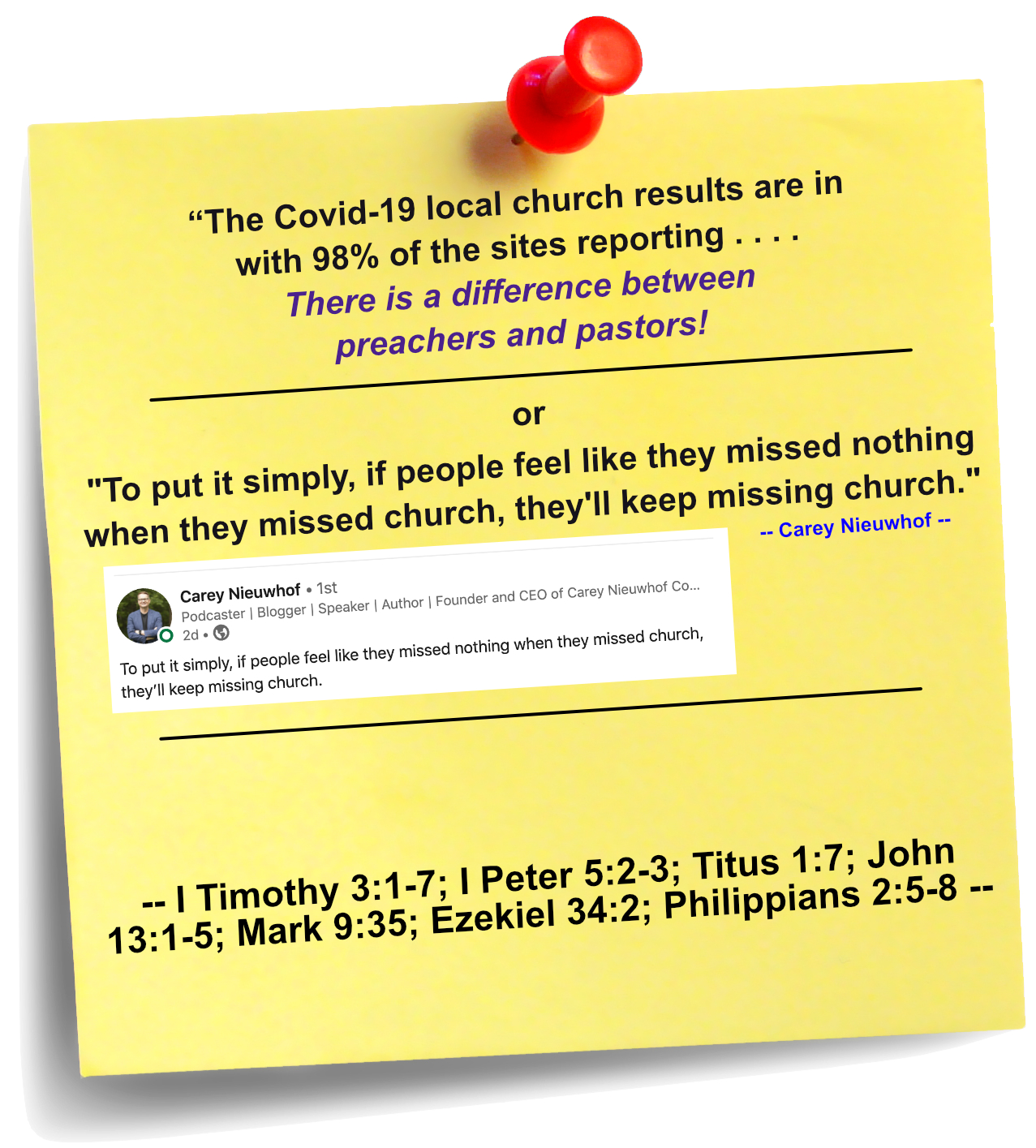
no-shameJust got a phone call from a church member who was sent a personal, handwritten note from a local church ministry.  They were surprised —  because their pastor had not even made one phone call to their home, or to any of their family members since “March” — the BEGINNING of the COVID-19 crisis in America.

Now, a handwritten envelope, with a handwritten note inside, arrives in their mailbox. It states that they would have liked to stop by and even visit were it not for the situation that church ministries face. If they are interested in having them personally visit, the church would be willing to come by and visit safely and cautiously.

The sad and distressing reality is that far too many pastors across America have failed to pass the test they were faced with this year.  Ask people yourself!  See if you do not hear the same response — “Nope, my pastor has never “called” [1] me to see how we are doing or to pray with me/us.” [2]

“F” Is For Failure ! [3]

√  Failed The Test — not because they lacked the time to adjust — most all would dismiss any charge of neglect during the first “14 Days To Flatten The Curve.”  It has been almost 10 months!

√  Failed The Test – not because someone from the church had not called [1] — though some have not heard from anyone on the church staff.  Praise the Lord; someone cares because it is about genuinely caring!

√  Failed The Test — because the lead or senior pastor has not shown any personal interest in “calling” [1] each and every member and friend of the local church ministry!

√  Failed The Test — because the lead or senior pastor passed off that responsibility to other pastors.

√  Failed The Test — because the lead or senior pastor passed off that responsibility to the “deacons” and excused themselves out by such a move.

√  Failed The Test — because the lead or senior pastor is “tone deaf” as to the message he is sending by thinking that the deacons and/or other church leaders can do what he should be doing, and alone can be accomplishing, as the shepherd of the flock.

√  Failed The Test — because the lead or senior pastor has the disrespect to argue that an email or text message is personal and meaningful. [4]

√  Failed The Test — because what is said about family, love, care, compassion, and genuine concern stand in deep contrast to the reality of pastoral failure in 2020!

Oh, by the way — the personal, handwritten letter which showed up in the mailbox of that member of a Bible-believing church — it was sent by the Jehovah Witnesses — They will figure it out even though pastors can’t won’t. [5]


1. Let’s even include in “calling” the sending a personal, handwritten note.  Let’s include  loading a few lawn chairs into the trunk of the car and visiting on the front lawn. Let’s include in the word “calling” sending over a door-dash meal with a personal note.  Let’s include dropping off / handing them a dinner, dish, or a dessert.  Let’s include sending a spiritually directed book to read during these days of seclusion.  Let’s include a “zoom visitation meeting” for those who want to and can participate.  Let’s include . . . .  Let’s include . . . . . Let’s include. . . . Oh, there are ways! —  Many ways — if there is a will!

2. But be reminded that attending “prayer meeting,” “men’s prayer breakfast,” the Sunday morning prayers, and prayer as a personal and spiritual discipline is important!

3. Perhaps I am being too harsh in my grading — for some, I should raise it to a “D?”

4. “Better than nothing” is all it can be claimed as being.

5. “Won’t” not “Can’t” because there are ways, but it takes genuine concern and care, along with some thinking and denial of self-serving activities.  Watching and reading about the political issues of the day at night, rather than making some meaningful and personal calls from the comforts of home in the evening is a choice!

Is There No Shame!:  There is a loss of “shame” in our culture and society.  That is not only witnessed by what is happening in the political world, but in the life of the church.  Is there no shame!

Oh, did I tell you my pharmacist called us again THIS WEEK! — December 18, 2020

FOB: Who Is The Person Responsible For It!


FOB freight. . . . . .

For domestic shipments, there are three key documents to be aware of: the bill of lading, the freight bill, and the Freight On Board (FOB) terms of sale. 

. . . . . .

. . . . . .

. . . . . . . 

“The acronym FOB, which stands for “Freight On Board,” is a shipping term used in retail to indicate who is responsible for paying transportation charges.

It is the location where ownership of the merchandise transfers from seller to buyer. The seller pays the freight, and the buyer takes the title once it’s been shipped. The buyer pays the transportation costs from the warehouse or vendor to the store.” Link

♦♦♦♦♦ ♦♦♦♦♦ ♦♦♦♦♦ 

One of the most important aspects of FOB terms is that it helps determine which party owns the freight while it is in transit. If the freight is damaged or lost, the insurance policy of the owner is in effect. Thus, it’s important to be clear about the terms and know who is responsible for the shipment at every stage of its journey.  Link

♦♦♦♦♦ ♦♦♦♦♦ ♦♦♦♦♦ 

. . . . . . . 

While there are pastors and preachers who would like to pass off responsibility for the effectiveness of the message, the reality is — They bear the burden!

You’ve heard the excuses . . . . 

  • “I just preach the Word.  It is up to the Holy Spirit to convict and apply it.”
  • “If you don’t like what is said, take it up with the Lord!”
  • “Like Paul, I don’t come with persuasive words.”
  • “Our calling is not to eloquence, but to truth-telling.”
  • “Jonathan Edwards read his sermons to the congregation.”
  • “I’m just the preacher.”
  • “If you are not getting anything from the sermon, maybe it is you!”
  • “People don’t want to hear the truth today.”
  • “It’s not the transmitter — you need to turn your radio on the right frequency!”
  • etc . . . . . . . etc . . . . . . etc. . . . . 

Yes, there is a modicum of truth in those statements, but only a smattering.   

Passing off the responsibility to the listeners, who have voluntarily and repeatedly come to hear the Word of God preached, hardly qualifies them for being rebuked as unwilling or unreceptive listeners.  “Sinners” — Yes — But sinners who deeply want to live for Jesus! “All” — “No” — But most all are in the battle to be more and more like the Lord.

The unwilling or unreceptive
are those who are still “at home in bed” on Sunday morning!  

Those seated before the preacher on a Sunday morning
have chosen to be there,
even after hearing the preacher preach “week after week!”

. . . . . . 

The simple reality is . . . .

√  You are the preacher-teacher!

√  You claim to meet the qualifications of that position, of which one of them is “apt-to-teach.”

√  You claim that you are worthy of attention!  “Above reproach” and/or “blameless” is another biblical qualification, which makes you worthy of the interest, attention, and receptivity of the congregation.

√  You prepared and delivered the message . . . AND you should shoulder the overwhelming responsibility for its effectiveness in the minds, hearts, and lives of God’s people!

√  The hearers didn’t choose the words, the organization of the content, or the presentation’s non-verbal elements. You did!

√  AND . . . . you were given the freedom to set aside secular employment in order to have a significant and meaningful portion of “40 hours” [2] to prepare — AND maybe for only one message a week!

. . . . . . 

Sorry, the sermon is FOB. 

While the “freight” is God’s truth, you are the one who is transporting it! 

The party which has possession of the “freight” in transit, from the study to the pulpit, is you.  If the “freight” is damaged or lost in transit, it is important to know who is responsible for its shipment! 

That would be YOU!

The message is being delivered by you, after having been given hours of “freedom from the secular,” in order to work on how best to transport it most effectively.

The recipients have paid all the charges for its final delivery. 

How it arrives at the “dock” for pickup was determined by your choices.  You decided on the options which were available.  You determined on how to present it, illustrate it, clarify it, say it, and apply it.

The “freight” was given to you, and you must now transfer it to the congregation. They are there to pick it up!  The condition of the “freight” upon their arrival is your liability! 

“Apt To Teach”
“for the edifying of the body of Christ”

Take Responsibility For The Freight’s Delivery!

. . . . . . 

While some preachers-teachers fail to edify the saints (which they have been gifted to do, if indeed they are supposedly called to that position), they continue to occupy those positions of utmost importance.

It is of utmost importance because it affects determines the health of the believers, the ministry of the local church, and those who are lost. Those who are lost but occasionally saunter in to listen to the message — especially during various special events such as Christmas, Easter, a baptism, a child’s dedication, Mother’s Day, etc. [3]

Isn’t it strange that rarely is a preacher-teacher asked to step down from the pulpit ministry because they fail this requirement, the biblical requirement, of “apt to teach? [4]

. . . . . . 


Other Information & Links: 

1. the bill of lading

2. I am assuming (and it is a flawed assumption) that most members of the congregation only work a 40 hour week. They probably work far more and that does not include travel time.

3. I am glad that salvation is based on God’s calling, else some preacher-teachers during this Christmas season would be the ones responsible for the lost who come to listen and hear little-to-nothing that can or will challenge their minds, hearts, and will. Fortunately, the salvation of any individual is not in the hands of men!

4. Let’s get all excited about “Beth Moore” and/or the subject of “women preachers,” because it violates the Scriptural qualifications. However, let’s not address the qualification of effectiveness in preaching. If a preacher-teacher is hard on the listeners, mediocre-to-terrible, fails to grow and develop into an effective biblical communicator, and/or the minds, and the hearts, and the lives of God’s people are not being meaningfully challenged, such preacher-teachers have not been called to the pulpit ministry. They may well have a role in ministry, but not in the preaching-teaching ministry.

Preachers-Teachers have a responsibility to not only what the Bible teachers, but to constantly improve their ability to communicate. That requires more than the study of the Scriptures. Taking time to think through how communication works if foundational to becoming more effective. The alternative is remaining in a “homiletical rut.”

The Repeated Pattern of Wrong-Doing In Ministry

a patternIt only takes a cursory reading of ministry wrong-doing to realize that there is a repeated pattern — in fact there are several obvious patterns.  

√  One pattern is the use and abuse of God’s people.

√  A second pattern is the abuse of biblical truths and principles which are invoked to conceal, not shed light, on wrong-doing and wrong-doers.  The most abused passage of Scripture is Matthew 18.

The third pattern is stated by John Dickson, representative of RZIM in Australia, who just resigned.

…….

…….

Here is what Dickson said . . . .

“Back in 2017 the sexting allegations were explained away to me, by senior leaders at RZIM, as malicious and entirely false.

I believed my friends.

I just believed them. I guess I wanted to believe them. I didn’t even think to dig up the court records for myself and scrutinise any inconsistencies in what I had been told.

I somehow didn’t think through how inappropriate it was for the Zacharias family to impose a non-disclosure agreement on Lori Anne Thompson.

I defended Ravi to all who criticised him, even after his death in May.

And even when the spa allegations came out in September, I still kept on saying to critics who asked my opinion, “I fear the worst, but my personal knowledge of Ravi makes it hard for me to accept the allegations, and my trust in the organisation gives me confidence they will pursue the truth above all else.” I’m not able to say that anymore.”

…….

…….

Here is what account after account of ministry wrong-doing repeatedly demonstrates when it comes to the fellow leaders, board members, administrative personal, staff, or pastors.

  • Wrong-doing explained away.
  • The defending of wrong-doing and/or wrong-doers,
  • over a period of time
  • by those who do not want to believe what has actually happened,
  • to a fault,
  • to a shameful fault,
  • even after another example is provided,
  • because of a personal and experiential knowledge — which is contrary to how they have been treated and dealt with in that ministry.

Lesson Learned! 
Probably not!

…….

…….

lessons learned gif

The Unforgivable Sin In Pastoral Ministry

sinking shipAs we all recognize, there are different ways to lie . . . . .

√  To make a statement which is factually not true — It does not comport with reality. We do not need many or any examples of that in these final weeks of an election.

√  To misrepresent the details and facts — Technically, it may be true, but it is represented in an inaccurate way. He made that comment, but what was said before or after was purposefully left out because it would fail to support what we are claiming was said. A half-truth is a misrepresentation, though not a factually untrue statement.

√  To purposefully distort the details and facts — The details and facts of a situation, conversation, or event did happen, but not as stated. It has the sound of truth because many details are included, but not as constructed or stated.[1] Some of the details may even have been omitted — “What they did not tell you was . . . . “

√  To make nuanced statements —  One uses a particular word or phrase, which deceptively makes it true. The purpose and hope of using that word or phrase is to give an impression that is not true. The statement is said in such a way as to imply what is not true. [2]

√  To make a promise, and then not fulfill that promise — Every parent has felt that responsibility. “Dad, you said you were going to take me to . . . on Friday.” [3]

√  To deceive, misdirect, obfuscate — There are ways to deceive, while not outright lying. “Did you break that vase?” Response: “What vase? Was a vase broken?” No one said that they did not break the vase, but they mislead. To distract, muddy the waters, or divert attention to something other than what is at issue is to deceive.

Whether it be a blatant misstatement of the facts, distortion, a nuanced statement, misrepresentation, omission of details, obfuscation, diversion, misleading, deceiving, or a broken promise, etc . . . .  all are included in the meaning of the ninth commandment which is typically stated as — “Thou Shalt Not Lie.”  We are called upon to be “truth-tellers” (Ephesians 4:25 and many other passages!).

♦♦♦♦ ♦♦♦♦ ♦♦♦♦ ♦♦♦♦

All Things Church:  One of the most serious deeds that a ministry, local church, or pastor can be found guilty of is dishonesty!  When confidence in what is being done or said is lost, so is the effectiveness and future of that ministry or leader!

Lying By Leaders:

To purposefully cover-up information which if “the church” were aware, they would demand serious action be taken.

To suppress information from the congregation which is their right to know and would help them make informed decisions.

To make nuanced statements which may be “true” technically, but mislead the listeners to believe other than the truth of a situation.

To shield, shroud, blurr, or cloak financial information from the governing board or congregation.

To twist the Scriptures in a way that it supports or argues for what the Lord never intended it to say.

To argue for the need of appropriate caution and privacy in revealing the details of a matter, when the reality is an attempt to conceal one’s own wrong-doing in the handling a matter.

To create the feeling that all was, or is being done, honestly, above board, and/or transparently.

To play down the seriousness of wrong-doing by euphemisms or less than accurate terminology.

To give the impression that the ministry leadership knows and/or supports a decision or action, while knowing that they are seriously divided about it.

To fabricate a Matthew 18 case in order to silence criticism, disagreement, or controversy, or in order to dismiss a legitimate (or illegitimate) critic.

To assure or influence a board or congregation by misdirection or distraction concerning the real issues at hand.

To engage in “ministerial exaggeration” or “fudge on numbers”, in order to give an impression or to make an impression.

To actually plagiarize sermonic material. [4]

………

Ministry leaders and pastors, you cannot make a mistake on the issue of honesty!  Your entire ministry and influence depends on being a truth-teller!

Everything in the conduct and effectiveness of your ministry depends on your honesty.
Yes, EVERYTHING!

………

God’s people (and the lost world) can handle listening to a mediocre sermon. 

“The church” will accept uninspiring or poor leadership.

But what God’s people (and the watching world) will not and should not tolerate
is a lack of honesty!

Lying is almost unforgivable by a pastor!

………

………

………

It Will Sink You!

sinking ship


1. Many bills that go through congress are a cabal of different lesser bills included to garner support for the main bill. When you vote for or against the main bill, it could be said that you voted for or against this-or-that (the lesser bills), only because you voted for or against the main bill. “Yes, I did vote for the discontinuation of benefits to the “arts” because I voted for the $1,200 stipend for all Americans

2. Uh-Oh — but here goes — “I am not banning fracking.” “Not ban” implies that fracking on public and private lands will not be banned. If it is then banned on public lands, and only allowed on private lands, the statement is true, but only true because the statement was nuanced.

3. Another Example: If an individual states that your conversation is “off-the-record” and then shares that conversation with others, that individual has lied to you. He broke a promise and lied to you!

4. I say “actually plagiarize because there are many words, ideas, statements which have and do float around the Christian community whose source is unknown, and are quoted by speakers and preachers.   For instance — The laws of sowing and reaping.  Many books and commentaries are used in sermon preparation which provide ideas, thoughts, and statements which help in creating a sermon.  However, taking a sermon “carte blanche” or anything close to that is lying; it is plagiarism and unethical!

i.e.  — Recently, Vice President Pence stated . . .  “You are entitled to your own opinion, but not to your own facts.” (originally by President Ronald Regan), and was accused of plagarism.  VP Pence was not implying that those were his words.  Rather, most were well aware of those quip.

The Most Consequential Decision A Ministry Can Make!

3D white people. Stopping a chain reaction of dominoes fallingOne of the most consequential decisions or far-reaching actions a Christian ministry or local church can engage in is the . . . .

– firing of an employee

– dismissal of one of its members

If you don’t believe that, then you have not gone through that experience yourself.

If you don’t believe that, then you have not watched one of your children navigate those converging white-waters.

If you don’t believe that, then you have never experienced or watched the spiritual, emotional, psychological, and social turmoil these white-waters set into motion.

These two experiences will spiritually and emotionally strain and test every part of the “raft’s” integrity, AND . . . there are usually others in the “raft” along with them . . . also struggling!

whitwaters raftingThat is precisely why both the exclusive exercise of administrative power in the firing of ministry staff-employees, and the exercise of church discipline against a member of a church fellowship is so consequential and weighty! 

That is precisely why “the church,” in God’s wisdom, must be involved in any such process and/or action.  

There are few, if any, other church decisions with more far-reaching impact on the individual(s) involved, along with its impact on . . . .

  • other family members
  • friends & friendships
  • church relationships
  • a pastor’s personal integrity
  • the church’s officials & leadership
  • a local church’s reputation

That is why when “the church” body is excluded from or denied a meaningful involvement in these decisions, “the church” experiences considerable disruption!

Obviously, one can point to “outliers” when it comes to allowing for a meaningful involvement by “the church.”  Those “outliers” or extreme cases are typically and disingenuously cited to argue for unwarranted secrecy.  That is the repeated pattern for how ministries explain the obscuring of their decisions and actions.

The “outliers” should never be justification
for denying what ought to be
the usual and commonplace practice of
transparency, equity, and honesty! 

When “the church” is excluded from or denied some level of meaningful involvement, it is a blatant violation of the words and spirit of both the covenant relationship between the membership, and the many passages regarding handling people in the body of Christ.

When “the church” is excluded from or denied some level of meaningful involvement, it also violates the words, spirit, and purpose of all the steps laid out in Matthew 18.  What you will find in example after example of “power gone awry” in ministries and churches is the abuse and misuse of Matthew 18.

Allowing these kinds decisions to be made by a pastor(s), or by a select group of individuals is to potentially and/or administratively sow disunity.  It should be pointed out that when such decisions attempt to provide cover from congregational awareness, the disunity is sown by those who purposefully and unnecessary conceal “the story” behind such actions.

Excluding “the church” body in these decisions creates an atmosphere where members of the church refuse to buy-in to actions of those who have bypassed them.  Failing to allowing for a meaningful time of questions and answers during an all-church business meeting, before such actions are taken, and only upon the majority vote supporting such actions, is to potentially stir up the waters of confusion and/or discontent.

The wake left behind can be devastating – both unfairly, as well as deservedly.

Unfairly criticized when the action is correctly based, has scrupulously followed the biblical steps, and the participants and their actions are willing to stand up to examination.

Deservedly criticized, when there is an indecent basis for even starting such action, a sloppy and/or unbiblical process, and participants who will not or cannot respond to fair scrutiny.

All too typical is the charge of “sowing disunity” against those who legitimately seek answers and expect leadership to be honest and accountable.  The charge is leveled against those who have been ill-served, uninformed, and denied the opportunity to genuinely and meaningfully hear and ask questions.

When there is an appropriate basis for a staff member’s firing, or the exercise of “church” discipline against a brother or sister in Christ, there must be carefully followed biblical process, that can stand up to the fair scrutiny by both the person fired or disciplined. The process must be clear and seen as legitimate, not marked by confusion, murkiness, and/or  unanswered questions. [1]

Anything short of working through a honest and open process when firing employees or exercising church discipline in a fair, consistent, transparent, and biblical way reveals leadership’s woeful lack of grasping the gravity of these actions.  It reveals that they have never navigating a “raft” in such relational “white-waters” — personally, or alongside one of their loved ones.

Without such a process, leaders may decry the unrest, dissatisfaction, and discord, but the leaders who denounce the discord have created it.  They ought to be held to account for their failure to grasp and demonstrate the weighty and consequential nature of their unbiblical process and their inappropriate concealment and actions.

♦♦♦♦♦ ♦♦♦♦♦ ♦♦♦♦♦

Pastors & Other Church Leaders Invite Discord!

Pastoral Staff: It is “the church” which has called a pastor to serve in their ministry, regardless of any recommendation of a selected search committee, a deacon board, or a lead pastor.  It is the church that has taken on the financial responsibility of its pastors.

It is NOT the lead pastor or officials of the local church who call an “assistant-youth-associate pastor” to that ministry.  Nor is it the lead pastor and/or selected officials who financially support them. It is “the church” who recognizes a pastor’s call to their ministry and provides the financial wherewithal to fulfill that calling! [2]

And rightfully, it is the ultimate and sole responsibility of the church to dismiss-fire them — based on its operational needs or for just ethical cause.

To by-pass the congregation in dismissing or “firing” of a member of the pastoral staff is to potentially invite and even provoke bitterness and division into the church!

When doing otherwise . . . .

Pastors & Leaders
are potentially inviting and even provoking
bitterness and division into the church
.

♦♦♦♦♦ ♦♦♦♦♦ ♦♦♦♦♦

Church Members: When pastors and/or church leaders have the authority have taken the authority to dismiss members of the church, they are the individuals who are sowing and scattering the seeds of discord in the local church!  They bear the responsibility for church division — and all of its effects! The covenant relationship of any and all members is with the other members of their church.  Their covenant far exceeds any individual(s) or select groups of individuals!  Their covenant relationship is far beyond a pastor or any select group of individuals within the church body.  It clearly is not within the biblical purview of the role and responsibilty of deacons — Acts 6.

When doing otherwise . . . .

Pastors & Leaders
are potentially inviting and even provoking
bitterness and division into the church
.

♦♦♦♦♦ ♦♦♦♦♦ ♦♦♦♦♦

Whether it be employees or staff members of a ministry, or the people who have joined a fellowship of believers, none have given up the right to be treated appropriately, rightfully, transparently, and fairly by a ministry.

When doing otherwise . . . .

Pastors & Leaders
are potentially inviting and even provoking
bitterness and division into the church
.

Over the years of teaching, pastoring, and ministering, I have been taken back, saddened, and yes — provoked by the way faculty, staff, volunteers, and members of a church ministry are handled and mishandled! It reflects a defective or wanton unawareness of the impact on people. “People” in the plural!– Not only the one(s) being disciplined, but the family, his-her friends, fellow-workers, and other members of the church body or ministry.

Calling up “outliers” to excuse, justify or exempt pastors and leaders from an open, honest, fair, and transparent process carries the same odor found in the world of politics.  Decrying what happens in the political world, while engaging in the same unfair and secretive methods, which equally deny equity and accountability is taking hypocrisy to the most egregious levels — “Egregious levels” because it is in the church and by its very leadership!

♦♦♦♦♦ ♦♦♦♦♦ ♦♦♦♦♦ ♦♦♦♦♦ ♦♦♦♦♦

That Is Why
It Is & Must Be “The Church?”


Because Firing & Dismissing People
Is One Of
The Most Consequential Decisions
A Church Body Can Make!


[1] The Possibilities:

1. Legitimate & Clear:  At times, that process is uncomplicated because the reason for firing, or the discipline “trespass” is legitimate and clear. The wrong-doing is uncontested – For instance, the individual has been in involved in sexual immorality. Typically, he/she is not disputing the general “facts” of the situation.

An opportunity for clarity, any needed explanation, expressions of repentance, expressions of understanding as to the actions being taken, disagreement with such a decision, corrections to the record as to what did and did not occur, etc. still need to be offered and provided.

Guage Agenda biblicallyWhen a member of “the church” cannot even state the reason behind the firing or the dismissal of a brother or sister in Christ, no less with any clarity, that is an obvious indicator that the process has been agenda-driven, not biblically handled.

More On “Legitimate:” The distinction is to its opposite = “fabricated. “Fabricated” can include an accusation that has no basis in fact, or an attempt to make something a Matthew 18 issue which has no Scriptural basis for resulting in ex-communication. Rather, Matthew 18 has been weaponized to control legitimate dissent or calling-out the sinful decisions or conduct of another.

Misguided and persona-driven church leaders too often cite an ethical violation as justification for firing, while having allowed far more serious ethical misbehavior to go unaddressed.  Or it happens by misguided and/or ego -driven pastors and leaders who call up Matthew 18 as a way to control the speech and criticism of the membership. The implementation of Matthew 18 then becomes a means for controlling any legitimate criticism by the membership.  It can be used and has been used to put other members on alert that if you disagree, seek explanations, ask questions, challenge decision, and/or call-out wrong-doing, you too may be threatened with such actions.

Dissent or disagreement is viewed and spoken of as disloyalty or “sowing discord.” An underlying fear of questioning or disagreeing is generated. Members may be formally removed from church life, or “God will visit His judgment on this-or-that person or group if you ‘touch the Lord’s anointed.’”

2. Unfounded Or Disputed: At other times, the “truth” and/or “facts” of what happened are disputed or perhaps even unfounded. The two parties have different “stories” – and I mean “stories” in a good sense. The stories are divergent enough that “the church” is called together to hear the “facts.”

NOTE: When the person who is fired, or in the case of church discipline the offended and the offender are at loggerheads, and one of the parties is unwilling to “tell it to the church,” there still should be the opportunity to hear the party which is willing to or interested in laying out his account and his-her perception of what has taken place.

To deny a willing party to “tell it to the church” is to misunderstand or purposefully discount the gravity of the process thus far, and into the future, on that person and others.

3. Fabricated: At other times, the so-claimed reason for firing, or the “trespass” is fabricated – bogus – biblically unfounded as a basis for firing or ex-communication.

It is the real possibility of such a potential meeting with “the church” that keeps everyone honest. When a meeting with “the church” is circumvented, short-circuited, or denied, all kinds of so-deemed causes for firing, or charges of “a trespass” can be unfairly hidden and/or fabricated.

[2]. Another discussion can be had regarding those who are hired internally — church office staff, professional Christian school teachers,  and the like.

I would still maintain that when doing other than providing an open, honest, and transparent process  . . . .

Pastors & Leaders
are potentially inviting and even provoking
bitterness and division into the church
.

///////

“Deacon”: Sorry, That Definition Has Already Been Taken!

cher finger on scale

“Wait On”
or
“Weigh In On”

////

///////

///////

What Are The Dynamics Operating?

Authority and power are rightfully invested in leadership ranging from the secular to the sacred, from presidents of Christian institutions or a local church pastor. As with any effective organization, it is foundational and necessary that there be leadership, and leadership, which has authority. That truth is seen on every level of society worldwide. All manner of organizations exemplifies it — from evil (Al Qaeda) – to – righteous ( Samaritan’s Purse) — and every kind of organization in-between.

The need for leadership is uncontested by sinners and saints. What is often at issue is not authority, but accountability. “Accountability” is where the discussion on authority all changes. The issue is not the need for leadership, but “accountability.” Few dispute the need for strong leaders and agencies that protect American citizens’ security, but there is much dispute because of such leaders’ lack of accountability. It revolves around the improper use of authority, and/or even moves into the realm of the “corrupt” use of authority.

You have probably heard individuals in the political world say, “I take full responsibility for what has happened.” As we have learned, that means nothing. There is little to no accountability in the world of political power. That lack of accountability is what corrupts all kinds of institutions and levels of power! Anyone who does not acknowledge that reality has not read about Falwell Jr., James Mac Donald, John Ortberg, Tullian Tchividjian, Ravi Z., or…or….or…or. One only needs to read the accounts reported by Julie Roys just in 2020.

Once someone gains power in a broken system, then, they enter an elite subgroup within that system. Their fellow power-holders will do everything in their power to protect them. (This is why it was so important that Ortberg and Strobel spoke out against their former master Bill Hybels. It’d become perfectly safe to do so. He was radioactive by then, impossible to help or save. )

“A broken system contains almost no provisions for reining in wrongdoers or removing them from power — because then all of these power-holders’ positions would land on the chopping block. None of the leaders in these systems really deserve to be there, and most of them behave in ways that would get them instantly removed from power in more functional systems. Not so, in broken systems.

Perhaps Ortberg sought counsel, but if he did, the counsel was misguided or went unheeded. If the counsel came primarily from loving friends, did their love discount the severity of the danger? Friendly counsel often supplies more support and even rationalization than the confrontation and rebuke that may be required. This is why I think it’s always good to check in with a few detractors. They care less about your feelings and tend to shell out truth with no sugar (another reason to love your enemies—Luke 6:27). — CToday on John Ortberg

♦♦♦♦♦ ♦♦♦♦♦ ♦♦♦♦♦ ♦♦♦♦♦ ♦♦♦♦♦

//////

What are some of the dynamics
which play into this lack of accountability
and even blight decisions-making and actions?

//////

The Number #1 Dynamic:
Number one, and number one in its causality, is the structure of leadership within the local church. “Church polity” is a structural element. Tell me how your church governs its affairs, and I can likely forecast where the problems will occur.

Church governance is so foundational that churches are even defined by their “polity” . . . .

  • hierarchical
  • single elder
  • plurality of elders, or
  • congregational rule.

The decision-making process, vision (or lack thereof), outreach, evangelism, hiring (or firing), staffing, salaries, direction, and the handling (or mishandling) of “people problems” all change based on which form of government is followed.

However, even within those basic forms for church government there are variations. Those variations revolve around the “power-dynamics” which are also at play. For instance, even in congregational church government, where the power is centered in “the church” body, that may not be the reality of the situation — and we are all well aware of that fact.

Some “congregational rule” churches are pastor, or deacon, or long-time family, or pastor-deacons, or pastor-deacon, or long-time clique run.    The power structure in place generally determines . . . .

  • What happens and does not happen
  • What is allowed and what is not allowed
  • What is promoted and not promoted
  • Who is in and who is out
  • Who is employed and who is not employed
  • What the salary is or is not
  • Who is disciplined, or (more likely) who is not
  • What can be said, and what cannot be said
  • What missionary is and what missionary is not supported
  • What ministries are important and unimportant
  • etc . . . . . etc. . . . . [1]

Sadly, that is more often true than we honestly want to acknowledge.

However, not acknowledging it leads to its continuance.  It does not lead to a healthy church, or needed healthy change.

Where some of the change needs to begin is with a proper understanding of the role of deacon. Deacons may see themselves as the co-leadership team within the local church. They see themselves, along with the pastor, as co-leaders of the church, its ministries, and the policy decisions. In such a situation, it is the deacons, along with the pastor(s) who are the final gatekeepers of the church. Most all, and maybe all, actions, decisions, policies, changes, direction, finances, salaries, officer selections, etc. are filtered through them. [2]

waiterIn contrast, Acts 6 establishes them as servants of the church, dealing with the temporal life of “the church.” They were selected to insure fairness and equity in the distribution of the resources. Their activity was separated from that of the apostles, not connected to the apostles’ work and ministry.

And if Stephen is a biblical example of what it means to be a deacon, being a vocal Gospel witness is one of the primary traits of being a deacon. The reasons for the spiritual qualities stated I Timothy was their biblical knowledge and their boldness to speak the Gospel — as did Stephen.

Sadly, we do not even hold up that expectation and requirement very highly (as demonstrated in Stephen’s life). What deacon do you know who has a testimony of sharing the Gospel week after week? I’m not speaking of results, but passion!

If they are not doing that, or doing that poorly, surely, thereis no reasonable justification for allowing them to make any recommendations, or allowing them to share their thinking and vantages with the pastor(s). I might suggest that if the deacons are not serving and are not passionate about sharing the Gospel, they have no reasonable right to be part of the decision-making process. Bad decisions come from those who don’t know God’s people and their needs. A weak sense of direction comes from those who are not personally involved in sharing the Gospel with those who need Christ! Start sharing the Gospel, and as a deacon, you will not only support the church in its outreach, but you will be urging the church to do more to reach those who need Christ.

Nevertheless, there is no biblical support for the deacons being anything more than “servants” who address the church’s temporal needs and issues (Acts 6; I Timothy 3:8) and a passionate vocal Gospel witness. Their qualifications for office match their responsibility as caring people-persons/servants and “evangelists.”

There is nothing in the Scriptures that supports the position that deacons are an official or unofficial decision-making body that discusses, evaluates, or recommends actions and/or policies to the church body. That is also why some churches and/or pastors see the “deacons’ role” as what others would call “trustees,” dealing with the ministry’s physical needs.

Interestingly, most pastors recognize and acknowledge that deacon’s primary biblical role is that of a servant — not a decision-maker. One of the proofs of that is the adoption of a “The Deacon’s Caring Program.” That program is a decades-old program that sought to get back to that recognized biblical position. It made its rounds across the church spectrum. It was headed up by and taught by Howard Bixby (Haven’t heard that name in a while.).

Obviously, a pastor can listen to any group of men (and women –“even so must their wives”) he wishes to for advice or vantage. He can meet with, talk to, and ask any individual or group for their viewpoints, opinions, or final judgments. But in the end, the deacons’ biblical role is “serving” God’s people in making sure the needs of God’s people are addressed in an equitable manner.

I am not here to argue elder rule versus congregational rule.  Nevertheless, churches which operate with an “elder rule polity” again make the argument as to the biblical role of deacon.  The obvious and clear biblical role of deacons is precisely why some churches and pastors adopt the polity position of “elder rule.”  Biblically, they do not see the role of the deacon as part of the church’s leadership. They sincerely believe that the decisions of the church are not part of the responsibilities delegated to the deacons or any other individual or group. Instead, they see the church’s leadership and decision-making to be the primary, if not sole, responsibility of the “elders.”

Let me frame the argument another way. If the pastor were to set up an “Org-Chart,” would he place himself under the deacons, or under the Great Shepherd? That establishes the fact that most pastors, if pushed to express their actual position on the role of deacons in the local church, would conclude that the deacons are not a decision-making body.

I well imagine that I can not reverse the decade’s old practice of allowing the deacons to be part of the official decision-making process — since Howard Bixby never accomplished that goal after decades of making the biblical argument, neither can I. I am fairly certain that I will not be able to persuade the deacon board to relinquish their role and power within the local church willingly.  I have little hope that most pastors will abandon a pastor-deacon decision-making polity.

Nevertheless, continuing to allow the deacons
to be part of the church’s leadership,
or party to the officially or unofficially leadership decision-making process,
has significant implications for church practice, decision-making, control, and operation.

Example: The Matthew 18 process involves three to a maximum of four people only [3], and then the third party, identified as “the church!” There is no basis in word, spirit, or biblical principle to insert those serving as deacons into this three-step process [5]. These “servants” are not biblically designated to be grand jury members recommending an indictment, nor to be adjudicators of a matter. Inserting the deacons into the church discipline three-step process creates a deeper and more dangerous power structure within the local church.  Why?  Because now we are not only dealing with the nature of membership, but the subtle control of God’s people.

The fact is that the deacons have no biblical or Scriptural part to play, or authority to exercise, in that process. There is nothing in the Scriptures which inserts them into that process, or any other process other than serving the physical needs of “the church,” and a passion for evangelism.

Let me accept reality. I understand that most congregational ruled churches operate with a pastor-deacon leadership structure. In most cases, the group “pastor-deacons” is the official and/or unofficial decision-making body ahead of “the church.”  Nevertheless, the potential for problems occurs when the deacons see themselves as anything else than the representatives of “the church.” They are not the pastor’s deacons; they have been chosen by “the church” to represent their best interest! They are there representing their brothers and sisters in Christ.

To allow any action to move forward, to permit decisions to be made without a sincere and meaningful input from the fellowship of believers, to disregard the thoughts and thinking of the brothers and sisters in Christ who they serve, is indicative of just such a grave misunderstanding of what their role was in Acts 6 — servants of God’s people, who are there there to promote fairness and equity.

The misuse and even abuse of position and power are incredibly substantial when the deacons see themselves as anything else than the representatives of “the church.”

They are not the pastor’s deacons; they have been chosen by “the church” to represent their best interest! If they see themselves as the protectors of the pastor(s), or the hedge between leadership and those in the pew, the situation is exponentially even more problematic.

What is Scripture’s Definition Of “Deacon?”

Screen Shot 2020-10-14 at 11.59.06 AM


No one gets to pull out their “Bible Dictionary”
and redefine “deacon.” 
Sorry, that term is already taken and defined by the Lord.

///////

//////

An Even More Menacing Situation:

Add to that — the very real possibility — that if the deacons are complicit in any wrong-doing along with the pastor(s), the likelihood of successfully calling-out that wrong-doing or the wrong-doers actions is near nil. Just as in Acts 6, it was a confidence in the first deacons’ fairness and equity, which gave God’s people assurance that there would be a “godly-just-appropriate-resolution” of the problem.

Imagine a situation where the pastor(s) has been called out for wrong-doing, and for the sake of illustration the wrong-doing has indeed occurred. And for the sake of illustration, at least two people have made the same assertion as to the wrong-doing. Nevertheless, the deacons step in and summarily discharge the issue. I know that some might not be able to imagine such a possibility. But I can assure you that it happens.

That is the potential when deacons see themselves as protectors and not servants of God’s people. When they assume powers never biblical given to them, or are given the authority to operate as the decision-makers, or operate as the gatekeepers of the decisions, actions, and policies of “the church,” all kinds of confusing and upsetting dynamics begin to play out.

I have always been committed to “congregational church government” throughout my years in the pew and behind the pulpit. It is because I know that it is vital that pastor(s) answer to the people, and that the deacons are there to represent God’s people. In fact, when they fail to represent the people, I have called them out for that as well!

Without a check on power within the church, whether it be a check exerted by the deacon board in representing the best interest of their fellow brothers and sisters in Christ, and/or the check exerted directly by the congregation through genuine elections and free discussion and debate, the dynamics operating are menacing! [4]

The menacing currents which begin to operate in such an atmosphere can be even more damaging to a member(s) who is willing to call-out the wrong-doing of pastors and deacons!   The result — a conjoined or complicit defensive agenda may be put into place, in order to prevent “the church” from ever hearing the facts of the situation and/or wrong-doing!

It is unhealthy and pernicious when the deacons . . . .

  • assume authority, which is not theirs.
  • assume decision-making powers in place of the church.
  • have the authority to stop a matter from ever getting to “the church.
  • presume that they can operate unilaterally, without “the church.”
  • insert themselves into the three-step process of Matthew 18.
  • refuse to allow step three to take place = “tell it to the church.”
  • act as far more than servants.
  • not act as caring servants and “evangelist.”
  • think they are “the church.”
  • usurp the right and authority given only to “the church.”

They have then far-exceeded their right, authority, or position!

You are now approaching the “political elite” mentality who believe that they know better than the people — and worse — a corruption of the biblical process.

When this happens, a clearly worded biblical process is now usurped by preventing the church from hearing “what has taken place,” — from at least a different perspective. Only as God’s-people refuse to relinquish their right and responsibility to carry out the biblical process, will this kind of corrupt process be prevented and corrected.

When ministry leadership refuses transparency
and/or access to “the church,”
believe them.
As with most in power,
they do not want to relinquish
the power and authority
that they do not even rightfully or biblically possess.

♦♦♦♦♦ ♦♦♦♦♦ ♦♦♦♦♦

“Deacons”
were called to
Wait On
their brothers and sisters in Christ,
Not To Weigh In On
some of the most consequential decisions of church life.

The deacons are to model fairness and equity
in handling their brothers and sisters in Christ. 
To do anything less than that is to
break trust with God’s people!

♦♦♦♦♦ ♦♦♦♦♦ ♦♦♦♦♦ ♦♦♦♦♦ ♦♦♦♦♦


1. Some congregational ruled churches have no power to nominate its own church officers and/or deacons.

Some congregational ruled churches have limited ability to chose or remove a pastor, nomination a deacon, propose the support of a missionary, decide on the salary of its pastor(s), hire or fire staff — or to even know when or as to why, or meaningfully participate in any of the above.

2. Sometimes actions, decisions, policies, changes, direction, finances, salaries, officer selections, etc. never even get to the congregation if the “pastor-deacon gate” disallows it.  Some ministries control the information which is appropriately, necessarily, and/or is rightfully that which should be made at least available to the congregation.

3. I am taking the Matthew 18 scenario — I understand that it could involve more than two people if the offended and offenders are a larger group. One person who is the offended. One person who is the offender. One or two other people as witnesses in step two. The total is max four.

Obviously, it is possible that the deacons can become party to the dispute. They could be, along with even the pastor, called-out for wrong-doing. Then, they would be involved, but involved only as potential offenders or the claimed offended and therefore greater in number than max four.

4. I might make the easy argument that when a “the church” body is divided on this-or-that matter, and the deacons are united on the same decision, they do not reflect, and/or do not know, or haven’t spoken to, or are willfully ignorant of the congregation, or believe they know better than their brothers or sister who serve and worship with them.

Being A “Loss Leader”

Mac Donalds BBQLoss Leader: “A loss leader is a pricing strategy where a product is sold at a price below its market cost to stimulate other sales of more profitable goods or services. With this sales promotion/marketing strategy, a “leader” is any popular article, i.e., sold at a normal price.”

Mac Donalds introduced and just reintroduced the “McRib” as part of their menu options.  There are different vantages as to why Mac Donald is resurrecting the McRib, and why now!

One theory is that it is due to low pork prices.
√ Another theory is that they believe that they can make money for a limited period of time, until it peters-out.
The most accepted theory is that it is being used as a “loss leader.”

Many believe that it was reintroduced as a “loss leader” product promotion. It is being sold at a loss to lure customers into their stores, who will then purchase yet other items that yield a profit.

Key Words & Statements: (from the original article)

  • A “loss leader” is a product that costs businesses more to make than customers pay for it.
  • hopes that they will lure customers
  • Think of cheap printers that require expensive ink.
  • to get customers through the golden arches.
  • McRib just isn’t popular enough to be a full-time member of the menu.
  • The menu item makes money in limited runs, but becomes less valuable long-term. 
  • Any combination of these theories could be true. But the mythos matters more than the truth.
  • all of these guesstimations

Key Biblical Illustrative Thoughts::

  • temptation
  • long-term gains
  • short-term gains
  • long-term losses
  • willing to lose, to gain
  • the cost
  • popular / popularity
  • value / valuable
  • truth / myths
  • attracts
  • sacrifice

Sermonic Examples:

Businesses are willing to make no profit or even take a loss on the sales of a product to benefit in other ways. It is a sacrificial move. Just as there are sacrifice hits and bunts in baseball, the business world sacrificially offers products. Yes, these “business sacrifices” are self-serving, but not sinfully self-serving.

However, in the ministry, such sacrifices would be sinful. To engage in actions that are portrayed as sacrificial, while actually aimed at advantaging a ministry or an individual, is ungodly and shameful. Self-serving decisions are always sinful when it comes to ministry, serving in a ministry, pastoring a local church, or witnessing to those who need Christ . . . .

♦♦♦♦♦ ♦♦♦♦♦ ♦♦♦♦♦ ♦♦♦♦♦

Businesses understand that they’re ways to attract customers.  Do not think for a moment that Stan himself is not as shrewd.  Businesses know that if they can take advantage of a person’s desire to buy a product at a really low price.  They understand that the low priced items will lead to yet other decisions!  It is those other decisions that they are aiming at and seeking to profit from!

♦♦♦♦♦ ♦♦♦♦♦ ♦♦♦♦♦ ♦♦♦♦♦

At times in life, whether it be raising children, making family decisions, or reaching out to those who need Christ — you need to be willing to sacrifice, to forget what will be gained and look at it in the long-range.  The “Long Look” is what matters!  The men of this world are wiser than the children of light!

In ministry, forget calculating the cost and even the losses of this-or-that ministry, and begin thinking about the benefit to the Kingdom.  Yes, it costs dollars to cover the cost of the friends of your church youth, so that they can attend snow or summer camp!  But many of those friends have never attended a Christian camp. . . .

♦♦♦♦♦ ♦♦♦♦♦ ♦♦♦♦♦ ♦♦♦♦♦

Where are the “loss leaders” in ministry, as pastors, as leaders — who are willing to take the losses which come with serving in the local church.  With far too many pastors and ministry leaders, the ministry is really about them.  They lack the long-look!  They artfully encourage, or subtly suggest decisions which benefit them, not the people of God.  No — not “loss-leaders” but “profit-leaders” — seen in their disingenious agenda. Covid-19 has been a great revealer of that! . . . .

What Causes The Loss Of Your Platform

losing your platform.jpg  Losing Your Platform!

  1. A platform gives an audience a desire even to attend.
  2. A platform is your connection; it is why people listen & respond.
  3. A platform amplifies your message.
  4. A platform can be gained or lost.

The “Preaching Ministry” comes with certain stipulations.  One is that the congregation has called you to carry out the pulpit ministry.   Therefore, they believe that your words should carry meaningful weight in their minds and hearts.  In fact, by calling you as their pastor, they are willing to change their lives based on what you have to say to them as a spokesman of Scriptural truths.

Pastoral ministry is a position of influence.  A pastor has no power to force or demand change, but can only “argue” for change by a clear and effective understanding and application of the Scriptures.  A part of that “argument” is who is talking to them.  I would maintain a significant portion of the argument.  That would be easy to support by simply pointing out how people do not listen to and/or read the words of those who have lost all approbation and regard.  Whether it be a news channel or paper, opinion writer or commentator, theologian or pastor — people give their attention to those they respect.

That is why it is possible for a pastor to lose his platform!  It happens when he is no longer trusted as a preacher, or even believed as a reliable representative of Scriptural truth.  He is no longer considered trustworthy.

√ Sometimes this happens suddenly — i.e., Bill Hybels?

√ Sometimes this happens in a domino manner.  One domino falls, and that unearths another and another — i.e., Paige Patterson?

√ Sometimes this happens over a long period of time — The pastor dies from a thousand small cuts over time — i.e., pastors who are finally asked to leave after years of ministry, or have no real influence in the lives of God’s people.

I well imagine that there are various shades in between these three general situations.  Nevertheless, they all amount to this . . .

The pastor no longer has a platform.

The pastor has nothing to say to the people which has any real impact on their thinking and/or, therefore, their lives. There is no serious consideration of his words in regards to their lifestyle or their decisions. That lost influence becomes more and more apparent and prominent, both in God’s people’s lives and in the attendance and attention given to the services and preaching, respectively.

Recently, I was talking to a parent of teenagers who was upset by the personal decisions which the youth pastor had made.  The parent first made sure he understood what had indeed taken place.

The youth pastor had attended a secular rock concert which featured recording artist whose song lyrics were ungodly-to-vile. AND he had posted pictures of his attendance on Facebook (and thereby his enjoyment — since there were no words of unpleasantness or disgust). The parent spoke to the youth pastor and called up some of the lyrics and words of of the various songs and would not even repeat some of the lyrics.

Venture a guess as to the youth pastor’s response!

The youth pastor defended his attendance with that parent.

The youth pastor was defensive and unresponsive.

The parent then spoke to the senior pastor — who, upon hearing about the situation, the lyrics, and the terrible response of the youth pastor — was equally grieved by that youth leader’s actions.

Wisely, the youth pastor did not take that stance when called in by the senior pastor.  The senior pastor indicated that it was wrong for him to attend, no less as the youth pastor, and it was equally “foolish” (I am being kind) to then post it.

The youth pastor never went to that parent to address the issue.  The parent then sternly told the youth pastor. . . . “You have nothing to say to me.”  By defending and excusing his actions, and never facing the fact that he had made terrible decisions, no less defending such decisions, he no longer had any ministry in the life of that parent or family!

When I heard the statement — “You have nothing to say to me!” — I thought about how pastors can and do bring people to that place in the local church ministry!

………

#1) A Lack Of Honest Consideration Of Criticism Or Change:  There is fair and just criticism!  Unfortunately, too often, the youth pastor’s response is reflective of pastors in general.  Pastors are not considered, and for good reason, to be open to much of any criticism, not even honest criticism!  Like those living in the “Washington Bubble,” they too may be living in the “Ministry Bubble” — an “ecclesiastical bubble” called the church office.

 That is the “bubble” where fellow pastors, administrators, and staff assure each other that — “Everything is going good —- right?”

That is the “bubble” where people believe that it is good and godly to support poor-to-terrible decisions and behavior, in the name of being faithful, under authority, and respectful.

Honest and fair criticism is dismissed and marginalized by commingling it with all kinds of sinful communication.  Pastors may actually believe their perspective is correct because others in the bubble support it.  However, the platform damage has been under-calculated.

When you cannot face or handle honest criticism, or even what you may believe to be unfair criticism (and indeed it may be!), you as a pastor may be standing in the pulpit, but the platform is structurally undermined!

………

#2) The Shepherd Lives Differently Than The Sheep Are Directed: 

All understand that when a pastor preaches it, but does not live it, the platform slowly decays.  I say “slowly” because there is always a great deal of grace that God’s people give their pastor, but not endless grace.  It does catch up with pastor-preachers.

 That accounts for one of the reasons why pastors find themselves moving choose to move after 3-5 years of ministry at a local church.

 That is what accounts for the lethargy and inertia which sets into the operation and ministry of local churches, which just seem to “merry-go-round” year after year, accomplishing little-to-nothing.

When the words, actions, decisions, behavior, attitudes, lifestyle, spirit, or drive of the pastor-preacher confounds and/or contradicts what is taught, the platform of influence deteriorates as the carousel spins. [1]

………

#3) Using Political & Discretionary Power: Some pastors use and abuse their power — and a pastor does have power and, more particularly, discretionary power. If you want to see if politics have infiltrated your church, just watch what happens when someone disagrees or bucks the pastor. See if he/she . . . .

  • disregarded
  • marginalized
  • retaliated through discretionary decisions
  • ostracized
  • transferred to a lesser role
  • purposefully unmentioned
  • unused
  • smeared internally
  • disciplined
  • dealt with more harshly than others have been

When the use and abuse of power is noticed, the platform of influence shrinks to only a “loyal band” who learn to circle the wagons.  You will come to notice . . . .

√  That those who support and/or allow the use and abuse of power — for all kinds of mixed reasons: opportunity, relationship, advantage, favor, employment, position, friendship, service & ministry, self-worth, etc. — will form the core of ministry.  However, there will be an ever-rotating congregation of God’s people who actually “get it” and move on! 

√  That there is a rotating checklist of church leaders who repeatedly fill the official positions of church ministries, adding only others who pledge their loyalty and are willing to be another wagoneer if necessary.  Any dissonant voices which have been heard or detected will be considered members of the hostile forces who may be bold enough to attack the wagons.

. . . .

As a pastor-preacher, you can make mistakes and even sinful, self-serving mistakes.  “There are no perfect pastors-preachers!”  The truth may be better stated as . . . “Pastors-preachers are far from perfect at times!”  There is a lot of “grace” that God’s people express towards their pastor, a man they sincerely want to honor and respect!

√  You can inappropriately or wrongly respond to fair, and even unfair criticism.
√  You can exhort others, and not exhibit the same.
√  You can inappropriately or wrongly misuse your power and position.

. . . . BUT what you cannot do is be less than fully and genuinely honest in confessing and correcting those mistakes, self-serving actions, inappropriate conduct, and poor-to-terrible decisions.

If you don’t, then “no surprise,” the platform of influence” you have been called to and given by God’s people, will worsen and waste.

One day, another pastor-preacher will follow behind, finding the pulpit-platform dilapidated.  He will have the gloomy and dismal task of rebuilding it — if he can.

Many pastors will not be able to recover the damage which has been done.  The all too typical pattern is — A new pastor who stays but a few years because he finds that he is unable to reestablish the trust of God’s people.  The damage has been too extensive.


1. Examples:

“Be faithful to the services of the church”: But then a pastor, wife, and/or children rarely attends Sunday School, evening service, youth activity, special services, mid-week services, “not their speaking event,” or all-church events-activities are no-shows.

“Love God’s People”: But, who does not even visit some of the most seriously ill people of the church — and then offers lame excuses as to why they have never been to the hospitable or house — which would never wash were he or a family member that seriously sick!

Don’t compromise your beliefs, even if it costs you.”: But when it comes to dealing with church leaders — the out front people, on-stage workers —  little is said or done about their shaky lifestyle choices, immodest dress, sporadic church attendance, lack of participation-service, sloppy work habits, allowing members to exploit other members (prospecting from the pews), immorality, etc.  Because to address such issues comes with a cost — the loss of some members or workers.

AND OTHER ADMONITIONS . . . . Be honest / Be fair-minded / Be considerate / Be gracious-kind / Be forgiving / Be a model to others / Be consistent / Work hard / Be selfless / Love all people / Move on when mistreated / Walk the higher road / Serve / Give generously / Tithe / Give the glory to God / Remember – this is not our home / Don’t love money or regard the rich / Show humility / etc.

Yep!
The standard is high for all church leadership!

Three Ways To Fail In Ministry

fail stamp“Failing At What You Have Been Uniquely Gifted To Do

May Be One Of The Real Failures In Ministry.”1 

On March 28, 2019, Dr. Crawford Loritts spoke at Dallas Theological Seminary.  In speaking  to hundreds of future pastors and preachers, Loritts stated that a preacher will fail . . . if he fails at any one of three tasks. 2

  1. You Need To Proclaim Truth
  2. You Need To Possess Truth
  3. You Need To Do All That Is Written In It
  • Proclaiming
  • Possessing
  • Practicing

All of God’s people have been called upon to proclaim, possess, and practice.  The Scriptures have a word for that —  “disciples.”

Nevertheless, while all believers or disciples are to proclaim, possess, and practice the truths of Scripture, the pastor is decidedly more responsible.  He is rightfully held to a higher standard — “to whom much is given” / “be not many teachers” / “a bishop then must be” / “apt to teach.”  He is the one who is “preaching” to others about proclaiming, possessing, and practicing!

I would suggest that failure as a pastor is uniquely connected to that position and role.  The very nature and purpose for being in the pulpit are preaching and teaching God’s Word to the Lord’s disciples. What makes him different from all other “disciples” is his preaching and teaching ministry.  AND THEREFORE, his unique position and ability to preach will be weakened or debilitated by those three elements . . . .

  • not clearly and effectively proclaiming the truths of Scripture
  • not personally possessing and feeling those biblical truths
  • not practicing and living out those truths in his life and the life of his family

#1) Proclaiming: Preaching involves the ability to effectively communicate the clear and simple truths and principles of Scripture.  When pastors complicate or contort the truths and principles of Scripture, they contribute to their failure.

Complicate: May I suggest that the truth derived from this-or-that passage of Scripture is far more simple than most make it.  The real work in preaching is communicating truths effectively.  The hard work is often more about how to go about getting simple truths across to the mind, heart, and will of the listeners.

God’s people did not sign up for a seminary class in theology.  If you think that those listening want to hear what all took place in “the kitchen before the meal,” you would be mistaken!  Rather, they have come to the “dining room” for a good meal!  God’s people are there — voluntarily — because they just spent a week in this fallen world and need a good spiritual meal that speaks to their minds and hearts, which can help direct their feet.

Contort: At times, Bible preachers-teachers work hard to avoid what a particular Scriptural passage states because of the passage’s personal implications. To preach what the passage states may conflict with their own life-style, or it may oppose what they want to believe, or how they conduct their ministry.

“i.e. Train up a child in the way he should go: and when he is old, he will not depart from it.” — apparently no longer means what it says.  The verse cannot mean that because I can give you an example.  It must be the verse, not the failure of the parents.

God’s people are willing to show a great deal of deference to a pastor’s understanding of a passage of Scripture — “Oh, I never thought of that passage that way.”  However, there is a breaking point.  When the clear and simple sense of a passage is twisted beyond what seems obvious and natural, that deference becomes terminal.  It dies a slow death as the pastor tries to make a passage say what is rather obvious.

I have often said, “If you just picked up the Bible and read this passage — in its context — as a new believer, or even if an unbeliever was reading it, what would you say was being said by the author?”

#2) Possessing:  Another preaching element includes being “without guile” — sincere, genuine, authentic.  The “disciples” who are listening expect that what is being preached and taught is genuinely held, possessed, by the pastor.

That when a pastor speaks about love, compassion, hospitality, patience, prayer, sharing one’s faith, service, honesty, not a sluggard, etc. — that he truly believes in what he is saying!

Again, God’s people show a great deal of grace when it comes to pastoral expectations — “None of us are perfect.”  “We will all fail.”  However, if the one who is preaching to others is not meaningfully identified by that which he challenges and exhorts others to be, it is “influentially-deadly.” Given time, the pastor-preacher has no real impact and life-changing impact on God’s people.

I have heard pastors share that they are embarrassed by God’s people’s behavior or responses — in serving, attendance at a funeral, lack of interest in teaching, immodest-inappropriate dress, poor attendance patterns, in opening up their homes, showing hospitality, repeatedly showing up late, etc. I have often said to myself (a few times to them) — “You taught them!”

Pastors who . . . .

  • don’t go to church services while on vacation
  • do not show up to serve alongside of God’s people
  • allow their children to dress inappropriately
  • don’t attend the teaching of God’s Word when others are teaching
  • show up late and/or exit early
  • don’t attend a funeral / wedding unless officiating
  • do not invite others to their home
  • do not personally care and visit
  • delegate their responsibilities to others on the staff
  • have little time to talk to and get to know others

. . . . will slowly dull the ears of those they are preaching to!

#3) Practicing: Preaching biblical truth, and failing to understand, that by your actions, you are also nonverbally communicating . . . .

√  what you believe “in deed”
√  whether you really believe what you verbally said you believed
√  whether you yourself grasp that what you say you believe is so not you

. . . . will sink you given time.

Over time, God’s people soon come to realize that ministry is much like the world of politics — do as I say, not as I do / “me, but not thee.”

It will sink you.  It typically shows up one of two ways . . . .

  • Your ministry will be short-lived — one of the reasons pastors keep moving after 3-4 years.
    OR
  • You will have little-to-no real influence in the lives of God’s people.  There will be little real change in the way God’s people live life.

Many a preacher has a “tin ear.”  They do not grasp that all that they are saying from the pulpit is being correlated with how they live life.  That is why there are biblical requirements for pastoral and preaching!

. . .. . . 

There is a lot of grace and kindness which a pastor-preacher is given by God’s people, and it can be stored in the bank of good-will.  That grace and kindness will forgive many a weakness and failure.

Nevertheless . . . .
There are ways to fail at the very calling you have been given
as a pastor-preacher!  

♦♦♦♦♦♦

post it note pastor preacher V2


1. Ted Martens

2. LINK:  https://briandoddonleadership.com/2019/09/15/you-will-fail-as-a-preacher-if-you-do-not-do-these-3-things/

1. You Need To Proclaim Truth –  “This Book of the Law shall not depart from your mouth”. Crawford states, “These people don’t need to hear your opinions and ideas.  They need a word from God.”  He goes on to add, “These people don’t need to hear your stories.  They don’t need to see your movie clips… They don’t need to hear that.  They need to hear a word from God.”

2. You Need To Possess Truth –  “you shall meditate on it day and night”  He says, “You have to absorb the truth.  This truth needs to become who you are… Absorb it.  Know it.  It is who you are…  It is not something you use.  It is not a ministry tool.  It is your identity.  It is living and powerful.  And the Spirit of God shows up when you honor the Word of God.  It is literally the voice of God.”

3. To Do All That Is Written In It – “so that you may be careful to do according to all that is written in it.  For then you will make your way prosperous, and then you will have good success.”  Crawford makes an interesting observation.  He says, “Notice the pronoun. Then YOU will make YOUR way prosperous.”   He concludes this portion of the message by saying, “Ministry is incarnational.  You have to become a picture of the desired destination at which others should wish to arrive.”

1 2 3 4 5 6 

Five Ways Pastors – Preachers Showcase A “Tin Ear”

tin earAt the end of this post, I realize that there will be some speakers and preachers who may legitimately discount what is said because of the common plight which accompanies a “serial speaker.” [1].

Yes, I understand that there are people who unfairly knit-pick the words and message of preachers-teachers.  That does not abrogate the legitimate!

And — Yes — at times, not only do we as pastors fail to communicate effectively, but we fail to communicate properly. We say it the wrong way, or we say the wrong thing. Or we don’t say what we should have said. Or we did not say it clear enough. We misspeak. We choose the wrong word(s).

However, none of that precludes the fact that as a speaker-teacher-preacher, we may have a “tin ear.”  We may not hear what we are saying.  We may not hear what it sounds like to those who are listening. That can be the fault of the “radio receiver.”  But it can also be caused by the “transmitter.” 

We may be talking in a way that seems appropriate to us, but is in fact offensive.  However, we do not hear it that way — but it is to those listening!

……………

In Public Speaking:

Have you hear a speaker, politician, or political commentator make a comment, after which you thought or said . . . .

You are kidding!
Do you know how that sounds!
YOU . . . . are saying . . . . .WHAT?
That’s the pot calling the kettle black!

Some speakers have a “Tin-Ear.”

Tin Ear:

insensitivity to the appropriateness or subtlety of language.”

√ A speaker does not understand how that sounds to the audience who is and/or may be hearing it!

√ To be “Tone Deaf”:  Tone-deaf is also used to describe a person who either ignores, or worse yet, seems to be oblivious to how offensive or upsetting something they have said is to an audience.

. . . . . . . . 

From The “Pulpit”:

However, some pastors also may have a “tin ear” when it comes to . . .

  • the use of certain illustrative material.  I have heard some illustrations and said . . .
    “Ugh . . . what was he thinking of to use that as an illustration.  It comes across terrible!  Far too graphic!”
    “The sexual imagery in that illustration is really quite offensive.”
    “T-M-I”
    → “I am getting uncomfortable with some of the depth or details of the story.  I think I need to bring my children out.”
  • personal marital or family details (which most believe ought to be kept private)
    “I hope his wife cleared him before he shared that information.”
    “If I were his child, I would be embarrassed for that to be shared.”
    “I know the pastor is trying to be transparent, but that will stick and linger in the minds of the audience.”
  • exhortations, admonitions, and reproofs, which they themselves are known to violate.
    “How can you be admonishing us about “family” when your children do not even attend church on any regular basis.  Don’t you hear yourself?!”“Pastor, please don’t exhort us about marriage, when you show such disrespect to your wife.  I hope you are listening to yourself.”

    “Really, you are being critical of church ministries who excuse sexual sins, and you yourself have refused to address it appropriately in your own church ministry! Don’t you hear how that sounds to God’s people?”

    “Pastor, you are you talking about sinful behavior and forgiveness! Don’t you hear how that sounds to those you have sinned against and never personally addressed or confessed your wrong-doing?”[3]

  • repeatedly bringing the focus back to yourself.
    “It really is all about you, isn’t it.  Even when praising someone else, you have to take some credit.”“Yes, yes — I know — there are 100’s of people who tune in and watch every week from around the world.  Don’t you hear how prideful that sounds?”

    “Yes, you are the pastor.  Remind us of your position again and again.  Do you hear how un-servant-like that sounds to your congregation?”

    → “Rather a self-serving message about criticism.  It sounds like there are people you are going after — from the pulpit.”

  • disingenuous explanations.
    “Really, that is the reason you are giving for canceling that service this year.  Do you hear how disingenuous that sounds!→ “Repeatedly explaining why attendance is down (or giving is down, or few attended this-or that event) sounds so hollow.  Maybe the reason is found in what we are doing?”

    “Why not just accept responsibility, and stop giving reasons for what you did which were unwise-to-wrong!  It sounds so insincere and repulsive!”

    “No, that is not a biblical principle.  It is what you have to believe and teach so that ‘wrong’ looks ‘right,’  ‘poor’ looks ‘good,’ ‘misguided” looks “wise.’  You don’t grasp how foolish it sounds when you do that with Scripture.

. . . . . . . . 

The Causes:

  • Impromptu: Sometimes, the material is impromptu.  It came to the speaker-preacher’s mind at the moment and was not filtered out by the process of preparation, time, and/or re-think.  Making comments off-the-cuff and not hearing how it sounds at the moment is potentially dangerous.
  • Experience: At other times, a speaker-preacher lacks experience.  Over time a preacher learns that such illustrations, examples, rabbit-trail comments, references, or wording do not go over well.  Experience provides feedback from a spouse or family member, comments from members who graciously “reference” what was said after the message, and/or the ability to read facial grimaces and uneasy audience movement.
  • Self-awareness: The cause may also be due to a significant lack of self-awareness.  The pastor doesn’t grasp at all how contradictory or prideful his words sound because he is so personally aloof.  While the listeners are surprised that he is making such comments, he sees nothing worthy of such a reaction.  He may even defend his words, double-down, and argue with those who suggest otherwise.
  • Hypocrisy: The worst cause would be hypocrisy.  That is what we see in the political world of public speaking.  Individuals, who either don’t see how hypocritical they are, or forge on even when they know and understand their hypocrisy.

. . . . . . . . 

Suggestions:

√  Be very cautious about using any material which comes to mind on the spot!

√  Don’t specifically refer to previous members of the church in a negative way, no less by name — Audience’s Thinking: “One day you may use me as an illustration.”

√  Consider using a general reference rather than being too specific — “There are Christians who can be so divisive and critical in a local church setting.”

√  Consider moving from — “Some of you here today are doing a terrible job of raising your children to love Jesus. . . .” — to —  “There will be those who in most every church who are doing a terrible job at raising their children. . . . “

√  Be careful who you commend or vouch for.*  Audience Thinking: “They surely don’t know that person very well!  Got pastor fooled.”

√  Be careful when speaking about salary, pastoral compensation, or critics and criticism.  If a pastor is not careful, it may come across, and may even be true, that a pastor is using the “bully pulpit” for self-serving purposes and even as a one-sided opportunity to make his case.

√  Be careful what you commend or reference.  It might have been “good” at a point in time, but it might be far different later. Audience Thinking: “He watches/watched ‘Boston Legal’!”

√  Stay away from saying anything which is sexually inappropriate! — “My wife is hot.” / “When I was kid we went skinny dipping at a pond with . . . ” / “I read the story of . . . .”

Some speakers-preachers may not realize that they are asking the audience to call up mental images that are so out of place in church on a Sunday morning — and/or out of place, period!

√  Be careful when listing this-or-that and then indicating that you wrestle with one or more of those listed items. — i.e. “Some of God’s people wrestle with anger, or impatience, pornography, worry-anxiety, sexual immorality, alcohol or drugs.  I understand the battle with some of these sins.”  Audience Thinking: I hope it is “impatience.”

Yes, there are pitfalls when it comes to speaking.
It comes with the position and responsibility!

Yes, there are those who will knit-pick your comments.
Sometimes, it is the “radio receiver.”

And yes, sometimes, it is the “transmitter.” 
And it is your responsibility to “hear how it sounds!”

Ethos” is always in play when it comes to preaching.  People listen (and even decided to attend) because of their regard for the speaker. People give their attention to, or turn-off/tune out, when the speaker’s integrity or credibility comes into play! [2].

That is why there are qualifications for being a pastor-preacher-teacher!

When it comes to some of these listed pitfalls, let me also say . . .
“Been there and done it!”


1. “Serial Speaker”:  There are those who spend their lives “speaking.”  Politicians, “Ted Talk” speakers, those who travel on the Speaker Bureau, or attorneys don’t even come close to the volume of speeches and words that preachers do.  Preachers-teachers are “serial speakers” who speak to a “serial audience.”  “Serial” because it is the same speaker and the same audience, two to four times a week, and often for years!  Add to that counseling, small talk, funerals, weddings, committee meetings, discipleship, etc.

2. I find it much more difficult to listen to Ravi Z. (who passed away this year) after the scandalous stories were rightly reported before he died, and after he died.

3. I am always set back when I hear a pastor say that he knows of no one to whom or nothing for which he needs to apologize.  Such a lack of self-awareness is telling and odious.  It might be better (and more humbly) said . . . .

“I repeatedly ask the Lord to help me be sensitive to what I need to make right and follow through on, based on Matthew 5:23.  I know that I too easily believe my own evaluations — as Proverbs 21:2 reminds me — and I need help in understanding how I have wronged others by my decisions, actions. and attitudes.  If there are those who I have wronged, I need the Spirit of God to help me see it, acknowledge it, and seek his/her forgiveness for such actions.”

As Paul states, I know nothing against myself, but that does not mean that there is nothing about which I need to address and confront, as I am aware that they have “ought against me.”
. . . . . . . 
. . . . . . . 

* I know about ending with a preposition — I just refuse to agree or conform!