
Category: Uncategorized

RZIM — You May Not Want To Face It But — It’s Over!

closed. . . . . 

√ You have nothing to export!
√ You are offering “junk bonds,” and most everyone knows that!
√ Your stock has crashed to new and unrecoverable lows!
√ It’s time to turn the lights off and close shop!

RZIM has nothing to sell, surely not credibility!  Its apology rings hollow when you realize that they were unable and/or unwilling to detect the stench.  It is time to close down the business, and that is what it now about.  There is no longer any reason to maintain the storefront. No one cares to read his books, support his organization, quote or cite his words, or use his name as a source.  It is time to box it all up, haul it away, and turn off the lights as you walk out.

The very person whose ministry was about making the argument that Christianity is credible “(apologetics”) has proven his words incredibility uncredible!  He has perhaps done more damage to the name of Christ and Christianity than the decades of ministry, which were at one time accounted as good.  If my ministry used the word “apologist” to describe its work, I would change the name and avoid such a descriptive promotional appellation.

As I have repeatedly written, the “church’s” model for accountability is broken, AND that was known and proved long before this story broke.  It didn’t take this example of moral failure to establish that conclusion.

This has been known and felt by church members across America who have experienced the same leadership complicity in covering for the directional, oversight, and moral breakdown of its leaders, administrators, missionaries, and pastors.

As I stated, the RZIM example is not proof of leadership’s failure to hold men accountable when an organization gets too large. That reality has been already and continues to be, proven by example after example.  Check out Dave Ramsey as the most recent example of that template!

If this stench could be left unaddressed for years . . .
then there is no stench that can escape being ignored!

Instead, RZIM is proof that any ministry, even the least of these, is well able to ignore the smells of abusive behavior by the very leadership which is there to prevent such unbiblical and unrighteous behavior.  If this pervasive rancid stench could be ignored by those given the position of oversight, . . . If this stench could be left unaddressed for years . . . then no stench can escape being ignored!

No matter how small the organization, ministry, or local church, the fact is that ungodly, unbiblical, abusive, sinful, or immoral words and actions can be ignored or dismissed by those who ought to be the last protectors of God’s people.  That too has been proved over and over.  Those who have been put in place to hold leadership accountable can become ignorantly or knowingly complicit in allowing the bodies to be hidden and the odors to be ignored.

It is time for the least of these — the smallest of ministries, missionary boards, and local churches — to clean up its approach in addressing the wrongdoing of its presidents, leaders, board members, deacons, missionaries, administrators, and pastors! The stench is just as real and noxious when it wafts across the room of a few staff members & employees, or the pews of a small congregation, or the membership assembled for its church business meeting. And yes, the stench is just as ignorable and coverable by any and all who have been given the responsibility of being “watchmen,” there to protect the city, not the ministry elite.

It is over,
even if they continue to open the front door,
turn on the lights,
and excitedly welcome the few straggling customers who wander in,
not knowing what has really happened!


♦♦♦♦♦ ♦♦♦♦♦ ♦♦♦♦♦ ♦♦♦♦♦ ♦♦♦♦♦ 

How do you even continue to
get these words out of your mouth!

*linkedin

Screen Shot 2021-02-14 at 6.51.02 AM


Screen Shot 2021-02-14 at 6.51.24 AM

*linkedin

♦♦♦♦♦ ♦♦♦♦♦ ♦♦♦♦♦ ♦♦♦♦♦ ♦♦♦♦♦ 
Just more proof that they are tone deaf!!!

♦♦♦♦♦ ♦♦♦♦♦ ♦♦♦♦♦ ♦♦♦♦♦ ♦♦♦♦♦
♦♦♦♦♦ ♦♦♦♦♦ ♦♦♦♦♦ ♦♦♦♦♦ ♦♦♦♦♦  

It’s time to turn the lights off and close shop!

closed

And let’s face the truth . . .
you should be closed!


You have lost any platform!


“Why would I leave the church?”

Screen Shot 2021-02-15 at 10.17.17 AM


And
Check Out . . . .Rachael Denhollander’s blog and books!

Screen Shot 2021-02-14 at 5.21.38 AM

The Proof Is In, The Model Is Unworkable

The report was just posted yesterday.

An external audit of RZIM has issued a report on the allegations against Ravi Zacharias, and it is shocking beyond words!  That is not hyperbole; it is shocking beyond words.  When a report includes the word “rape,” it is mind-boggling!

One conclusion is clear, as has been demonstrated over and over (on even lesser scales, accountability can not be and must not be governed by those who are part of the institutional, corporate culture.   Those in leadership positions at RZIM have utterly failed at . . . .

  • detecting the deception of Ravi Zacharias
  • asking the right questions
  • seeking appropriate outside help to assess the situation
  • investigating the complaints and charges which were made
  • show sufficient concern for those who were abused by the ministry
  • genuinely giving those used and abused a fair hearing
  • addressing the complaints and charges (until forced to by public and private pressure)
  • accepting responsibility

As previously stated, the “church’s model of leadership accountability” is “unworkable!”

Over and over, we see the same pattern . . .
The Inability Of Church Leaders To Hold Other Leaders Accountable.

That has been established time and time again.   The ministry and local church model for dealing with misconduct is proven once again as inoperable — by the starkest example.  “Too many patients have died on the table” to allow boards, fellow ministry leaders, deacons, or church elders to be part of the “diagnosis and operation.”

There are two primary reasons for the ministry and local church model’s failure.

#1) Relationships (and this is #1):

Relationships interfere with clear-mindedness and judgment.

Once someone gains power in a broken system, then, they enter an elite subgroup within that system. Their fellow power-holders will do everything in their power to protect them.” [1]

As stated, the power holders finally speak out when it eventually or ultimately becomes perfectly safe to do so, when this-or-that leader makes a terrible decision or engages in an inexcusable action, which makes him radioactive then impossible to help or save.

“A broken system contains almost no provisions for reining in wrongdoers or removing them from power — because then all of these power-holders’ positions would land on the chopping block. None of the leaders in these systems really deserve to be there, and most of them behave in ways that would get them instantly removed from power in more functional systems. Not so, in broken systems.” [1]

#2)  The Arrogance Of Those With Power & Position:  Those who are in positions of power and who could and should have detected and addressed it were AWOL!  Those who are in oversight positions of power, just like the leaders they oversee, are far too often arrogant!  The ministry directors, chief administrators,  school presidents, and pastors are convinced that they will not be found out and/or that they can talk their way around and out of their wrong-doing.  Like them, those overseeing the organization are also self-convinced that they have the facts and the story right!

The proof?  No one of them has stepped down from their position of “corporate oversight!”  Apparently, they feel no need to immediately step down from their positions!  They should.  They failed, and if they failed to detect one of the most egregious violations of morality, they lack the ability and/or the desire to detect anything.  They failed even to detect the “smell!”  They should all resign!

It was not that they were unable to detect such a smell, which many outside of the organization thought worth a serious investigation.  But it seems obvious that they were unwilling to even pick up the scent until enough pressure was applied.  They were not unable; they were resistant —  which goes back to point #1.

This starkest example argues for the brokenness of the model to even detect wrong-doing and wrong-doers who are engaged in far lesser abuses of power!  If leadership “couldn’t” detect this odor, then what has to “die” before the scent is picked up!

How many more people [– co-workers, church members, new believers, loyal opposition, ministry volunteers, givers, trusting servants, church whistleblowers, dismissed members –] need to “die on the table” before it is admitted that the internal leadership of a parachurch ministry or a local church, cannot and/or will not address the wrongdoing of its top leaders!

The natural tendency is for leaders and leadership to cover-up,
not to address wrong-doing, and wrong-doers!

We, of all people, should know that!
II Samuel 11!

5 Reasons You Need A “Loyal Opposition!”

push back words

Loyal Opposition“:

“Loyal opposition is one of democracy’s grandest terms. Once used to shield the party out of power from accusations of treason, it now describes the institutionalization of opposition, most famously Great Britain’s elevation of the minority party leadership to a shadow cabinet. Termed the “greatest contribution of the nineteenth century to the art of government stand-in for some of the best practices in democracy: making space for dissent, knitting outsiders into democracy’s fabric, attending to the institutional dimensions of integration. It perfectly captures one of the basic aims of democracy: maintaining an opposition that is loyal.”

. . . .

. . . . . . . 

In the church, “The “Loyal Opposition” are those who have given their time, talents, and treasure to the ministry for years and have genuinely sought to support the leadership, but now must put “integrity” over any such loyalty.

Most all of us avoid conflict.  I realize that some must like it.  Nevertheless, I well imagine that anyone involved in a disagreement would rather avoid it — especially after it is over – ugh!

Nevertheless, there are times when strong and needed disagreement needs to be voiced to leadership.  There is such a thing as “loyal opposition.”

Loyalty” and “opposition” are not opposites.

A person can be loyal and still be “hurtfully critical” of what has been said or done.  If that were not true, Proverbs 27:6 (“Faithful are the wounds of a friend; but the kisses of an enemy are deceitful.”) would not use the word “wounds.” The word is not “pokes,” “nudges,” or “elbows.”  Their words and actions leave bruises.

Their words not only offer no support but actually hurt.

They are not only against an action or decision but publicly vote against what is being suggested.

By the way, it is the “kisses” that are pernicious and sinful.  We have heard it said —  “They are kissing up to them!”  That is exactly what is happening when people dissemble to one’s face, but behind closed doors, say and seek that same person’s downfall.

Loyalty must never outweigh integrity!

At times, maintaining integrity requires stated and/or public opposition.

Also, it should be said that it is “integrity” that generates loyalty! It is because of a person’s integrity, there is an accompanying loyalty.  When a person’s integrity is fractured or worse, so is one’s loyalty to that person.

There are some clear and poignant reasons ministry leaders and pastors need the loyal opposition.

#1 — Varying Intelligence: “Loyal Opposition” is needed because no one [1] is smart enough to . . . .

    • think of all the options
    • see all the opportunities
    • grasp all the intricacies
    • address the variety of situations
    • know and understand the various specialties
    • realize all of the implications
    • think of a better, or the best

You probably are not the smartest man in the room.  You may be in charge, but that is not an indication of your intelligence.  The proof of that is seen repeatedly at all levels of society.  There are those in authority who lack even common sense.

An intellectual arrogance fuels a disregard of, and even disdain towards, “opposition.”  “We all” think that we are smarter than we are.  That is part of our sinfulness.  If anyone ought to seek out a different vantage, it is God’s people, who understand that truth.

“Every man is right in his own eyes.” However, when “his neighbor searches him out, “that a decision, action, or situation is seen in its full light.

#2 — Varied Perceptions:  “Loyal Opposition” is needed because there is more than one vantage or viewpoint on almost all life issues.  We all realize that there is “more than one way to skin a cat.”  There are different ways to accomplish the same end.  Allowing those who see things differently to feel the freedom of input generates different ideas about “cat skinning.”

#3 — Self-Serving Thinking:  “Loyal Opposition” is needed because there is an all too natural tendency to make self-serving decisions.  Those decisions do not benefit God’s people, the church, or the kingdom work.  They were brought to the table and introduced because it advantaged the one making the decision, recommendation, or policy change.

There are those who serve in leadership positions and even serve as pastors, who suggest and/or implement changes that benefit their family, children, finances, workload, and/or benefits.  The potential examples are all too numerous [2].

#4 — The Church’s Giftedness:  “Loyal Opposition” is needed because the church was designed to involve people with a variety of different gifts.  Those different gifts motivate the way we think and respond to events in life.  The person with the gift of “mercy” responds to a situation differently than the one who is gifted with “administration.”  One of the reasons God’s people think and act differently is that their gift pushes them in a different direction.

#5 — A Mutual Respect:  “Loyal Opposition” is needed because leaders and pastors need to develop respect for those who disagree.  There is a “cancel culture” that has long been part of far too many ministries and local churches.  Long before that term was created to describe what is taking place in society and culture, it was part of church culture.  Disagree, criticize, and/or speak up, and you are charged with “sowing discord.” [3]  You are now marginalized — you are now “Marjorie Taylor Green-ed.”  You will not sit on any “committees.” You may be villainized, or threatened, or even dismissed from membership — with the same lack of process we see and deplore in our society!

There is an appalling lack of respect for those who disagree, disagree, stand in opposition, and/or criticize [4] bad and even sinful decisions and actions.  Some may not grasp how difficult it is to stand up to wrong-doing and wrong-doers in a church setting.  There is a strong desire to allow a lot of leeway to the pastoral leadership in the church’s operation.  As I would often say to my children who were attending our Christian school — “If a teacher comes to me about your behavior, it has to be bad because I know how difficult it must be for them to speak to me as the pastor!”

It is no surprise that the world is unimpressed by the church, which lacks the ability to navigate disagreements and loyal opposition because they are often disrespected as well.  Dealing with disagreement, criticism, and opposition in the church is a good place to learn respect for those who differ!

Jesus and the woman at the well demonstrate the respect due to all men, no less the household of God.  He never “canceled culture” and dismissed those who disagreed! Rather, He died for all men — for both thieves!

Had some of those involved in contemporary ministry scandals had some board members, yoke-fellows, friends, or their wives who were willing to speak up and stop the madness taking place, the story might have ended a different way!  The end of the story was sad and damaging because no one spoke up, or spoke up in a way that was strong enough to hurt — to “wound.”

. . . . . . . 


1.  Please do not disregard the fact that there are degrees of intelligence.  There are highly intelligent people who have a lot of experience and knowledge under their belt.  There are those who are very ignorant!  If you don’t recognize that fact, you will listen to all and everyone with equal weight.  There are the “simple (naive), the wise, the perverse, and the alert, as seen in the book of Proverbs.

2. Here are just a few I have seen (and even tempted by as a pastor) . . .

  • Administrators and pastors who make changes of policy that benefit their children attending their Christian school
  • Changing the insurance plan, now that they have faced or are facing a substantial deductible.
  •  Revamping the staff salary schedule when their son or daughter is now working in the church ministry.
  • A new policy that now allows nepotism.
  • Seeking constitutional changes that give greater freedom for leadership to make decisions without seeking congregational approval.
  • Setting up a church business meeting situation so that few can or will attend, or so that there is little-to-no genuine opportunity for input or discussion.

3. There is a parallel “cancel culture” spirit, which can be found in too many churches.  Disagree, and you are charged with “disunity.”  That has been part of the church culture for years in far too many churches.  “Sowing Discord” is the church’s cancel culture mantra used to squelch needed, candid, and truthful criticism.  There is little-to-no place for the loyal-opposition* to challenge the self-serving decisions and actions of those in power and influence positions.

Sometimes, the ones “sowing discord” are those in position and power.  Their decisions, policies, pronouncements, actions, or words caused a problem that must now be addressed by those who are part of the membership.  While those who now disagree and stand up against what has been done are labeled as “sowers of discord,” the truth is that it is the reverse!  Who are the “sowers of discord” when James MacDonald’s words and actions became so abusive that he was rebuked?  The members were vocally critical of his actions.   Ultimately they voted him out of his leadership position — (sound like “publicly disagreeing” to me)!  He claimed that they were sowing discord.  Hardly!

4. Yes, there it is wise to seek to and/or address an issue first with those who are/were involved in making that statement, decision, or policy.  That may not always be possible due to the unwillingness of those in leadership to make their actions or decisions known before announcing them and/or presenting them in a business meeting.  There are even those who will so arrange a general meeting to avoid any genuine or fair discussion.

Like you, I “hate” going down that road, but it is only because those addressing wrong-doing and wrong-doers should not be canceled or silenced!

“I Will Never Forget It!”

elephant never forgetIn and around 1977, we were traveling from Tennessee Temple College to Paterson, New Jersey.   Gas was 30 cents a gallon, and we were driving a “Buick” Opel.  Yes, even back then, 30 cents a gallon was enough reason to buy a small gas-saving vehicle.  Add to that, we were living on a professors’ salary of $9.700.  We bought the Opel used, and I worked on it now and again as needed.
Over some weeks, I began hearing a noise in the “rear-driveshaft-pinion-gear-wheel-bearing” area????

I removed the driveshaft, along with the pinion gears and the two axles.  I checked it all out, and everything seemed good!  I reassembled and filled up the differential with new lubricant.

What I didn’t know was that after you worked on the differential, you had to “stake” the “threaded rod” holding the differential gears in place.  “Stake”? — In essence, deform the metal on the very end of the threaded shaft to prevent the nut from working its way off the threaded rod over time, since a lock-washer was not a possible method for a spinning drive-shaft.

I didn’t do that!

As we were traveling up to Jersey, I again began hearing sounds in the rear end.  I thought — maybe I still didn’t solve the problem, and I will have to pull the axles off again — AND I had all the tools in the trunk to pull off both axles (my trunk was a tool and parts store most of the time)!

“That is what must be the problem.  I should have just replaced them in Chattanooga!”

So I pulled off the exit (Bristol, Virginia), looked for an auto parts shop that might have the bearings, and if they did, I planned to have them press on new bearings, install the axles myself in the parking lot, and then back on my way!

It was just 12 noon on a Saturday.

As the Lord has it, there was an auto parts store right at the exit.  I mean, a real auto parts store that has everything and does everything — including pressing on bearings!

But they had no bearings for an Opel.  It was made by Buick, but it was still a German-made car!

“There is a Buick dealer in town!”

“Really!”

“Yea, they are open till 2 on Saturday!”

So, I drive off to the dealer, but it is getting close to closing time on a Saturday afternoon!

We’re about to close.  We can work on it Monday!”

“Okay . . . . Is there a motel in town?”

Yes, right down the road — a Holiday Inn.”

“Can someone drop us off at the Holiday Inn?”

“Sure!”

We get a hitch from the Buick dealer to Holiday Inn.
$12.00 a night!  — Ugh — UGH — That is 46 gallons of gas!  More than 6 fill-ups!

We check-in and plan on being there Saturday and Sunday night — at least two nights — but may more?

“Let’s see what churches there are in town — for Sunday services tomorrow.”

We find one with all the markers for being a Bible-believing church — AWANA, Sunday night services, Mid-week services, etc.  So I call up the number listed in the Yellow Pages.

Yes– the Yellow Pages!

The pastor answers and introduces himself.

I introduced myself.

I indicated that I am a teacher at Tennessee Temple.
(I thought that might help as well in getting a ride to the church.)

And I asked him for the times of the Sunday services.

“Can someone pick us up at the Holiday Inn tomorrow morning?  Our car is in the Buick dealer’s parking lot for repairs.”

What happened?”

Yada-yada-yada . . . .

“Look, check-out of the Holiday Inn.  See if they will refund your money and stay at our house — whether it is only till Monday or all week — whatever it takes!”

Holiday Inn agreed!
That was a surprise!

We stayed at the Pastor’s house till the car was repaired.
Surprisedly, it was finished on that Monday, and we left as soon as it was finished. [1]

It was at a church in Bristol, Virginia/Bristol, Tennessee!  Never forgot that experience!

I found out what it feels like for someone to take the time and show care and concern for a “poor” and broken down TTC professor!

Never forgot that — nor the feelings I felt when the pastor showed that love and personal sacrifice to help us out!

Never forgot it– even now, over 40 years later, those feelings come back!

ZOOM FORWARD:

NOW . . . .Zoom forward to the later 1990s.

I am now pastoring in Trenton, New Jersey.

Our family home phone was the parsonage church line and number— the kind with the dial that was fairly stationary – – lol.

It is 2 o’clock in the morning, and the telephone rings next to me.

I pick up the phone, pause a moment after clearing my head, and say — “Pastor Martens here — how can I help you!”

“My name is Jimmy Harrison.  I am a student at Tennessee, Temple University, and I broke down on 95 at exit 61 (that’s our exit — we are but a few miles off that exit).

 “I looked up your church in the Yellow Pages and got the church number.  I wasn’t sure I would get anyone this time in the morning.  Is there someone who can help me out?”

What do you think I said – – – –

Like I said — I never forgot how good it felt for someone in Bristol, Virginia to care about me — to step in and step up to help!

When you are at the receiving end of the kindnesses of others — whether it be help, a lift, a card, a call, a hand, a place to stay, some extra bucks, an opportunity, a job, or just demonstrating that someone cares — It really FEELS GOOD! 

You can either absorb those feelings and kindness — maybe even thinking you are entitled or deserving of such kindness — or you can “never forget it.”

You can either consume it or be reminded again how caring feels when you are on the other side of need.

“Never forgetting” means that it feels so good that I imagine others would also feel like I felt on that Saturday afternoon.  Therefore, I am going to let that experience change the way I respond to people in need — whether it be a phone call — a card — a visit — a helping hand — some money — a job — unloading a moving van, proving an opportunity — making a referral — et.al.

You can either absorb the kindnesses of others, OR you can let it so affect you that you put yourself in their place and think — “I bet that they would never forget it as well —  if someone showed that they cared — in whatever form that takes in their sickness, sorrow, crisis, financial strains, or time of need.  I would wager that they are just like me!”

I think there is a Bible verse that teaches that principle — may be more than one!

II Corinthians 1:4 — Who comforteth us in all our tribulation, that we may be able to comfort them which are in any trouble, by the comfort wherewith we ourselves are comforted of God.

Philippians 2:4 — Look not every man on his own things, but every man also on the things of others.

Maybe it is just the God-intended and inherent design of the Golden Rule — “Therefore all things whatsoever ye would that men should do to you, do ye even so to them: for this is the law and the prophets.”


P. S.: Now, let me tell you the times I have failed at this as well!  I know one thing, not remembering Bristol, Virginia, will only cause more such failures!

P.S.  That principle works in reverse as well.  You know how lousy it feels when ______ . Well, that is also how someone else feels when you do that to them!

1. For the mechanically interested, the noise was not the wheel bearings — The pinion gears were loose and sloppily gyrating in the housing.

If A Tree Falls In The Woods and NO ONE In The Congregation . . . .

tree falls in a woods

Who hasn’t heard and thought about the question . . .

If a tree falls in a forest and
no one is around to hear it,
does it make a sound?

That is a philosophical question involving the definition of “a sound.”  If “a sound” is the movement of air molecules (compression waves), then the answer is yes.  If “a sound” requires that those air vibrations reach and vibrate an eardrum (compression waves + an eardrum, AND brain signal), then the answer is no. However, there are a lot of animals in a forest who still would have heard that “sound.”

Nevertheless, being less philosophical or technical, there are some very real and practical implications of that question regarding speaking and preaching.  If you preach, and no one is actually listening to what you are saying, have you preached a sermon?

“Not Listening” can be the result of at least three factors (others may flow from these three) . . . .

  • Distractions — Created by the audio/video team (all too common), other people ( who walk down the middle aisle and across the front, to a seat on the far side), one’ children, and/or personal concerns (which are not even close to being addressed nor any hopes of it being addressed.). The environment before and midst the sermon affects what is heard.
    . . . . . . . 
  • Poor Preaching — While some would like to call up the ministry of the Holy Spirit to justify “mediocre-to-poor-to-terrible-to boring” preaching, such a hope is fiction.  The Holy Spirit’s work does not include the miracle of taking the boring and turning it into the absorbing.  Even those preachers who take such a flawed position have “listened to” and attest to the fact that preachers can be “mediocre-to-terrible.”  “Apt to teach” means that there are those who are “not apt to teach.”
    . . . . . . . 
  •  Walking Your Talk — Yes, there are no “perfect” pastors or churches. Those kinds of statements are “straw-man” arguments.  Of course, there is no perfect anything (except our Lord).  Nevertheless, some speakers and preachers lack credibility and therefore turn off the ears of those listening.  We see that all the time in our culture and society today.  Whether it be hypocrisy, obvious inconsistency, known self-serving actions, decisions, or personal failure as a husband-father, all muffle and deaden any words from being heard.  That is why there are qualifications for being in ministry, and we all know that!

Far beyond the “environment,” the lives, actions, decisions, ministry practices, and lifestyle choices can render the preacher-speaker’s words as dead as the sound of a tree falling in the woods.

If while preaching, no one is around who is listening,
does it mean you have actually preached a sermon? 

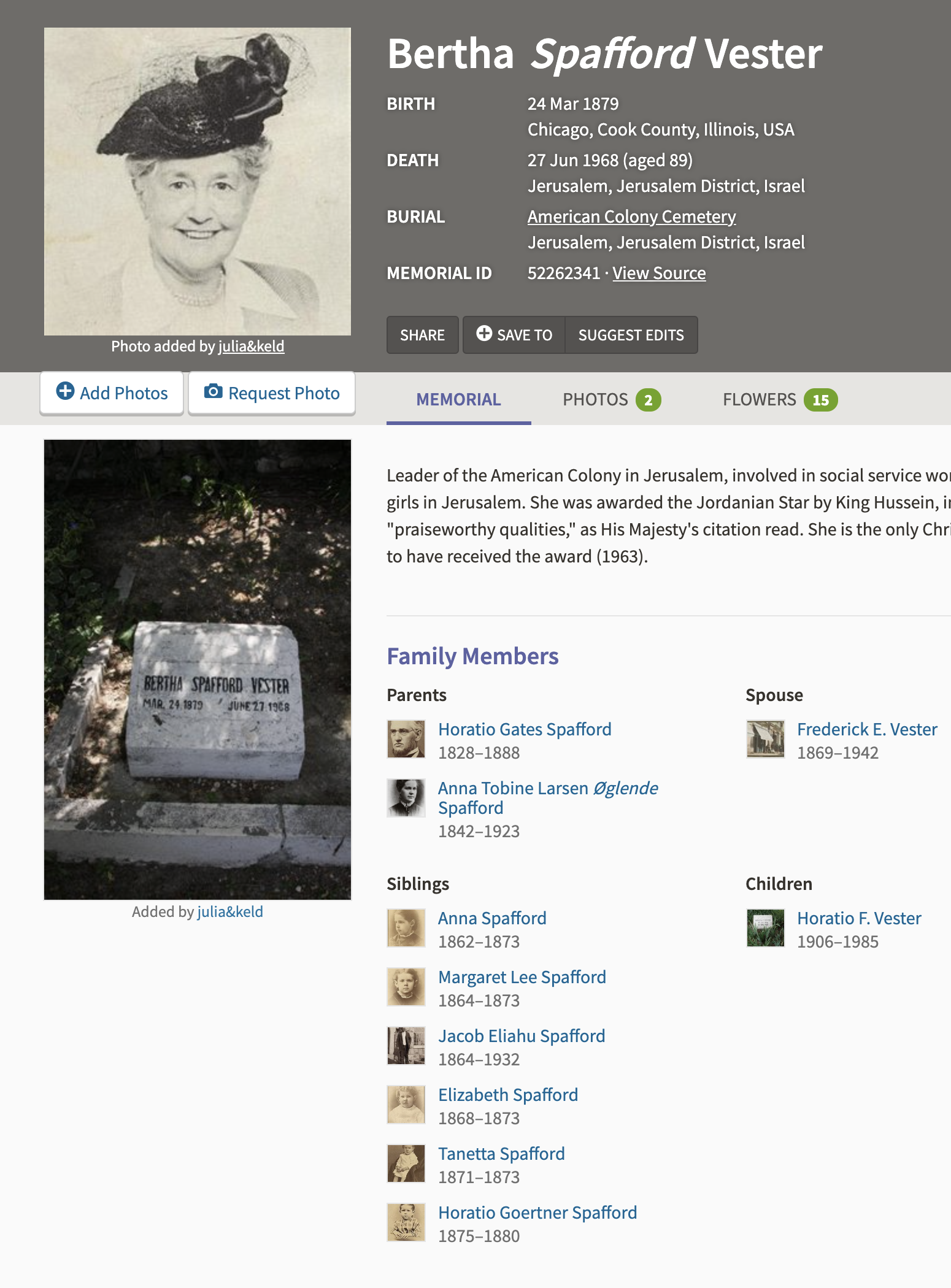
The Story Of — “It Is Well With My Soul,” as told by their daughter Bertha Spafford

“Bertha Spafford Vester ” was born to Anna Spafford on March 24, 1878, after the loss of her daughters in 1873.

She Authored A Book Titled — “Our Jerusalem.”

♦♦♦♦♦ ♦♦♦♦♦ ♦♦♦♦♦

The original manuscript has only four verses, but Spafford’s daughter, Bertha Spafford Vester, who was born after the tragedy, said an additional verse was later added and the last line of the original song was modified. The music, written by Philip Bliss, was named after the ship on which Spafford’s daughters died, Ville du Havre.”

When peace, like a river, attendeth my way,
When sorrows like sea billows roll;
Whatever my lot, Thou hast taught me to say,
It is well, it is well with my soul.

(Refrain:) It is well (it is well),
with my soul (with my soul),
It is well, it is well with my soul.

Though Satan should buffet, though trials should come,
Let this blest assurance control,
That Christ hath regarded my helpless estate,
And hath shed His own blood for my soul.
(Refrain)

My sin, oh the bliss of this glorious thought!
My sin, not in part but the whole,
Is nailed to His cross, and I bear it no more,
Praise the Lord, praise the Lord, O my soul!
(Refrain)

For me, be it Christ, be it Christ hence to live:
If Jordan above me shall roll,
No pain shall be mine, for in death as in life
Thou wilt whisper Thy peace to my soul.
(Refrain)

And Lord haste the day, when the faith shall be sight,
The clouds be rolled back as a scroll;
The trump shall resound, and the Lord shall descend,
Even so, it is well with my soul.
(Refrain)

PDF Link to Her Book.

Beginning on page 30 — the story behind the hymn is shared, as told to her by her mother,

Also the  Link To  video presentation of that story.

Screen Shot 2021-01-31 at 10.51.41 AM

Screen Shot 2021-01-31 at 10.54.46 AM

Screen Shot 2021-01-31 at 10.58.11 AM

Screen Shot 2021-01-31 at 10.57.33 AM

Screen Shot 2021-01-31 at 10.57.19 AM

Screen Shot 2021-01-31 at 10.56.50 AM

Screen Shot 2021-01-31 at 10.57.48 AM

The Difference Between “Mush” & Sic’Em”

Musher- sled dogs

. . . 

The difference between saying . . . .

Mush & “Sic’Em”

. . . . . . . 

. . . . . . . 

. . . . . . . 

. . . . . . . 

. . . . . . . 

. . . . . . . 

Why is church life becoming more and more difficult?

It is — and you probably already know that.

I should say early on, some of that is self-inflicted!

I will venture out and say . . . .

Church life will never be the same after 2020.  In fact, 2020 is flowing into 2021 BECAUSE  2020 has changed life and living.  2020 is flowing in 2021 because a “sea-change” has taken place.  We are not going to b returning back to the regular order of “2019.”

When I read what I thought were reasonable and disarming comments of a well-respected and effective pastor who worked alongside me for six years, I settled into this opinion.  Even those prudent, equitable (Can I use that word anymore?), balanced, wholesome, and wise comments quickly came under assault.

Pastors and church leaders are discovering that the influence they had — or believed they had — in affecting the lives of God’s people in good and right directions, is fading and perhaps, in some cases, is gone.  Disagree with God’s people — socially or politically — and you may well find yourself absent some members and church friends on the next Sunday morning.

In fact, even disagree medically  — “mask or no mask” — in areas in which neither side has any expertise and about which the “scientific opinions” differ widely — and “you are looking for a fight” — or a different church!

There are those pastors who have chosen to wade into the polarized waters of political discussion.  To them, I say, “You did it to yourself!”  It is a lose-lose decision to speak to a broad spectrum of people from “the pulpit.” — the pulpit of the church sanctuary, or Facebook, Twitter, et al.

If you don’t believe that the church congregation reflects a wide spectrum of viewpoints, opinions, thinking, then you are not in the pulpit, [1] you are in the pew.  That is a part of what makes pastoring complicated.  By design, the composition of the church congregation reflects a wide spectrum of individuals.

However, I have seen some of the sanest attempts of pastors to take a reasonable biblical-church-theological position crash and burn as they have simply argued for carefulness and restraint.  As pastors have suggested that the church needs to keep its focus on its calling, even “careful,” “balanced,” “prudent,” and/or “proportional” words have resulted in — “sic’em” — by those who do not like any such words of restraint.

The culture has caught up to the church.  The culture has long infected the church, and it has only been revealed in all of its brassy bold print.  Discussion with people who see things differently, even as to “carefulness,” may quickly devolve from a rational conversation into ad hominem and dismissive comments — “You are just stupid to think that!”  / “That’s just ignorant!”

We don’t like to have discussions with people we disagree with, and the proof is becoming more and more manifest.[2]  The previous proof was the many different churches that keep popping up.  The new present-day evidence is (and will continue to be) . . . .

  • people looking for another church
  • many staying with online watching,
  • a percentage dropping out of church life altogether
  • more and more church hopping
  • pastors switching ministries [3]
  • less effective evangelism
  • front and back door membership [4]
  • unstable church staffing, and/or
  • unsettled finances because of some who no longer financially this-or-that ministry.

More and more, the word “Mush” seems to sound like “Sic’Em.”

If the church doesn’t offer something different from what has been happening in culture, the Gospel will no longer be what we are fighting for.  Rather, we are “witnesses” to the reality that we cannot even tolerate each other’s differing vantage, no less those who do not even share our hope and faith in Christ. [5]

. . . . . 


. . . . . 

1. Talking to others who well-agree with your vantages is far different from talking with those who hold meaningful differences.  And, while others might say to those on the other side of an issue, in some form or another —  “Pastor agrees with me.” —   that is far different from you personally disagreeing with those individuals.  There is a lot of “pastoral grace” is given by the members and friends of a congregation, but not after an in-person disagreement.

2. Most all of us avoid conflict.  I realize that some must like it.  Nevertheless, I well imagine that anyone involved in a disagreement would rather avoid it — especially after it is over – ugh!   Yes, there are times when strong and needed disagreement needs to be voiced to leadership, but as loyal opposition, because loyalty must never outweigh integrity!  It is “integrity” that calls up loyalty!  And, like you, I “hate” going down that road, but it is only because addressing wrong-doing, and wrong-doers cannot be silenced!

3. Some pastors have already said too much.  Who wants a pastor who is “so stupid.”  We don’t like people who are so wrong in their viewpoints.

“Relevance”:  I know that there is a tendency to claim that preaching and churches need to be “relevant” and address these socio-political issues.  A better time to address the issues of the day might be later than sooner.  A better time for such an endeavor might be after the water has receded, and a better perspective can be had. Perhaps, even what the truth is has been so muddled that it is unwise to socio-medically-politically pontificate.  Let’s ask the great Apostle Paul — I Corinthians 6:12; 9:22.

4. New members found a place where they are more comfortable until the pastor or even others say something that stirs the socio-political waters.

5. There is a parallel “cancel culture” spirit, which can be found in too many churches.  Disagree, and you are charged with “disunity.”  That has been part of the church culture for years in far too many churches.  “Sowing Discord” is the church’s cancel culture mantra used to squelch needed, candid, and truthful criticism.  There is little-to-no place for the loyal-opposition* to challenge the self-serving decisions and actions of those in power and influence positions.

* “Loyal Opposition“:  Those who have given their time, talents, and treasure to the ministry for years and have genuinely sought to support the leadership but now have put “integrity” over any such loyalty.

A New Trend In Church Music [& Roy Orbison]

crying roy Orbison

In 1964 I went to college — lost.  I was saved under the evangelistic ministry of Harvey Springer [1] — a cowboy evangelist.  Years later, my mother accepted Christ as her Saviour, at the age of 60.  She would often say . . .

“I love reading the Bible in German.  It speaks to me so differently. 
“German” says it differently to me than the “English” words.”   

German was her native language!  It was her childhood language for 16 years – plus.

Mom came to America at the age of 16.  She was sent over by her parents during the rise of Hitler.  Her parents have serious misgivings and fears of where her country was going as it saw the rise of his power and the rise of wars.  She was sent to live with her uncle — “Uncle Louie” — a German tailor who lived in North Jersey. 

During the years of raising us, mom and dad often spoke German.  They attended a German-Methodist church where the adult services were in German.  Throughout her life, she was fluent in speaking “High German” [not “Platt·deutsch”/Low German, like dad, who was raised on a farm in Bremerhaven, northern Germany].    We “always” heard mom speak German to others who knew the language — and in North Jersey, there were many!

She was always self-conscious about her ability to speak English, though we never understood why.  In fact, in her early years in America, she became a legal assistant for an attorney.  Then in our pre-teen years pursued an education and career in nursing.  She worked as a nurse at Paterson General Hospital into her 70’s.

Again, she would often say that she loved reading the Bible in German.  Why?  The fullness of meaning and word usage that accompanies a learned language and culture were part of what made reading it rich in German.  Language is not merely words, but a culture, an upbringing —  an emotional diary of events and personal historical nuances.

. . . . . . 

“Music” Two Artforms: 

“Music” is a combination of two elements — two artforms — the poetry and the musical score.  There is an obvious trend that is occurring today, and it can be heard when listening to Christian music on the radio and in the church.  Different musical scores are being used when playing and singing well-known hymns of the faith.

I am not addressing the “arrangements” of great church hymns.  “Arrangements” of the hymn, which typically follow the original musical score, or arrangements which “begin–vary–come back” to the original musical score, is not my contention.

Nor am I making the argument that “changing up the musical score” has no merit, but there should be clarity and understanding as to the ramifications.  The frequency and breadth of this trend may well be indicative of such a lack of understanding of the ramifications — or just a disregard of them regardless.

Church music, like a native language, carries with it an experiential history. [2]

“Music” is more than words; it like a “childhood learned language” carries with it the emotions, the experiential and cultural chronicle, and the original congregational worship context.  Sing “The Old Rugged Cross” to a different musical score and then sing “The Old Rugged Cross” to its original musical score and tell me that it is the same musical experience!

Again, that is not to contend that there is no merit in changing up the musical score.  Nevertheless, do not do so thinking that the “ministry dynamics” have not changed. [3]. Do not believe that nothing has been lost in regards to the worship value for those who learned that music in their “native tongue.” 

Let me also argue that variant musical scores often disregard the creative “musical” elements that went into the original creation of that hymn.  The musical score works with the poetry for it to reach its fulfillment and become a well-known and liked hymn over centuries.  The proof of that is seen in listening to some versions of “It Is Well With My Soul” played in a minor key.  When I hear those versions, I often say — They messed up that hymn.

To go to the metrical index of the hymn book, and attach the “hymn” to an alternate “musical score,” disregards how the music draws out the fulness of the poetry, and the “emotional diary of events and personal historical nuances” which ARE all part of that hymn. [5]. This trend of taking the words and attaching them to a different musical score is to — “Read the Bible in ‘English’ when the native tongue is ‘German.’ ”  That is why people say — “I miss the old hymns of the faith!”

Worse than this trend is the trend to repeatedly choose and use musical scores that repetitively bear a particular composer’s marks.  The revisionist music begins to all sound the same.

. . . . . . 


. . . . . . 

1. Harvey Springer — see below


2. Not only church music, but all “music.”  That is why those who lived in the 50s, 60s, 70s, 80s still love listening to the music of their era.  It carries the overtones of that age.

3. An easy way to make that argument is to ask — Where do you see this happening in the secular musical world.  They understand how the musical score affects the significance and appreciation of the song — I have not heard the classic Roy Orbison song — “Crying” attached to a different musical score.  Has anyone done a musical score “remake” of the Righteous Brothers’ “Unchained Melody” — There are arrangements, but no “remakes” where the words were put to a different musical score!  

“Crying” (1961) was a popular song on “American Idol.”  Carrie Underwood sang if on her finale night!  None of the singers “changed” the musical score –Kree Harrison / Billy Gilman
— (Crying, Roy Orbison – 1961 — Remember — I was saved in my late teens.)

Even the Spanish version preserves the musical score!

4.  Take a hymn that little-to-no-one knows or has ever sung, change up the musical score, and nothing is lost.  Why?  Because it has no experiential history.  Sing that hymn using that variant musical score for months, and it develops its own attachment to that musical score.  Now, have the choir sing it as written in the hymn book.  

5. I have heard some old hymns of the faith put to a different musical score, and it worked.  At times, it drew out some of the elements of “poetry,” which lacked that musical color.  But that has been rare in my humble experience.  

♦♦♦♦♦ ♦♦♦♦♦ ♦♦♦♦♦ ♦♦♦♦♦ 

Fiery Evangelist Harvey Springer Dies

The Rev. Harvey H. Springer, fiery fundamentalist evangelist who built the Independent First Baptist Church and Tabernacle of Englewood into one of the largest congregations in Colorado, died at 11:50 p. m. Friday in Swedish Hospital after a heart attack. He was 59. Rev. Mr. Springer was stricken at Silver State Youth Camp in Jarre Canyon near Sedalia, which he operated during the summer. Some 3500 children are attending this year’s camp session at a rate of up to 400 a week. The pastor, who long referred to himself as the cowboy evangelist. addressed the campers Thursday night and again at the noon meal Friday before he was stricken. Rev. Mr. Springer headed the Englewood church, which is independent of other Baptist churches, for 30 years. He made many radio broadcasts, published a weekly newspaper and wrote and published numerous books and tracts. Rev. Mr. Springer was a hellfire and brimstone preacher who often made tours of the South. He was a shrewd businessman who formed many organizations to foster his activities.

Rev. Mr. Springer was an executive officer of the ultrafundamentalist International Council of Christian Churches. Rev. Mr. Springer for years published the weekly, “Western Voice From Out of the Rockies”. He was born January 18, 1907, in Oklahoma Indian Territory, the son of Otto W. and Delia Phelps Springer. He spent most of his earlier years in Oklahoma. In 1925 he married Miss Evalena Shaffer, daughter of the founders of Shaffer’s Crossing southwest of Denver. He appeared in Englewood in two evangelistic campaigns, then became pastor of his Englewood church in 1936. Funeral services were at 2:00 p. m. Tuesday in the Independent First Baptist Church and Tabernacle, 3170 S. Broadway, Englewood. Burial was in Littleton Cemetery. The Rev. Victor Sears of Ft. Worth, Texas, pastor of Castleberry Baptist Church, and the Rev. Sam Morris, a San Antonio, Texas, evangelist, will conduct funeral services. Surviving, in addition to his wife, are a sister. Mrs. Ruby Riley; a brother, Byron E. Springer: a nephew and four nieces, all of Denver. Silver Heights, north of Castle Rock, along with the Silver State Youth Camp and the Silver State Nursing Home, all in Douglas County, were products of the dynamic leadership of Dr. Springer.

The Rev. Harvey H. Springer — 1907-1969 

4 Reasons They Come To Hear You!

active volcano 1

. . . . . . . 

One subject which floats around the “expository preaching community” revolves around “felt-need” preaching.  With pastors, it comes in second (it may be first) only to church music.  One of the first articles addressing it in a real way was y Al Mohler, in 2006 — and is still very turbulent today.

. . . . . . . 

One of the reasons that it is active and still erupting fifteen years later is because some of the preaching ministries of some of the most effective preachers are marked by the words “felt-need.”

With all the superficial talk about preaching — or not preaching — to the “felt-needs” of the audience, the reality is that much (I think most) preaching addresses “felt needs.”  They reject the label, but not the reality  because addressing real needs was built into the DNA of preaching.

“Felt needs” is one of the motivations for attending  — week after week, and listening to the same person preach to them from God’s Word.  They know and understand that they don’t have the answers to all that the week has thrown at them and are looking for some biblical help.  They are looking for help in both thinking and action when it comes to . . . .

  • child-rearing
  • a marital issue
  • financial difficulties
  • pestering habits
  • a prodigal child
  • a very uncomfortable disagreement
  • thinking about political issues
  • a shaky job situation
  • making a major change or move in life or the life of the family
  • consistency regarding various biblical disciplines
  • et al.

In fact, introductions are typically designed to establish the relevance of the message to life and living.  Add to that the fact that sermonic application is aimed at speaking to real needs.  AND not to mention that we as pastors state that God’s Word speaks to all the needs and demands of life and living — “throughly furnished!?

. . . . . . . 

There are typically four primary reasons people — members, regular attenders, and visitors [1] — attend church — especially on Sunday morning . . . .

1 – To Act Responsibly: It is what God’s people ought to faithfully practice. The preaching of God’s Word and fellowshipping with God’s people is who we are as believers.  It is a matter of faithfulness!  [2]

2 – To Acquire Information: God’s people do what to learn what the Bible teaches.  They do want to understand the Bible and learn what it has to say.  “Theology Proper” — who God is — is important to them!  “Theology” may not be as important to them as those who have been called to the ministry.  They may not be interested in some of the technical discussions pastors and seminarians get involved in or even preach-teach about.  Nevertheless, for many, Sunday morning is the most concentrated exposure to biblical truth and principles. [3]

3 — To Untangle Life: Life is often confusing. Have you ever heard someone say — “What is that about!”  They have witnessed something or heard something and were perplexed, confused.  “Why did she just blow up like that when Bill asked them that question?” /  “After 25 years, she says she wants a divorce!  You are kidding.  What is that about?”

  One of the aims of preaching is to give coherence and understanding about life and living — in a fallen world — from a biblical vantage.  After Saul throws a spear at his very effective warrior, David, there needs to be an explanation, and the explanation is jealousy.  That does not just happen in history; it happens today and helps people understand what is happening and how irrational sin is.

Part of preaching is helping God’s people explain and understand what happens in life — i.e. — The pride, ego, and self-centeredness of men drive them to carry out all kinds of twisted plans.

4 — To Resolve Agitation:  Who of us has not experienced “mental agitation?” When thoughts clash, we seek to make mental peace.  Just like when the body ingests too much sugar, the body immediately begins to bring everything back to a proper balance and releases the appropriate amount of insulin into the system.  The body is meant to operate with everything in balance.

Likewise, events take place, words are spoken, new information is introduced, and there is a mental disruption.  When people or events throw things out of balance, the mind seeks to bring things back into balance.

    • “I didn’t know that!  Are you sure that is true?  If it is, then I am starting to take an aspirin a day.”
    • “I can’t believe that they said “no” when I asked them if they could help me out next week.  How many times have I given my time and energy.  You are kidding!  I thought  . . . but I don’t think that way anymore.”
    • “What do I do now?  My son-or-wife-or-husband walked out the door!  How do I deal with all the anxiety, fears, and thoughts which refuse to quiet down?
    • “My doctor just told me that I have colon cancer!”
    • “My daughter was just arrested on a drug charge.”
    • “I can’t even tell anybody about it.  I am too ashamed!”

Whether it is by . . . .

    • adjusting ( taking an aspirin a day),
    • seeking out more information (reading everything about that form of cancer),
    • looking for different information (getting a second opinion),
    • refusing to listen to -read-watch “upsetting” sources of information (turn on a different channel, I can’t listen to them!),
    • shutting down and cutting off people (I’m through with them!)

. . . . all are avenues for regaining our mental equilibrium.

People come to church looking for answers!  They are trying to find the path that leads back to mental and emotional peace, to mentally re-balance.  Read the Psalms, and you will see. David working through that process — sometimes he makes it, and other times he utterly fails — I Samuel 27:1

Believers, and those who know not Christ as their personal Saviour, come to church expectantly because they need some re-balancing, and/or life has thrown them a serious curve this week.  Part of preaching —  and shepherding — is to help people meet that need for balance by understanding Scripture’s truths and principles.

Who of us have not heard a message which gave us understanding, or a competing needed truth, or the direction necessary for navigating the rapids — and thereby the peace of mind was restored!

God’s people do not merely attend out of a sense of sincere spiritual responsibility or to become more theologically educated.  They come because there are some real felt reasons.  “Some” are there because they are trying to untangle life and living as a Christian.  “Some” are there because events have agitated their minds and hearts, and they need some help, some answers, or at least part of the answer.

. . . . . . . 


. . . . . . . 

1. Obviously, “visitors” may attend to please the person who invited them.  Nevertheless, most do not respond to such an invitation.  How many of us have been told  —  “They are going to try to make it.” — but they never show up.  When there is a real need in their lives, they sincerely respond to an invitation and even show up.

If a pastor assumes that visitors will respond to an invitation (personal or mailed) regarding upcoming evangelistic services through a personal request or a mailed-out postcard,  he will be disappointed.  Too many distractions, alternative demands, and felt-needs are vying for the time of individuals and families.

The proof of that is seen in what is usually connected with the event — “A barbecue rib dinner with all the trimmings!”  Which, by the way, is addressing “a felt-need.”  Along with dinners, the advertising is also aimed at addressing felt-needs — “These special services are for husbands and wives (or moms and dad) who are seeking to make marriage all it can and should be!”

2.  That sense of faithfulness marks those who attend beyond the “Sunday Morning Service,” and even if there is little-to-no personal benefit per the topic, or even if the preacher is consistently ineffectiveness.

3. “Informational” is one of the main reasons new believers are so consistent in their church attendance — and their Bible reading.  The earliest days are marked by an intense interest in what they have little-to-no knowledge about, till now!

“Informational Preaching” works for new believers.  However, over time it takes a turn and those new believers, who were sitting under “informational sermons,” begin looking for something more.  That is why some churches become and are “feeder” churches to other local church ministries.

There Is A Word For That: It’s Not Shepherding

crime scene

I understand that anecdotal evidence is just that, an example, a single account that may not represent the whole.  “An independent statistical study” needs to be conducted to arrive at “certainty.”   Some would rather quote “Barna” — as if the “Barana Group’s” polling is any more reliable than anecdotal evidence [1].

Nevertheless, here are two disturbing accounts . . . . 2021 accounts.
(If you want to see it on a corporate level, a third example found below. [2] )

Case #1

Me:  Hi Pastor ______, how is it going at the church.

Pastor:  Doing good . . . . strange and challenging days to be pastor of a church.

Me:  That it is!

Pastor:  I am on zoom calls with about 10 other pastors, and it is surprising what pastors say . . .

We still got the money coming in . . . . we’re good — we’re okay . . . .

When I question it, they say . . . .

“Come on ______, you telling me that you don’t like this –You know you do.

We don’t have to preach as much, or deal with people and issues and we still get paid.”

Me: Wow . . . That’s shameful

Pastor: I have been visiting the members and offering “communion” with them at their homes.
At least we can take the time to pray with them!

(“I’ll leave it there, but it gets worse!)

♦♦♦♦♦♦ ♦♦♦♦♦♦ ♦♦♦♦♦♦

Case #2

Me:  Hi, “Bill, I wanted to touch base with how things are going in your life.  Are you still meeting with Pastor _________?

“Bill”:  Things have kind of trailed off.  He rarely calls me or contacts me anymore.

Me: How can I help?

“Bill”: It’s just good to hear from you.  Nobody has ever checked on me before. 

Me: Listen, I can help, if you need someone to talk to.  I know that over the phone is not the best way to do counseling, but I am here if you need to talk to someone.  In fact, I will even fly there for a day or two if that would help — or you can fly down to Florida — whatever works best. . . . . Did you get the book I sent you?

“Bill”: I pulled out the book again today — Gentle and Lowly — the one that you sent me.  When I read it, it moves in a way that I don’t understand.  I have come to enjoy reading it!

Me: That’s good! . . . . . It talks about a Saviour which is far different from the one found in many a church ministry — one that deeply cares about us …  and deeply loves us . . . . Not a Saviour who is looking to find fault, but to cover our faults and failing with His blood . . . . One who wants to bring us home forever.

“Bill”: I appreciate the book . . . . . . . It seems like the times I get together with him — when and if we do get together —  there is only one subject . . . . ‘Am I saved?’  And I am.  I am trusting Christ as my personal Saviour . . . but I don’t know if he believes me.  But I am making it — reading my Bible — but struggling. . . . .

(Again, I’ll leave it there, but there are many more heart-wrenching comments!)

I know, these are just two stories!  They do not represent the ministry.  No, of course they do not.  But they do represent some ministries — and far more than these two.  We will have to wait for someone to do a “double-blind test.”  Or we can hope that Barna will do a poll where pastors anonymously and honestly confess to such attitudes and responses.

With some pastors, fewer preaching demands, less church activity, and steady or increased income has not lead to more time and concern for the sheep.  It has lead to more time off, less preaching (temporarily and maybe permanently), and a greater failure to exhibit the grace and love required, and indeed expected from those who claim the title of “shepherd.”

I can say with certainty, there is far too much self-serving and shameful pastoral decisions and responses than some might like to admit, and which have been brought to the surface by the Covid and political crisis across America. With some, as long as the books balance, the bills are being paid, and no one on staff is missing a paycheck, all is well.

“Expositing the Scriptures” doesn’t mean that you have provided green pastures for the sheep.  Pastors who congratulate themselves on “exposition” may think they have thereby fulfilled their highest duty and in fact, hide their mediocre-to-weak-to-poor-to-terrible shepherding behind fulfilling that duty.  “Expositing the Scriptures” includes exhibiting the love, care, concern, patience, and compassion which”men of the  Book” preach the Scriptures require of His people — no less its leadership.

Lee Eclov states . . . .

Pastors, like all believers, are agents of grace.  But we dispense the grace of Christ as no other believers do.  We are shepherds.  Search as we might for a word more suited to our contemporary culture, shepherd is the only word that will do.  If we hope to understand what we’ve been called by God to do, we have to step into a foreign world of sheep and pastures, folds, and staffs, night watches and wilderness searches . . . . Patient, long-suffering, committed to the often lonely routines of care.  That’s. how God wants us to see ourselves.  In fact, that is one way God see Himself. [3]

Don’t take my word for it, just ask church members — particularly those who have not felt the freedom to return to the in-house church services, those who have been and are marginalized for being fearful — “How often has your pastor personally talked to, called, and/or prayed with you.”

When you hear their answer, you will be able to add a few more anecdotal stories to my point.

With some pastors, and more than imagined or is right, the ministry really is about them.

The word for such is not “shepherds.”


1. The Barna Group polling of “Christians,” “pastors,” “churches,” and “disciples” is as subject to gross inaccuracy to most all polling is.  “Polling” is DEPENEDENT ON who you poll (Christendom is not Christianity) , where you poll (the Northeast is not the South), when you poll (comparing the 50s-60s to 2021), and how you poll (the questions you ask give you the answers you want).

“Barna” results are used to argue for all kinds of trends, positions, and warnings.  There is one certain truth which all the Barna polls repeat in a variety of different ways.  It may be the only trend that Barna polls are picking up — the world is moving from Christ to a day of His return.

By the way, Barna now reports that most church members really don’t care about their pastors and that pastors lack credibility in the eyes of most members (whoever the  “they are” who have been polled).  That was in 2017 — Imagine today!

2. Dave Ramsey email To Bob Smietana
also — “And if you don’t like that, this is your cue . . . Don’t let the door hit you in the ass.”

3. Lee Eclov:  “Pastoral Graces” — pg. 12

Another beautiful quotation from his book . . . .

“. . . we must also remind them often, in full biblical detail, that Jesus will come back in glory. Pastors grace God’s people with the stories of what is yet to come. We keep their chins up, looking for Christ’s return. In this clinging and cloying world we urge them not to put down their roots.

I imagine a pastor being like an elderly uncle of refugee children. He often gathers them to himself and tells them stories of the homeland they have never seen. He tells them that on the day they go home they will be a beautiful bride coming down the aisle of the skies to meet her Bridegroom. The homeless children listen wide-eyed as he tells them that their homeland is a kingdom bright and righteous, where Life runs in the rivers and grows on trees. “Our King is the king of all kings,” says the uncle. “He rides a mighty charger and the armies of heaven follow Him. He knows your name and he himself is waiting to be with you.” The uncle tells these stories again and again because if he doesn’t the children will forget who they are and put down their stakes in Babylon. The challenge isn’t how to get them home. The King will take care of that. The uncle’s challenge is that he cannot let the King’s children forget their home.”