Category: ministry

It’s Twisted!

“Anything that makes you need God is a blessing!” — Thank was what was said on the car radio by a well-known Bible teacher [1] as I was driving across Florida to visit a friend dying of cancer.

That is more than inaccurate, though it aims at and woefully misses a biblical truth taught in the Scriptures.  It is a dangerous and damaging teaching.

I can imagine all kinds of injustice and horrific deeds of men that makes people need God and even causes them to seek His help, and those actions were wicked and evil!  They were not a blessing, nor a blessing from God!

Every good gift and every perfect gift is from above, and cometh down from the Father of lights, with whom is no variableness, neither shadow of turning.

The clear understanding of the passage states that there are gifts that are not good and perfect, and that not all gifts come from above. The good and perfect come from His gift shop. The bad and evil come from a different owner’s shop!

The good and perfect come from the Father of light, and some come from the prince of darkness.  That truth is unvarying — no shadow of any turning will ever be found when it comes to what the Lord God gives!

Some not-so-good gifts come from powers of darkness and evil, including wealth/money, popularity, power, talents, position, resources, and prominence.  Those “gifts of darkness” have been given to “devour people as a lion” in life and living.  Those “gifts” have perpetrated and perpetuated some of the most horrific acts of evil.  Vladimir Putin was given many of those gifts — from the prince of darkness.

And check out that verse in its context — “Let no man say when he is tempted, I am tempted of God: for God cannot be tempted with evil, neither tempteth he any man.” The Lord was never a party to the sins that tempt or too often overcome mankind.

Tell the families of Uvalde, Texas, whose children were killed, the parents of a young five-year-old child who was sexually molested, the wife whose husband has shattered their marriage, and the friend of mine who is dying of cancer (likely due to the unsafe environmental factory conditions) that what they are going through is a blessing, a blessing FROM God!

The underlying ideology of this kind of thinking and such statements has led to all kinds of passivity and inappropriate actions.  Poor-to-terrible counseling, wrong-doing, social injustice, and horrific abuse have been left unaddressed (and even justified as biblically appropriate and justified) because of this type of thinking — “We need to see this as from the hand of God.” [2]

Yes, I understand that God uses sin, sinlessly.  That God can still bless us, and does, midst our sin and the sins of others.  But the sin was sinful, it is not therefore acceptable to be left unaddressed, and it is not a blessing from His hand.  Any attempt to promote some passivity towards the sinful actions of men is but an argument to allow it to be more acceptable and/or for it to continue unaddressed!

I understand the truth that we can find rest for our souls during the most overwhelming times of life in Jesus, but not in some belief that or Lord was even close to complicit, found any pleasure in, or took some functioning part in the evil actions of men.

√  Rather, I find comfort in that He fully understands my pain, grief, sorrow, heartbreak, deep anguish, anger, and hurt — and sympathizes and empathizes with all that I feel.

√  I find comfort in the sure and confident hope that He will fully address the evil and wicked actions of men, in this life and/or in the life to come!

√ I find comfort in the sure and confident hope that He has fully planned and provided for an everlasting world to come where evil and the evil of men will be forever vanquished.

√  I find comfort in a humility of mind that recognizes that I cannot explain all that happens or is allowed to happen.

√  I find comfort in the understanding that there are mysteries and secrets known only to God, that we have not been told — that there is far more about God than contained in pages of Scripture!

√  I find comfort in that what God allows to happen is thoroughly consistent with all that we do and can understand, though we cannot reconcile them in our minds and hearts in this twisted and fallen world.

√  I find comfort in that we can run to Him in time of need (Matthew 11:28-30), and He can give me rest and peace which passes the peace I receive by understanding (Philippians 4:7) — that it passes the peace that I can and do get at times with understanding. [3]

  • No, I can’t explain why your child died at such a young age.
  • I wish I could explain why dad left, or you were put up for adoption, or mom was addicted, dad was an alcoholic, but I have no good explanation.
  • I don’t know why the marriage / family life was so pot marked with wrong-doing and evil/wickedness.
  • I have no explanation for why that house was swept away in the storm, and the house next door was untouched.
  • I can’t understand the Holocaust.
  • I have no knowledge of whether God is judging America by a pandemic or why your loved one died from it at the age of 32.
  • I don’t know why you live in America and others in Ukraine.

Nevertheless, I’ll hold onto the humility of mind that understands the biblical truth that we can find rest for our souls during the most overwhelming mysteries of life — in Jesus.

I need not adopt some twisted view of God’s sovereignty that somehow makes the wrongful, wicked, and/or evil actions of men more acceptable, a blessing, and/or anything less than wrong-to-evil — in order to find that rest! 

^


^

1. Link to Nancy DeMoss Wolgemuth’s “Revive Our Hearts” radio ministry on June 9, 2022

2. It is founded on a false and/or twisted understanding of the sovereignty of God, too often rooted in a theological ideology promoted by such men as John Mac Arthur and John Piper — some of the most prolific speakers, writers, and influential men over the past 40 years!

There is a connection between the present-day controversies involving John Mac Arthur and John Piper, concerning the abusive environments and/or teachings and their theological ideology!

There is a reason, not the only reason, that some ministries and local churches have failed to address wrong-doing and abuse, and it goes back to a twisted view of God’s sovereignty and a twisted theological ideology!

3. There was a day when Joseph got “understanding” as to why all that was happening was happening.  At times we get that kind of understanding, providing a measure of peace.

5 Changes That We May Well Regret In Coming Years

“Progressive” and “Transformational” are words that mark our culture and also mark the 21st-century church.

It is remarkable that in such a short space of time, the local church and worship have radically changed.

We may well look back at these initial years of our new century and have some serious regrets about what has taken place and what has been lost.

5 Losses Of Our Church Culture

#1 – Bible In Hand: Far fewer Christians carry an actual Bible to church. What at one time marked a Bible-believing church — Bibles in hand, turned to the passage under exposition, and resting on our laps for viewing and sermonic reference — is no longer a typical part of church culture.

The ability to underscore, make marginal notes, see a verse in its context, or follow along as a passage is taught have been radically altered or lost.  Instead, a passage of Scripture and/or selected verses are flashed on a screen and/or viewed on the LCD of a phone or iPad. [1]

^

#2 – Great Congregational Song Leading & Singing: There was a time when great congregational singing was part of the church service.  A great congregational song leader was part and parcel of what made a church service what it was.  Those hymns became so well-known that we can still sing them 10-40 years later. [2]

The congregational singing that marked the Bible-believing church(as people broke into parts) is now — maybe at best — a congregationally indistinct sound, by a small number of people, singing musical-melody-only, and marked by a moshpit-long-all standing up-repetitive religious song time.

^

#3 – Weekly Services:  Sunday School, Morning Worship, Sunday Evening, and Mid-Week Service were all part of what marked Bible-believing churches.  If you were looking for a good church on vacation, look for one with a Sunday evening or mid-week service.

Rather than realizing the vital need for Bible teaching, as did Rober Raikes or William Booth, ministry leaders and even local church pastors have decided to weaken the structure.  While many a ministry began with “just a few, “just a few” isn’t worth the time anymore.  And too often, why there are “just a few” attending isn’t a question that is addressed!  [3]

^

#4 – Church Bulletins:  This may seem small, but it had great benefits!  There were several great benefits of having a church bulletin. Knowing what is happening within the local church community, getting to know people and ministries by name, being reminded about those who were sick or shut-ins, rejoicing over the birth of someone’s new child, the date and time of a wedding, funeral, church event, attendance or offering numbers, learning about the accomplishments of fellow believers, heartened by a Bible verse or inspirational thought, and being encouraged about up-coming events was all part of was part of the Sunday church bulletin.

^

#5 – Hymn Books: There was a time when we as parents held the church hymn book at our child’s viewing level, followed across the lines with our finer, as our children learned the words, flow, and music of a church song.  The words are only needed and are now projected on a screen.

Following the music, singing parts, an effective all-congregational song leader, and congregational singing have been replaced by an overly loud, guitar-prominent, and drummer-led stage performance.

^

Not only has our American culture accepted and/or allowed some of the most extreme positions to influence the direction of our country, but ministry leaders and pastors have also allowed and/or encouraged some of the same kinds of excessive changes in direction.

Many may well look back and regret these five changes [4] that have been allowed or encouraged by ministry leaders, deacons, elders, church staff, and/or the pastors of Bible-believing churches.  Some may no longer assess them as concerned and prudent shepherds of God’s flock, but rather as part of the problems they themselves denounced!


1. There are a good number of implications to this approach when it comes to being a “Berean Christian.”  No surprise that Christians are and will be easily deceived by speakers who control what is seen and read during a sermon or Bible teaching time.

2. Many of the religious songs of today will be no longer in but a few years.  They have no “entrenchment value” or strength.

3. Some ministry leaders and pastors, from one side of their mouth, decry what has happening in culture and the world around them, while from the other side of their mouth, close down their Sunday evening or mid-week service.  They are pastoral pretenders, not serious contenders, who ought to be ashamed of such complicity — Philippians 3:19; Revelation 3:18, 16:15

4. A sixth regret could easily be our view of Sunday as a different day.  For too many, Sunday is no longer marked out as a different day — by the way we prepare, dress, attend, arrive, participate in, serve or parentally value the Sunday worship service of our Lord!  This, too, has been allowed and/or encouraged by church leadership.

This Is The Non-Sense Of Today’s Theological Ideologies

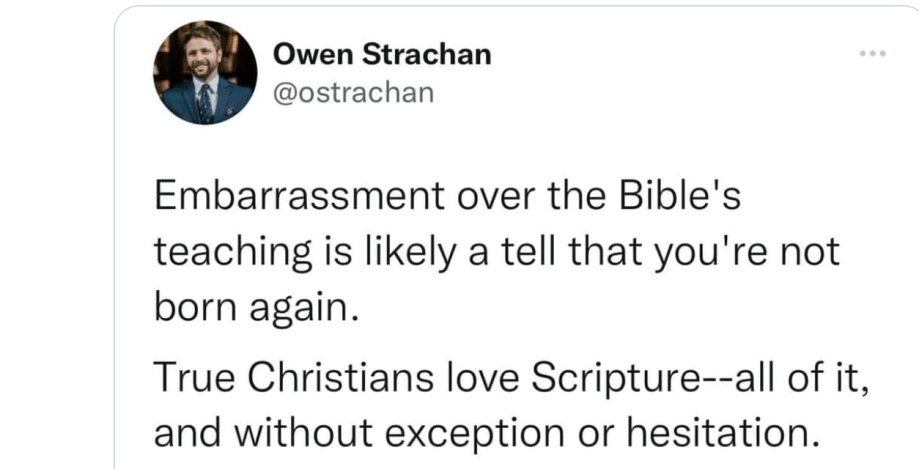
Owen Stachan is not some unknown stranger in the theological world.  He is all too well known!

My concerns are not about his beliefs or positions but more about how many others follow and hold to the same theological positions he espouses.

And this theological position is not some strange and aberrant stance; it is also typical of those who park out around the same Calvinistic campfires.  The stance that — it is all or nothing when it comes to sanctification.

There is little to no room for anything less than total devotion, spiritual growth, and/or change. [1]

I would suggest that the Lord’s own disciples were embarrassed over the Lord’s teachings; at times, they exhibited a lack of love for some of the truths He taught and hesitated in believing all that He taught — as have a wide variety of the many saints of Scripture (that are even identified) — Jonah, Lot, Samson, David, Abraham, Peter, Thomas, Nathaniel, et al.

These kinds of statements [2] and theological ideologies produce sermons that shake people’s faith in their salvation and constantly make people feel that they will never measure up to living out their lives as believers.

As some responded (and many in a similar manner) . . . .

“Christian, do not make your subjective experience with the Bible the grounds for your assurance. Jesus has already understood, loved and obeyed every word of Scripture on your behalf, and He is patient with us as He renews our minds through the Spirit.”

“Yes. The only thing I can see this tweet producing is hypocrisy, as people scramble to convince themselves that they love the Bible as much as they should so that they can feel a sense of assurance. None of do. We’re still in the flesh.”

There is nothing the Lord did not know about you
when He saved you.


1. What are the implications of this statement for those who do not take the position of “literal 24-hour day” creation and opt for the position of theistic evolution or even evolution?

2. Recently, another well-known pastor remarked that . . . . “I am not sure one is a Christian if they do not regularly attend church — I’m not saying they aren’t, but I am just not certain.”  This is the same type of Calvinistic / New Calvinism thinking non-sense!

If we all read the same books,
we will all think the same thoughts.

That also explains some of how we got here!

How Can You Say That About David?

David was a man after God’s own heart.

That statement seems odd to many who know the story of King David.

Some may not understand one of the prominent characteristics that marked and guided David.  It is apparent that the Lord understood it!

Yes, David, a man after God’s own heart!

Are we talking about King David . . . .

  • David, who committed adultery with Bathsheba.
  • David, who had Urriah’s life put in purposeful and fatal jeopardy.
  • David who was stopped from killing Nabal by Abagail — that David?
  • Are we talking about David who hid in Ziklag under the feigned loyalty protection of King Achish?

Yep — that David!

When David was confronted by Nathan the prophet, David did not fend off his clear and confrontational charge of Nathan. He understood Nathan’s parable was not only about him, but how egregious his doings were. Nathan’s parable had to powerfully stab the heart of David — by all of its passionate imagery!

David wrote Psalm 51, a well-known Psalm to all of us who, like David, know and understand how stained we are from birth with the ability to do what we know is wrong!

Abagail confronted David, and again David listened and reversed course. He heard the argument that Abagail was making and yielded to her words!

When returning to Ziklag with his army and seeing the city in smoke and the inhabitants deported — his response . . .

“And David was greatly distressed . . . . but David encouraged himself in the LORD his God. And David said to Abiathar the priest, Ahimelech’s son, I pray thee, bring me hither the ephod. And Abiathar brought thither the ephod to David. And David enquired at the LORD”.

David knew that he was responsible for the situation and his only hope was to go to the Lord for merciful help!

^

David’s life was marked by some heinous sins, he was also marked by a quality that God takes note of in our lives — self-awareness!

David was self-aware of himself and his own layers of sinfulness.

Again, when David was cursed by Shimei while fleeing the city of Jerusalem, he responds with a level of understanding that some never come to in life and living — (II Samuel 16:5-12).  David understood that such words were deserving and more — it was from the mouth of the Lord!  He was a bloody man!

As is seen repeatedly, David was a man you could talk to, and he would listen! He had ears to hear because he was self-aware of himself, his tendencies, his sinful leanings, and his own ability to justify and rationalize his sinfulness.

^

If you have been following what is happening in one of the largest “denominations” of churches in America, the SBC, you will witness an example of the lack of that quality.

Pastor Tom Buck, whose wife has written a book talking about how rough and abusive her husband was in the many early years of their marriage, decided to point his finger and identify a deacon who committed adultery over 20 years ago.

While claiming that he and his wife story was written to illustrate God’s redeeming work midst their marriage, the redeeming work in the marriage of that deacon is worthy of condemnation and removal.

Oh no, that deacon who has shown true repentance over the past 20 years, and has served admirably and with integrity on many different levels over the past 20 years, is not granted the margins of grace that Pastor Tom Buck speaks about in his own marital situation — as a pastor!

^

It is sad to say, but there are too many pastors who are so lacking in self-awareness. They preach on this-or-that, and have no idea of their own failure in that very area. Like Pastor Buck, those in the audience wonder how he could say what he says in light of what he himself has done, said, or gone through. The response is — “You are kidding me! How in the world is he able to say or do that?”

√ I have personally heard and seen pastors speak against the nomination of a church officer or deacon because of the behavior of one of their children. In contrast, their own children should have disqualified them from pastoring.

√ I have personally heard and seen pastors talk about love, kindness, forgiveness, care, and concern, while they failed to show those very same qualities in dealing with and dismissing a member(s) of the church.

√ I have personally heard and seen pastors rationalize, explain away, defend, and justify clear and even grievous wrong-doing by them and/or others, while preaching about the sins of the world around them and calling for a revival in America.

Not so with David. David was self-aware of his sin and sinful tendencies. Self-awareness springs from a humility that “gets it.” Self-awareness and humility are the cousin traits that marked David — and traits that Saul never had. They are symmetrical qualities.

Jonathan — David — or the experience of life could never get Saul to grab hold of them — no less see as absent in his own make-up — though they tried!

It leads to the . . .

 “for thee, but not for me-ism.” 

“For Thee, But Not For Me” —  is what we see in the world of politics . . . . and rightfully decry!

The continuing saga of the SBC is a microcosm of what happens when there is such a lack of self-awareness.

Justice – Part #2

Podcast LINK

Attorney Matt Martens joins host Marty Duren on this episode to talk about systemic injustices in the US legal system.

Matthew Martens has worked both as a federal prosecutor (9 years) and as a criminal defense attorney (11 years). His cases have ranged from capital murder, drug trafficking, firearms violations, and child pornography, to securities fraud, mortgage fraud, voter fraud, and public corruption. He has tried more than two dozen cases across the country both as a prosecutor and defense attorney. He is currently a partner in the Washington, DC office of one of the world’s largest law firms. Matt’s first book, Reforming Criminal Justice: A Christian Proposal (Crossway), is due out in early 2023.

Podcast LINK

https://uncommontarypodcast.com/2022/04/12/matthew-martens-systemic-injustice-the-bible-and-the-us-system-ep96/

You can follow him on Twitter @martensmatt1.

Justice

Matthew Martens has worked both as a federal prosecutor (9 years) and as a criminal defense attorney (11 years). His cases have ranged from capital murder, drug trafficking, firearms violations, and child pornography, to securities fraud, mortgage fraud, voter fraud, and public corruption. He has tried more than two dozen cases across the country both as a prosecutor and defense attorney. He is currently a partner in the Washington, DC office of one of the world’s largest law firms. Matt’s first book, Reforming Criminal Justice: A Christian Proposal (Crossway), is due out in early 2023.

“How is it possible when it comes to criminal justice in the US we have two opposite camps? One cries ‘defund the police’ & the other ‘more law & order.’  My conversation with Matthew Martens is enlightening. Have a listen and learn.” — Jen Oshman

===========================

“When it comes to criminal justice we have two opposite camps in this country: one side cries “defund the police” and the other side demands more “law and order.” How is it possible to have two very different perspectives on the same criminal justice system? And how should Christians be grappling with the way justice is currently carried out in our country?

On this episode we hear from Matt Martens who is a criminal lawyer, a graduate of Dallas Theological seminary, was a federal prosecutor for 10 years, has written for the WSJ and WaPo and is currently writing a book entitled Reforming Criminal Justice: A Christian Proposal (forthcoming with Crossway in 2023). Martens has a unique and qualified perspective with his robust background in both theology and both sides of our legal system.

From a theological perspective, Martens says Jesus not only declares us just, but is making us just. Meaning the gospel is not only about our individual salvation, but also our sanctification and how we live amongst one another. Part of preaching the gospel is seeking justice in our midst.

From a legal perspective, Martens says many Americans just don’t know how our system really works. He says there are outrageous injustices built into the system that the average person simply doesn’t know about. He wants to change that through his presence online and in his forthcoming book.

Two primary reasons we don’t see our criminal justice in a unified way, Martens says, are because we have varying degrees of education about our history as a nation and varying degrees of knowledge and experience with how our justice system currently operates.

Have a listen and learn. Martens covers a ton of both history and present realities. You’ll hear about how our criminal justice system was organized after the Civil War and how some of those practices remain today; how jury selection can have a huge and unjust impact on the accused; how both our bail and plea bargain systems coerce innocent people to confess guilt to crimes they did not commit; the realities of a broken policing system that leaves many crimes unsolved and prevents victims from experiencing justice; and more. Martens closes this episode by telling us what you and I can do to seek justice in our own localities.” — Jen Oshman

Podcast LINK —  https://podcasts.apple.com/us/podcast/all-things/id1449943664?i=1000548574978

You can follow him on Twitter @martensmatt1.

5 Red Flags

“Everything rises or falls on leadership” was one of the repeated quotations made by Dr. Lee Robertson, of Tennessee Temple days.  While teaching there, I heard it personally repeated by Dr. Roberston, by many of the students who attended over the years, and often by me.

While some may want to carp about the statement, stating that such a statement fails at giving proper weight to the Lord’s working and activity, the statement is thoroughly supported by repeated examples in Scripture.

Change leadership, and you change the direction, growth, and the blessing of the Lord — i.e., Psalm 78:67-72.  Who was sitting on the throne over Israel was all the difference.  Character, initiative, corruption, lack of vision, back-sliding, selfishness, wisdom, foolishness, stubbornness, insight, selflessness, presence, absenteeism, a self-serving spirit, laziness, et al. all impacted the effectiveness of the various leaders of Scripture — and today!

God not only ordains the end — blessing and cursing — but He ordains the means to that end!  The qualities of the person in charge are some of the means.  No pastor would take the position that the “who” has little to no impact in ministry!

What are some of the signs, indicators, or red flags that signal that there is a leadership problem?

^

#1 – A Lazy Organizational Culture:  Take note of the staff’s general work ethic!

Almost every one of us has the tendency to gravitate to less, not more.  We get complacent and lazy, and motivation can wane.  That is why leadership is built into every area of life.  There must be leaders who challenge and push the paid staff (and gingerly the unpaid) to work, and to work hard.

There is a reason the world includes supervisors, foremen, floor managers, and parents!  Not everyone has initiative and self-motivation.  An “ant” understands that — Proverbs 6:6-8 — the sluggard does not.  Effectiveness and accomplishment require leaders who expect and demand a solid and strong work ethic!

^

#2 – An Overall Decline In Attendance:  Is there meaningful and significant numerical growth?

No ministry is investing thousands and thousands of dollars and hours of paid and volunteer work, only to see little-to-nothing coming out of it all — out onto the “shipping dock.”  No business can survive long with that scenario.

When you begin to hear the words “quality, not quantity,” you have a clue that leadership is failing at the job. That is the “rhetoric of failure!”  Who is not for quality?  Nevertheless, it is not that you can’t have both — and should!

A ministry leader or pastor is called to a ministry not to maintain but to grow both deep and wide.  No ministry believes they are calling a “maintainer of the status quo.”

Adding a few straggling sheep from other ministries, seeing few saved, baptized, and joining the church, or adding numbers by newborns may be a commentary on what leadership is willing to accept as “growing.”

^

#3 – The Sheep Are Neglected:  It is no longer about the sheep, but it’s about the institution.

There is a reason that the leader is called a shepherd, the shepherd of the flock.  He is not a hireling, merely hired to watch over the sheep for a period of time, with no skin in the game.  He is a good shepherd and cares.

When a shepherd doesn’t know the name of their sheep, is uninformed/misinformed/disinterested in the condition of the members and friends of the church, doesn’t know whether they are even in the church service, and rarely visits personally — you have a leadership problem — a could care less leadership problem!

No, it is not a delegation problem.  It is not that the shepherd has failed at delegation, but at being the shepherd!   Shepards don’t farm out caring!  But hirelings do!

^

#4 – The Same Old “Same Old:” The ministry is just cruising along on the same old roads.

There are ways to reach people for the Lord!  Those ways continually change societally and culturally.  While a ministry may be comfortable with the old roads, and those old roads are not right or wrong, the question is — good – better – best.  Is there a better way to accomplish the same goals that bring a better rate of return on money and effort?

You can still go around the neighborhoods and put door hangers on the resident’s front doors.  You can do that or send oversized postcards by the thousands to everyone around the church.  Nothing wrong with that attempt; you are at least doing something.  However, is there a better way?  Is there a way that the energy, time, and cost are less and the effectiveness is equal or greater?  That is the question!

“Going down the same old roads” is a leadership issue!  Engaging more of God’s people in the ministry’s creative thinking, planning, and operations requires a leader who understands that there are people who are really good at creatively reaching out to people in the community.  It takes humility to accept the reality that others may have something worthy of consideration and implementation.

Change also means more work!  That goes back to the first point — laziness.  Some don’t want to think about change because it involves work!  At times, thinking about change is quickly dismissed because of the anticipated work involved in executing that change or new program.

^

#5 – Absentee Leaders: The leaders can’t be found when it comes to the church’s ministries.

The lack of leadership presence in ministry is all too common these days.  Maybe one pastor shows up or shows up for a very brief period of time.  Teachers, youth pastors, ministry leaders, deacons, board members, and/or associate pastors are not even expected to be present during this-or-that event.

The result is that few of the leaders — paid and unpaid — attend the concert, program, celebration, wedding, or funeral; the leadership expresses no such expectation!

Invisibility is acceptable! Why? Too often, because they themselves can’t be found at anything other than what they “must be” at themselves.  They don’t want to be bothered by ministry expectations any more than others in positions of leadership.

Can anyone justify why a youth pastor would not be at a kindergarten, middle school, or high school program or graduation ceremony?  Even if there were conflicting events, why not show up for whatever time one can, before or after, if possible?  Why not reschedule if you can?  How about putting someone else in charge until you can get there?  Have your spouse attend when you cannot, to rightfully excuse you?

There are ways to be present, visible, and caring — but it’s a leadership problem!  It is a leadership problem because there is little personal expectation, and therefore less than little when it comes to others!

^

The reality is that ministry leaders and pastors are too often like the sheep they lead.  They are self-serving and primarily interested in the same grass and comfortable pastures their sheep graze.

They want the leadership title of “shepherds” but want the same comfortable life as the sheep.

Sadly — and it is sad — this has been, and will continue to become, more the norm!  — Driverless ministries with no one really at the wheel, engaged and caring about what the ministry could be and should be!