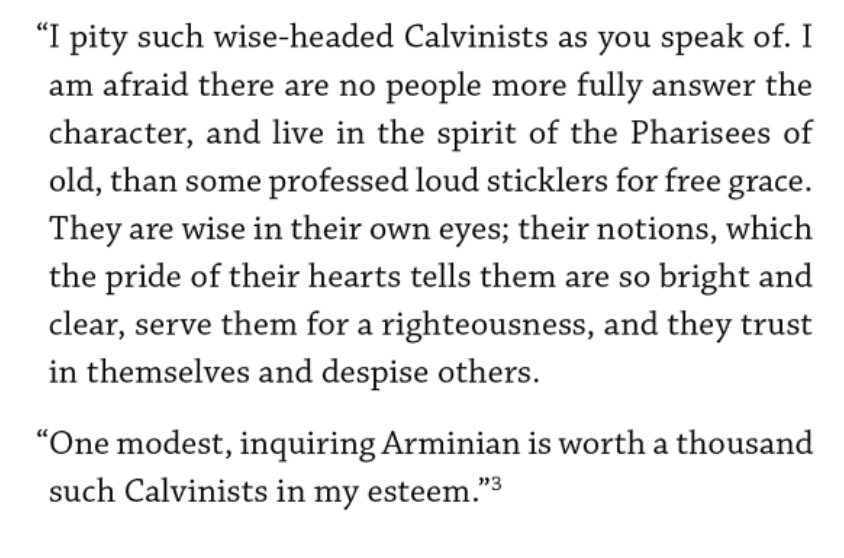
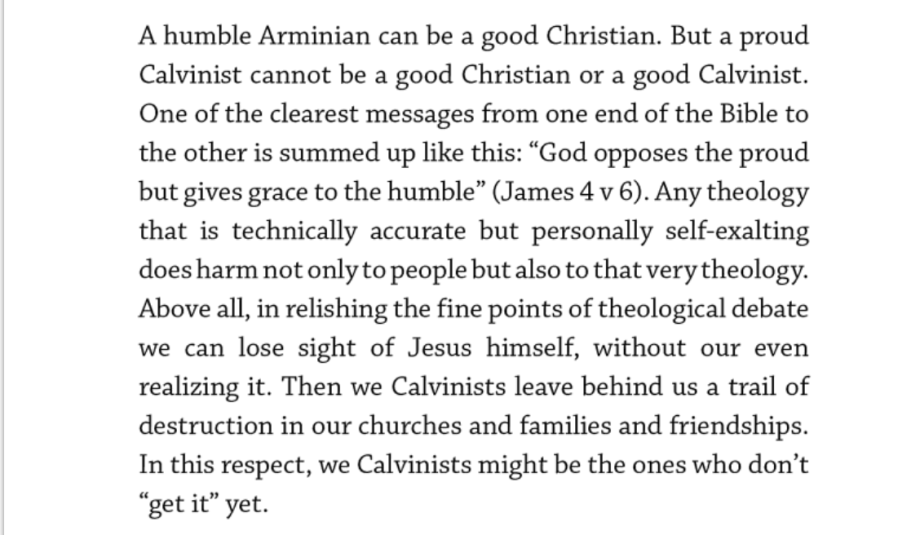
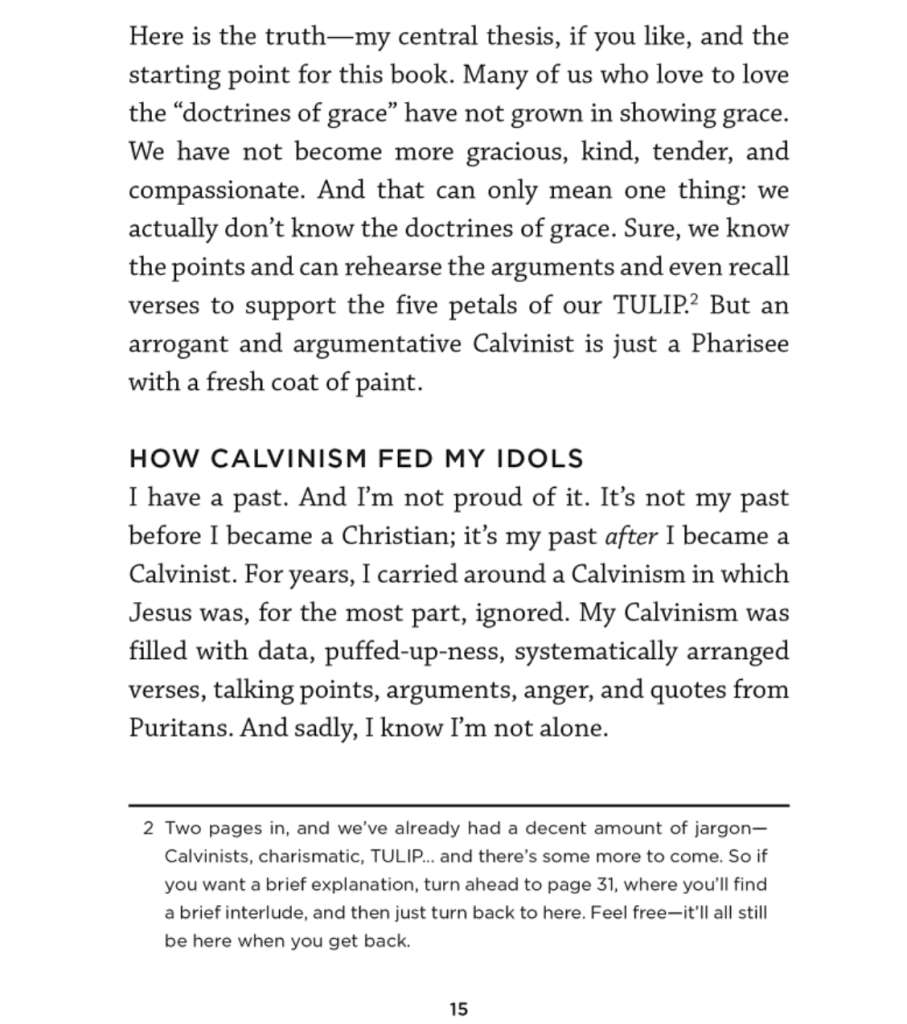
“We Calvinist leave behind a trail of destruction in our churches and families and friendships . . . .
. . . We Calvinist might be the ones who don’t ‘get it’ yet.”



And some are on pirate ships!
And some have been ignored by the lifeguard who is safely on shore.

Who:
The Crew:
When: December 20, 1943 — WWII
Where: Over Bremen, Germany
What: PDF of the Full Story – (Other links below as well)
Falling further back, the stricken B-17 came under sustained attack from enemy fighters. This time, the number 3 engine was damaged, along with the internal oxygen, hydraulic and electrical systems. Half of its rudder was lost along with its nose cone. Many of the gunners’ weapons jammed; the bomber’s defence was down to 2 dorsal turret guns and 1 of 3 forward-firing nose guns (instead of the 11 available). The exterior was heavily damaged.
Most of the crew were wounded. Sgt Hugh Eckenrode, the tail gunner, had been decapitated by a direct hit from a cannon shell. Sgt Alex Yelesanko, the right waist gunner, was wounded in the leg by shrapnel. The feet of the ball turret gunner, Sgt Sam Blackford, were frozen – the heating wires in his uniform had shorted out. The radio operator, Sgt Dick Pechout, had been hit in the eye by a cannon shell, and the radio was destroyed. And Brown himself was wounded in his right shoulder. What first aid the crew were attempting in those horrendous conditions was made even more difficult as the morphine syrettes had frozen.
Loss of blood and oxygen probably caused Brown to lose consciousness. Although his memory was hazy about the details, this is what he remembered – “I either spiralled or spun and came out of the spin just above the ground. My only conscious memory was of dodging trees but I had nightmares for years and years about dodging buildings and then trees. I think the Germans thought that we had spun in and crashed.”
Although partially dazed, Brown and his co-pilot, 2nd Lt Spencer Luke, managed to coax the bomber into a slow climb with only 1 engine on full power. To either bail out or attempt a crash landing were not viable options for Brown because of his injured crewmen. With single-minded determination, he decided to nurse the battered bomber back towards England.
Unfortunately, the crippled bomber flew directly over a German airfield, most likely the same base where Franz Stigler was. It’s assumed that Stigler was ordered to shoot the B-17 down. Stigler took off in his Messerschmitt Bf 109 and was soon alongside the bomber. As he recalled in an interview many years later, he could hardly believe what he was seeing; a bomber this badly damaged should not still be in the air. He could see the injured crew, some trying to give first aid to the more seriously wounded.
Stigler could not open fire on the crippled bomber. He remembered something Gustav Rödel, one of his commanding officers from his time in Africa, had told him – “If I ever see or hear of you shooting at a man in a parachute, I will shoot you myself.” As Stigler later said of ‘Ye Olde Pub’, “To me, it was just like they were in a parachute. I saw them and I couldn’t shoot them down.”
2nd Lt Charles L. ‘Charlie’ Brown glanced out his window to see a Bf 109 on his wing. And, not for the first time on that mission, he thought his time was up. His terror turned to bewilderment; instead of opening fire, the German pilot was gesturing at him.
Keeping his distance, Stigler was trying to get his message across to Brown using hand signals – land and surrender, or fly to Sweden. He was convinced they would never reach England.
Brown refused to land – as he himself said, “It wasn’t chivalry, it wasn’t bravery, it was probably stupidity.” To his surprise, the German pilot stayed with him, flying his Bf 109 in such a way that German anti-aircraft guns would not target the bomber. Once they reached the North Sea, Stigler saluted and flew back to his base.
‘Ye Olde Pub’ made it back to England, landing at RAF Seething, near Norwich in Norfolk, its crew exhausted, the bomber itself a shattered mess. Unbelievably, the only casualty was Sgt Hugh Eckenrode; the rest of the crew had survived.”
Franz Stigler, who’d moved to Canada in 1953, wrote to Brown, confirming that he was the one. The 2 men spoke on the phone and Stigler described everything that he remembered about their ‘meeting’, right down to the salute at the end. That proved to Brown that he had found the right German pilot.
The men became firm friends, visiting each other frequently and appearing together before Canadian and American military audiences.
Franz Stigler died on 22 March 2008; Charles ‘Charlie’ Brown died a few months later, on 25 November 2008.
I’ll finish this incredible story with Franz Stigler’s own words, when asked why he hadn’t destroyed his enemy that day – “I didn’t have the heart to finish off those brave men… I flew beside them for a long time. They were trying desperately to get home and I was going to let them do it…”
“I didn’t have the heart to finish off those brave men. I flew beside them for a long time. They were trying desperately to get home and I was going to let them do it. I could not have shot at them. It would have been the same as shooting at a man in a parachute.” [2]
. .
Key Biblical Thoughts:
. . . .
Sermonic Example:
(Include whatever information from above that you find useful)
. . . . We all know what is typically called “The Golden Rule” — Do unto others what you would have done unto you. When you make decisions or take action, think about what you would want to be done unto you, what you would want were you that person, in that situation. And then act on that understanding. Put yourself in that person’s place, position, situation, shoes!
Don’t merely talk about — loving God and loving others sacrificially — Love not in word, but in deed and in truth! — says John.
Other Information & Links:
2. “Franz’s younger brother August had joined the Luftwaffe against the family’s wishes, and lost his life over Britain. Franz then quit Lufthansa and enlisted, seeking to avenge August’s death.”
— https://bytesdaily.blogspot.com/2012/05/tale-of-two-planes.html
— Snoops = True: https://www.snopes.com/fact-check/charlie-brown/
“It had taken 46 years, but in 1989 Brown found the mysterious man in the ME-109. Careful questioning of Stigler about details of the incident removed any doubt.
“Stigler, now 80, had emigrated to Canada and was living near Vancouver. After an exchange of letters, Brown flew there for a reunion. The two men have visited each other frequently since that time and have appeared jointly before Canadian and American military audiences. The most recent appearance was at the annual Air Force Ball in Miami in September [1995], where the former foes were honored.
In his first letter to Brown, Stigler had written: “All these years, I wondered what happened to the B-17, did she make it or not?”
Sunday morning, June 24, 2021, at 1:22 in the early morning, the 12-story beachfront condominium collapsed. The tragic and catastrophic collapse of Champlain Towers South resulted in 98 people killed, ages 4 to 92.
The most aggravating factor was that PROBLEMS WERE REPORTED! Already in 2018, an inspection had identified serious structural problems. Now in April 2021, just weeks before the building collapse, Jean Wodnicki, president of the condo board, wrote that the problems identified in 2018 had “gotten significantly worse.”
“Indeed, the observable damage such as in the garage has gotten significantly worse since the initial inspection,” Wodnicki wrote. “The concrete deterioration is accelerating.”
“It is impossible to know the extent of the damage to the underlying rebar until the concrete is opened up. Oftentimes the damage is more extensive than can be determined by inspection of the surface.”
This tragedy parallels what happens before many a ministry collapse. It is not that the problems were not reported, but that the reports were ignored.
The “12 story beachfront condominiums” are the ones on the front pages of the news — RZIM, James Mac Donald, Bill Hybels, Jerry Falwell Jr., John Piper [1], CJ Mahaney, et al. These well established “12-story” ministries, at one time were believed to be powerful biblical examples that gave great hope for the cause of Christ. Until they weren’t. Until their leaders not only damaged or destroyed the institution but severely damaged the cause of Christ.
Many lesser-known “1 and 2 story condominiums” also face the same structural issues. The “collapse” will sound and look far different because they are smaller ministries. [2]
The “collapse” will be seen in diminishing attendance, tighter financial decisions, a reduction in church staff, fewer church ministries, less outreach, a drawing down on monies and assets, and even a change of pastors. Many pastors get out before the worse and/or final days of the “collapse.” Pastors move on; the people are the ones left to do the clean-up. [3]
The most aggravating factor regarding the “collapse” is that in most cases, the problems were reported! It is not that there were no signs of the structural problems. It is not that no one reported on the seriousness of the “weakening columns.” Rather, there were reports that were issued and ignored. The reports were explained and dismissed. The alerts were excused as one-offs.
Typically, the membership is not properly informed. The reports are sent to the “board,” and those who support the ministry are unaware of the issues — until they are not! Until 1:22 in the morning when they come to realize that the damage done by ignoring the reports will saddle their ministry for years, maybe for a decade and more. The long-term damage to relationships, and the ministry’s reputation as a whole, is not easily or quickly rebuilt. It took years to build it, and it will take years for someone to come in, overcome the damage, and rebuild it again.
There is an option . . . .

1. “This was supposed to be a landmark year for Bethlehem Baptist Church in Minneapolis, as the historic congregation, best known for John Piper’s 33-year tenure as pastor, marked its 150th anniversary. . . . Members who spent 10, 20, or even 30 years worshiping and serving there, who expected they would be part of Bethlehem for the rest of their lives, said goodbye to their spiritual home. “Bethlehem was the plan until we were going to be in Jesus’ arms.”
— https://www.christianitytoday.com/ct/2021/august-web-only/bethlehem-bcs-minneapolis-resign-meyer-empathy-rigney.html
2. One can argue with the accuracy of the numbers, but the numbers are not pretty. In 2020, it was predicted that 1 in 5 churches will close by 2022 — “that as many as 20 percent of churches could close within the next 18 months.” [2].
— https://baptistcourier.com/2020/10/how-many-churches-will-close/
3. Pastors move on to another ministry and explain to the new church search committee that the people, the leaders, a family, and/or the lack of spirituality caused the decline or collapse — not his leadership.
.

The Presumption of Truth
Correlates With Transparency.
&
It is
“Tell It To The Church”
which ensures transparency.
As we all recognize, there are different ways to lie . . . . .
√ To make a statement that is factually not true — It does not comport with reality. We do not need many or any examples of that in these final weeks of an election.
√ To misrepresent the details and facts — Technically, it may be true, but it is represented in an inaccurate way. He made that comment, but what was said before or after was purposefully left out because it would fail to support what we are claiming was said. A half-truth is a misrepresentation, though not an entirely untrue statement.
√ To purposefully distort the details and facts — The details and facts of a situation, conversation, or event did happen, but not as stated. It has the sound of truth because many details are included, but not as constructed or stated.[1] Some of the details may even have been omitted — “What they did not tell you was . . . . ”
√ To make nuanced statements — One uses a particular word or phrase, which deceptively makes it true. The purpose and hope of using that word or phrase are to give an impression that is not true. The statement is said in such a way as to imply what is not true. [2]
√ To make a promise, and then not fulfill that promise — Every parent has felt that responsibility. “Dad, you said you were going to take me to . . . on Friday.” [3]
√ To deceive, misdirect, obfuscate — There are ways to deceive, while not outright lying. “Did you break that vase?” Response: “What vase? Was a vase broken?” No one said that they did not break the vase, but they misdirected the questioner. To distract, muddy the waters, or divert attention to something other than what is at issue is to deceive.
Whether it be a blatant misstatement of the facts, distortion, a nuanced statement, misrepresentation, omission of details, obfuscation, diversion, misleading, misdirection, deceiving, or a broken promise, etc . . . . all are included in the meaning of the ninth commandment which is typically stated as — “Thou Shalt Not Lie.” We are called upon to be “truth-tellers” (Ephesians 4:25 and many more!).
“Buy the truth and sell it not.”
— Proverbs 23:23 —
 All of those sermons about — love, care, concern, and the church being a family — back when the church did not have to deal with Covid and the present social-political upheaval — sure sounded better then than what we see now.
Only two years ago, those sermons were believed to accurately represent what it meant to be a member of the church and/or reflect how the pastor cared for his people. He was the shepherd with a heart for God’s people. If anyone cares, it is the pastor! — He’s the under-shepherd who cares for his flock.
That was the expectation which was presumed to be the actual response of the pastor when difficult times came into our lives. Those expectations were taught as being biblically founded, appropriate, and reasonable by both those who shared leadership and sat in the pews!
However, theological and pastoral liberating “cloaks” now mitigate any pastoral failure!
√ Ministries and pastors are theologically liberated from failure by raising doctrinal banners.
“We believe in the deity of Christ. Many churches no longer believe that. We are standing on the Word and promises of God.”
“We need a revival in America — and in the church today. Churches are under attack today and our society is in shambles. Christ is the only hope of America.”
Those kinds of affirmations are enough to dismiss most any and all pastoral or church failures, short of the black and white unacceptable moral failures.
Sadly, I’ve heard it said by those who admit that their pastor is self-centered and cares little for God’s people.
“I know — and we even know personally — how little he cares for God’s people and those in the church. Yes, it is all about him, not about others. But, he preaches the Bible.”
There is an acceptable separation between saying and doing. Apparently, “doing” is not part of what a pastor is saying (non-verbally) or part of what the Bible teaches.
However, “doing” is actually part of the Bible’s teaching and is part of teaching!
Sometimes it is the “bibliological banner” that is raised above all other truths, doctrines, or practical principles of Scripture. . . .
“We are a church that preaches the unadulterated Word of God without compromise. We believe that the Scriptures are God’s solid rock of wisdom and understanding!”
“We are committed to expository preaching — line by line, precept upon precept. We don’t vary or equivocate on what the Scriptures teach!”
That will get a hearty “AMEN” and cover many a good reason to question what is actually happening when it comes to the church and/or with God’s people.
√ Ministries and pastors are pastorally liberated from failure by calling up the role, position, and/or office of “pastor.”
What was a legitimate biblical admonition — “receive not an accusation, but before two or three witnesses,” is now . . .
“Examine little to no concerns or issues that arise — Talk to few, if any, about what or why — Quiet or cover all disagreement — Allow no one to speak to those in leadership — Receive not an accusation no matter how many people have left the church — Respond to as little as possible . . . “
At times, pastoral liberation is endorsed by framing what has ( or had not been done) as needing a vote of confidence on either keeping or dismissing the lead pastor. There is a liberating quality to setting up that “either-or” response.
It is made to seem that any criticism of a pastor is only a push to have him voted out by the congregation.
It is made to seem that any criticism of a pastor is unloving or unkind — Don’t you realize that pastors are facing “burn-out” in ministry? Such questioning is harsh and ungracious.
Church leadership “circles the wagons” to protect the pastor from what they think is the intended purpose of criticism — dismissal. Instead of seeing such criticism as an opportunity to seriously help to correct course, they view criticism as a movement designed to “fire the pastor.”
Again, the options are not either-or: Keep or Fire. . . . Support or Dismiss . . . . or He is a Good or Wicked pastor.
The practical and evaluative options that ought to be considered are far more realistic and expansive than that . . . .
To bring to light an issue of legitimate concern, or to bring up the failure to serve and love God’s people, is — “You are sowing discord, and/or trying to get the pastor fired!”
There is no middle ground! Could it be that some are pushing the leadership to do what they are in a position to do and have been elected to do, representing God’s people? Those leaders are in a position to examine and discuss such concerns, and have a small enough venue to speak boldly and frankly about the pastoral actions and ministry directions!
Seemingly, the application of such biblical passages as . . .
* The Prodigal Son
* The Lost Sheep
* The Ninety and Nine
* The Good Samaritan
* “if you have done it to the least of these”
* “especially those of the household of God”
. . . . do not bear much theological or pastoral weight midst the proffered liberating excuses of pastors when failing to show care, sympathy, concern, or compassion for people.
♦ ♦ ♦ ♦ ♦
Yes, “There is no perfect pastor..” Yes, “There is no perfect church.” HOWEVER, the choices are not “perfect and imperfect.” Again, the choices are not either-or. They are — Excellent-great-good-average-weak-poor-terrible-toxic.”
We live in a day when it is Theologically and Pastorally Liberating to fail in ministry, reaching those who need Christ, and in ministering to God’s people.
No longer does the weight of biblical reasoning and common spiritual sensibility, which naturally flows from any discussion or reference to the love of God, of the incarnation (God moving into our neighborhood), demand a far better response by the church’s leaders, nor does it result in any meaningful consequences midst obvious pastoral failure!
What was once “amen and amen expectations,” when what was theologically and pastorally unacceptable and rightly rebuked, is now allowed to slide through as . . .
We do live in a day when pastoral failure has been liberated from the most reasonable level of appropriate expectations and consequences.

Probably like yourself, I have heard comments and assertions that I simply don’t believe. I have no proof that they are wrong, but neither do I have any basis for believing that they are right. But they have been stated with authority or by an authority.
I’m not saying that what was asserted isn’t true. Just that I simply don’t believe it. It will take more than a declaration by “They” — You known . . . . “They say . . . . “.
Here is another one I do not believe. It goes something like this . . . .
In making personal contact with people, if you are under 30 or 40 (“They say,” — part of the millennial generation [2]), a text, email, DM, or phone call/voice mail “works.”
I use the words “personal contact” because I am want to exclude those contacts that do work and work for all of us no matter what generation — i.e., “Will meet you there around 4.”
I am talking about “personal contact” that involves times of life that matter!
No, I don’t believe that any other contact outside of a real person, a person’s presence, actually “works!”
If we can at all be there, if there is proximity [3], if there is a meaningful relationship, and if your ministry to them matters — then presence matters!
Sending a text, an email, or making a phone call to someone experiencing these life situations, or during a real personal difficulty is inadequate and is not our Lord.
No, I don’t believe that Jesus would have sent a text to Mary & Martha, outside of the fact that He purposed to delay his arrival. He cared too much to do that!
A face-to-face, walk into the room, show up in person visit cannot be replaced by anything else! People want to see care and concern incarnated, like Jesus, to actually “show up in their neighborhood.”
The senior, or lead pastor’s presence means something! AND — no one can replace the presence of
the pastor.
Try saying this to a pastor — “You don’t need to go, I will. Your presence doesn’t mean anything more than any other deacon or member.” No one believes that, and no one believes that being there “in the flesh” is the same as sending a text message.
Sorry, I don’t believe that a text, email, DM, or anything short of “a caring pastor’s face” works, no matter who you are on “the-other-side-of-caring.”
We are all made the same when it comes to times of need, and presence matters to us who are in God’s image!
♦♦♦♦♦
In closing . . . .
I saw a sign at the dentist office yesterday . . . .
“You do not need to brush all your teeth, just the ones you want to keep.”
In the same vein . . . .
You do not need to be there for all people or all the life situations that matter to them.
You only need to be there for the people that
you truly care about
and with whom you want a ministry.
1. Some can be easily and quickly fact-checked because they are mathematically verifiable — i.e., Cleopatra lived closer in time to the first Moon landing than to the building of the Great Pyramid — Click here for proof.
2. “The millennial generation, sometimes also referred to as generation Y, is generally agreed to include people born in the early 1980s through the early 2000s.”
3. Have you ever said to your children, “You need to eat what’s on your plate; people are starving in the world and would give everything to have what is in front of you.” No, we can’t send the meal to them, but we can help our neighbor.
Is not that what “The Good Samaritan” account teaches — proximity! We can’t help all who have been accosted, abused, or used, but we can help those on our path, those who are proximate!

There are some real and unfair parts and pieces of being a pastor! I get that, but I am no longer sympathetic to that headlines and/or storylines — “Why Pastors Are Buring Out!” “The Great Reshuffle” “Should You Be Looking For Another Ministry or Job?” “Is It Time To Retire Early?”
Just had a friend and fellow pastor tell me again how hard it is to be a local church pastor! In fact, we left a church well over a year ago after a pastor had the non-sensical ignorance to tell the congregation that the lesson he had learned through Covid was that he never realized how tired he was. Never mind, the people who had lost jobs, were sick, and/or had enough fears already through the mess that was only beginning.
When the “coach” of the team says that he needs to sit on the bench and rest, the team is hardly inspired for the game on the everyday field!
It’s about him! That’s the real problem. While fellow leaders and staff commiserate with him and laud his years in ministry — God’s people struggle, with little genuine pastoral concern or care. Such words from the pulpit are designed to generate sympathy for and praise of his valiant struggle as the shepherd with a heart for the people. He wouldn’t have chosen this job or be doing this work, had not the Lord called him. He is sacrificing for others!
Honestly — I am tired — but I’m tired of ministry leaders and pastors bemoaning their calling! Yes, their calling into one of the greatest joys of life — working with and alongside God’s people, on one of the many fronts of the battle for the Gospel!
Here is what I say in response when I hear such words . . . . .
“You’re tired.” “It’s hard!” — Really!
We need to get some Afganhni pastors to write these articles about ministry burnout, exhaustion, resignation, and the like. Let’s have pastors who don’t know if they or their family will be alive in the morning. Let’s have pastors from third-world hot spots write about how they lay away at night and don’t know if their daughter is coming home, or has been raped! Yes, they might have reason to talk like American pastors who are wearied by far — far — far lesser concerns!
These are pastors, who are challenging everyone else to trust the Lord, be understanding, love others where they are, care and love your neighbor, and be more compassionate . . . . and they are tired – stressed out — worn thin — emotionally threadbare — struggling.
I’m glad Daniel, Joseph, Ruth, Mordecai, Nehemiah, and Paul didn’t say to the troops — “I’m Tired!” “This Is Hard.” or “I Need A Sabbatical.”
What happened to “Dare to Be A Daniel,” “There Is Joy In Serving Jesus,” “Battle From Victory, Not To Victory.”?
“If thou hast run with the footmen, and they have wearied thee, then how canst thou contend with horses? and if in the land of peace, wherein thou trustedst, they wearied thee, then how wilt thou do in the swelling of Jordan?”
Jeremiah 12: 5

Looking Ahead: The size of one’s salary will never change one’s heart condition, including the heart condition of a self-serving pastor. ♦♦♦♦♦ Selfishness is never changed by money. Increase is always seen as well-deserved!

Let me grab the words of Solomon in Ecclesiastes . . .
“There is an evil which I have seen under the sun, and it is common among men:”
When men are broadly exhorted about wrong attitudes or actions, they take quick inventory as to whether they fall into that wrong thinking or behavior before they inwardly and outwardly respond.
Example: Say this to a pastor who is unconnected to your situational example and see what is said in response!
” I cannot fathom how this happens, that not one pastor on the staff visited her mother when she was in the hospital for surgery, or then when she was transferred to rehab, still not one visited her mother!”
Two Different Responses: I heard two different responses when I said that to two different pastors as I was challenging them about showing care and concern for God’s people.
1 – “That hits home, Ted. I need to do better at loving my people. What are some creative ways that show we can be better at showing that we care . . . .”
2 – “Well, the demands placed by people on us as pastors can be unreasonable. I know that I have failed at it at times. . . . .As a pastor, we face . . . . We will fail at that . . . I have and probably will again . . . “
One was a Church of God pastor, and one was Baptist.
The human mind’s ability to process thoughts in milliseconds is astounding. The bank of failure and guilt is so quickly inventoried that in seconds we can decide to dispute or concur with what is said based on how we have performed in this-or-that role or situation.
I have seen people justify wrong-doing by making outlandish statements as to how they themselves would have responded if it had been them, and not another — “I’d be okay with that.” I thought (and often said) — “Are you kidding me! You have to say that because otherwise, you’d have to say you were wrong!”
The inability of men, God’s people, but worse yet, ministry leaders and pastors to say that wrong is wrong, even if it slays me and my heart, defeats any credibility that pastors rely on to move and influence the sheep.
There needs to be an island of reason in the sea of confusion that engulfs our culture and society today! Unfortunately, today, the confusion is left unabated in many ministries and pulpits. [1]
“There is an evil which I have seen
under the sun,
and it is all too common among Baptist pastors!
The inability to own it, and a lost credibility!
The inability to see, face and admit that we were wrong and/or that we have failed.
The refusal to genuinely apologize and make it right!
1. There are multiple biblical passages which address this problem . . . . .
Psalm 15:1-2 — “He that walketh uprightly, and worketh righteousness, and speaketh the truth in his heart.”
Proverbs. 28:1 “The wicked flee when no man pursueth: but the righteous are bold as a lion.”
Matthew 7:4-5 — “” Or how wilt thou say to thy brother, Let me pull out the mote out of thine eye; and, behold, a beam is in thine own eye?
Proverbs 21:2 — “Every way of a man is right in his own eyes: but the LORD pondereth the hearts.”
Proverbs 12:15 — “The way of a fool is right in his own eyes: but he that hearkeneth unto counsel is wise.”
Proverbs 26:16 — “The sluggard is wiser in his own conceit than seven men that can render a reason.”
II Corinthians 1:12 — “For our rejoicing is this, the testimony of our conscience, that in simplicity and godly sincerity, not with fleshly wisdom, but by the grace of God, we have had our conversation in the world, and more abundantly to you-ward.”
II Corinthians 8:21 — “Providing for honest things, not only in the sight of the Lord, but also in the sight of men.”
Psalm 51 — David exemplifies the honesty needed after being confronted with the truth about his grievous sin.
 All Things Church