Author: tmart2007

Blogger on RhetoricandHomiletics.org

“Open Letters” — If You Think They Are Unnecessary, I Suggest That Some Might Think Otherwise.

In every case,
it took someone going public
before action was taken! 

It is not that others were not told about what was happening!

It’s because internal controls are broken because of relationships and misdirected loyalty!

It was that no one took action until someone stood up, spoke loudly, and finally went public!

√ James MacDonald Fired from Harvest

√ Ravi Zacharias Hid Hundreds of Pictures of Women, Abuse During Massages, and a Rape Allegation.

√ Former Christianity Today editor Mark Galli accused of sexual harassment.

√ Brian Houston: Hillsong founder resigns — again — following misconduct allegations.

√ Jess Bogard: Hillsong shutters Dallas church after reports of pastors’ lavish lifestyle

√ John MacArthur publicly shamed and excommunicated a mother for refusing to reconcile with her abusive husband.

♦♦♦♦♦♦♦♦♦♦

Toxic church gaslighting protocol:

1. That never happened

2. OK, it happened, but it wasn’t that bad.

3. OK, it happened, and it was that bad, but you need to get over it.

4. Ok, we really don’t care if you get over it-we just want you to stop talking about it.

Lauren Chastain:

Concerning the Hillsong Documentary, now being broadcasted:

“Just keep in mind that for every victim that speaks up on that Hillsong documentary, there are countless more who didn’t have the capacity to speak up emotionally, mentally, or legally. Nearly every victim I know says, “I’m sorry, I can’t talk about that publicly; it’s too hard.”

Concerning Guidepost Report Regarding Christianity Today’s Mark Galli:

“Another aspect of reporting that seemingly is not sufficiently taken into account at CT is how the power dynamic between employees can influence the decision of whether or not to report harassment allegations. Some may feel intimidated or fear the consequences of reporting alleged misconduct by someone higher up in the organization – even if that more senior employee is not in the employee’s supervisory chain, and even if the employee has the option of reporting to HR. In an interview, one woman expressed a sense of futility about reporting allegations against higher-ups, stating that if someone at CT is important enough, they can get away with things; a female former employee made a similar observation. Another woman stated that Former Employee 1’s words seemed to matter more than a woman’s words in any “she said/he said” situation.

With respect to the investigation of harassment allegations, CT’s processes do not include defined written investigative procedures with specific steps or any requirements about documenting investigative findings.”

“When I said these exact words to the chairman of the board from our church 2 yrs ago, I was almost laughed out of the room.”

“And then you are accused of not going about things the right way.”

“The people in church who clutch their pearls over 4 letter words but have unending grace for predator pastors.”


Other Interesting Quotes:

“Here’s one experiment – start honestly questioning procedural matters (not even doctrinal ones) and don’t settle with shallow answers. You’ll be labeled a “troublemaker” and “divisive” in no time. You’ll be told “then why don’t you just leave?” soon enough.”

“It became very clear as I left certain church circles that there was an entire narrative that had been crafted about me and the reason I had left – all of which were false.”

 – – – – – – – – –

If we have learned anything, it is that board members, deacons, fellow pastors, leaders, pastors, elders, administrators, et al. are not capable of holding wrongdoers accountable internally.  Relationships, the drive to defend the institution over those who have been used, misused, and abused, and putting loyalty over integrity has repeated hindered internal controls.

It’s Sad To Be Saying This Now!

Photo by Allef Vinicius on Unsplash

In an article titled, “Six Ways Your Church Can Prepare for the “Great Giving Reshuffle,” [1] the author’s third suggestion is rather telling and odious.  It reveals what has happened within many a ministry and with local churches. It is a sad commentary on how wrong-headed the thinking continues to be — in this case, by the article’s author writing for ministry leaders. 


“Emerging indicators signal a change in giving patterns in the last half of 2022. If financial giving is reordered, how would you lead your ministry with less financial resources?

How can you prepare for and thrive when a giving reshuffle occurs? 

Here are six ways you can prepare:

3. Care for the souls of your people more now than ever. 

People are no less interested in your mission but are more eager to be part of an active community, especially a community that engages the emotional, spiritual, and family aspects of life. Core givers will dutifully give from a sense of obedience and loyalty. White-hot giving happens when a heart and mind sense authentic faith embedded in a life-giving, worth-it-all mission. 

The more your congregation knows you love them, care for them, and desire their best above all else – the more their giving will prioritize your church and mission.  

The trending word for this is attunement. Attunement means being aware and shepherding the soul in needs, wants, emotions, and personal pain when that pain comes. For the last decade, the primary emphasis has been on leadership. Yet, that leadership focus might have been skinny on the pastoral care side. [1]


“More now than ever” — really!  When finances are at stake, not when a ministry or church was doing well, but now — when the dollars might run out — care for people more now than ever!

As I have often said, the last argument made to a ministry or local church is $$$$.  When the giving is no longer sufficient to cover the costs of operation — salaries, benefits, utilities, programs, and maintenance — leadership begins to listen.  Then leadership gets curious as to what is happening and why.  Some things finally begin changing.  

Before being forced to care for the friends and members of the ministry, look for these attempts to advert that potential necessity — that of “caring for your people more now than ever”. . . . 

  • Church programs are canceled — After all, “the church is not about programs, but people.”  As if programs are not an organized way to minister to and meet people.  
  • Surviving church programs are financially restructured, attenuated, or abused [2] — “This year there will be a charge of $5.00 for the men’s prayer breakfast.”  As if having men attend a prayer breakfast is not something worth investing in — since we say that prayer matters.  Beyond that, if the cost of 20 – 50 people meeting for a prayer breakfast will make a difference in church finances, it really is time to close the doors.
  • Staff Changes Begin To Be Considered & Take Place: The most recent usually go first, unless someone is close to retirement, is ill-preforming in the role they are in, or no longer makes a difference.  The last to turn the lights off will be the Sr. Pastor or Ministry Head.
  • An Austerity Program Is Instituted:  It is not that anyone failed to care for the people — you do realize that! We are merely living in difficult days!  We need to be more frugal and careful.  Let’s turn off the lights, put off maintenance, use the church vehicles less, put off raises (at least for those under the most senior leadership members), turn the air conditioning down, and/or run a little cooler in the winter.

There is a great financial giving reshuffle [3] regarding church finances with many a ministry across America.[4]  No, not all because some did not need to “care for their people more now than ever.”  They were caring throughout the years of ministry (and through the Covid-19 pandemic ).  With some, finances were never the motivation for caring, or caring more!!

What has been obvious and shameful is actually being said publicly — to pastors and ministries — because that’s where we are — over two years late in caring about the “family!”

The article says what many would never say or admit, that too many ministries are about money, and caring is secondary.

How many?  
Don’t know — but the breadth and influence of Carey Nieuwhof’s audience may be a woeful indicator!

Caring becomes necessary when the finances get rough!

When the ship starts taking on water,
then it’s time to care about the passengers who can help bail you out!

^

Does Anyone Else Feel That People Are Being Used!?

^


1. https://careynieuwhof.com/six-ways-your-church-can-prepare-for-the-great-giving-reshuffle/

2. Other Ministry Income Is Used:  Income generated by other ministries, such as a Christian school,  VBS offerings, missions giving*, or other adjunct church programs, will be used in unclear or subtle ways to keep things running. 

* For instance, monies designated for missions will still be applied to missions, but in place of the general fund giving that was typically used.

3. I Don’t want to say, “I told you so,” but I did.  Over a year ago, I wrote a blog stating that giving was a lagging indicator of how well a ministry was doing in caring for its people through the pandemic!  

4. Some people need to make “the last argument” when it comes to the ministry that they have been supporting.  They need to stop giving to irresponsible ministries and churches, reshuffle their giving to other ministries that have never stopped caring, and never let $$ be a motivation for “caring more!”  Don’t stop  giving, but decide that it is time to make better choices as to whom and where you give!

5 Reasons That Explain The Escalation Of “Open Letters”

There are clear reasons that we live during a period in ministry and church life where more and more “Open Letters” are being written and publicly posted. [1]

#1 – More and More Public Ministries:  More ministries have sought to attract an audience far outside their geographical ministry area. The result is that those same ministries have become more accountable to a far wider audience. If you want to preach and teach (books, blogs, articles) to people all across America, be prepared to be held accountable for what you preach and teach by both God’s people and, yes — their pastors. Julie Roys’ rise to prominence is due to the prominence of large and public ministries — i.e., John Piper / John Mac Arthur. 

#2 – Covid-19: The lack of care and concern by far too many ministries and pastors has been all too visible during a time of great need. Previously, the lack may have been unseen because the need wasn’t so real. However, since Covid-19, many have come to realize that they are not a family, as is so often portrayed.

#3 – No Calling: There is an increase in the number of people who go into the ministry for reasons other than God’s call. Some (again, far too many) leave the business world, or their “college-educational field of original endeavor,” and decide to go into the ministry. “Some” have a weak biblical education, no seminary education, and/or far too little ministry experience. On that foundation, they decide that they are going to start a church. How has that worked out for the vast majority?

#4 – Sinful & Self-Serving Ministry Leaders & Shepherds:   There are ministry leaders and pastors who are as carnal as the people they minister to. RaviZ is proof positive that no matter the theological acumen, giftedness, person’s age, and/or achievements cannot handle the lure of recognition, power, and money.  

#5 – A Failed Accountability Framework: Those who form the surrounding leadership structure, that is in place to guard and guide a ministry, have repeatedly failed to rein in its ministry leaders. The model of “internal ministry accountability” is visibility and patently broken. 

The leadership that is in place to guard and guide a ministry or local church (that includes fellow pastors, staff members, board members, deacons, elders, et al.) has repeatedly shown itself unable to recognize wrongdoing and/or to call out wrongdoing. Too often, relationships interfere, loyalty trumps integrity, and/or explanations are accepted without the second or third question being asked.

What Happens Because Of These Situations?:

People “Go Public!” [2]
“Open Letters” are written because there is no way to address the questionable, wrong-headed, unbiblical, and/or sinful actions of . . . . [3]

  • public ministries that impact 1000s
  • ministries that lack the care and concern of their people
  • pastors who were never called into the ministry
  • self-serving ministry personalities and pastors
  • ministry leaders and pastors who are insulated and/or protected 

^


^

1. “Open Letters” were typically sent to those who belonged to this-or-that organization. They were sent to the membership and/or to the “leadership structure” in place. Today, the situation has undergone a significant change. Today, “Open Letters” can be found in a variety of places —  Substack, purchased advertising space in major newspapers, Twitter, SBC resignation letters and state resolutions, Julie Roys Reports, the Wartburg Watch, books (or book introductions & entire chapters), and through membership email.

2. Those who negatively respond to “Going Public” surely are not saying that those who went public concerning the actions of RaviZ, Dave Ramsey, James MacDonald, John MacArthur, et al. should not have gone public (after seeking to address the issues personally and privately first)!

Or is it that some just don’t like people “Going Public” when it is a ministry leader[s] and/or pastor[s] who have failed to respond to those who have personally and privately tried to address wrongdoing.

3. We should expect more and more “Open Letters” as the actions, theology, practicology, attitudes in ministries and local churches continues to deteriorate in the last days. — “shall he find faith on the earth?” Luke 18:8

4 Questions Worth Asking John Mac Arthur

via GIPHY

Of course, there will be no response from John Mac Arthur — at least at this time. Maybe later, subtly and covertly, he will justify and excuse what was done, at a time “foggily removed” from this terrible failure of grace — after people forget “Grace to You,” but not to her.” [1]

Too often, “Going Dark” is not an example of genuine godliness, but is merely a cloak of humility and/or suffering for Jesus. After all, what does a man like John Mac Arthur say to make such actions and words palatable to anyone who listens to what happened, other than a sincere apology. 

Most realize that an apology is not going to happen. Not because it is not in order; it is! Even his supporters can only say — “It is terrible (BUT we all make mistakes).” [2] “It was years ago!” [3]

Most sincere people realize that “Going Dark” is a strategy, not spirituality. Few are deceived as to what is happening. It is not an example of “powering under,” but a subtle way to “power over” brothers and sisters in Christ. . . . . and those who “Go Dark” are not “just like Jesus.” It is the world, not our Lord, no matter how much it is justified using a biblical proof text – i.e. “He opened not His mouth.”

^

Some Questions Worth Asking:

#1) Why broach an issue of “church discipline” before communion, as God’s people seek to prepare their hearts for one of the most meaningful sacraments of the body of Christ.

#2) Why go public? Why not call an all-church membership meeting to deal with such issues? Is church discipline a public or membership polity concern? Surely there were many who were present who had no awareness or involvement, maybe even those who knew not Christ as their Saviour.

#3) Why publicly include ANY of the sorted details? If you were going to speak publicly about the matter, would it have been sufficient to indicate that Elieen Gray has been removed from the church’s membership in very general terms?

4) Why by-pass the biblical standards? If Matthew 18 is the primary passage that is being used to define the practice of church discipline, follow what it states. . . . 

“tell it unto the church: but if he neglect to hear the church, let him be unto thee as an heathen man and a publican”

√ tell it unto the church

You are to inform the church, the local body of believers, not the public. Church discipline is an internal matter. It is just as one would do were a pastor called out for wrong-doing or dismissal. It is called the Royal Law – James 2:8

√ but if he/she neglect to hear the church

“The church” is to be brought into the matter and allowed to come to a consensus. “The church” means precisely that, “the church.” It is not the pastor or deacons, but “the church” is the final arbiter.

The Scriptures do not teach that there is an individual or a group of individuals who speak on behalf of the uniformed church, but it is the church that hears the matter and is then heard. 

The addressing of an issue by “one or two” allows any leadership to move an issue forward, on to “the church.”

“The church” hears the matter, fully and fairly, and comes to a joint decision and communicates that decision to the offender. 

“The church” is given the opportunity to hear the offender and the offended before making a decision, just as the original one, and then one or two more, were given the opportunity,

“The church” not only communicates that joint decision, but allows an opportunity for that individual to hear or not hear their conclusion — “if he/she neglect to hear the church.” 

^

Why bypass biblical instruction? There are reasons for by-passing the stated procedures; it is called control!

There is no reason not to follow what the Scriptures clearly outline as the steps for church discipline.

It is often argued that many churches do not engage in church discipline as they ought.  It may be equally argued that when churches do engage in church discipline, they woefully fail at following the biblical guidelines!  They use Matthew 18 as a weapon to control or silence what has actually taken place. 

Typically, the method is to skirt around the guidelines, while maintaining a semblance of biblical obedience.

One of the methods is to propagate the idea that an individual or a group of individuals can replace “the church” and/or speak for “the church.”  “The church” is now the Sr. Pastor, or the deacons/elders.  That avoids having “the church” hear the details or facts of a situation.  It avoids having the whole truth heard.  It avoids questions and questioning the given answers.  It is sinful manipulation. [4] [5]

^


^^

  1. The theme of Mac Arthur’s Shepherds’ Conference, March 2022, was “Unashamed.” I imagine the public shaming Elieen Gray before serving the Lord’s Supper is an example of that theme.
  2. Yes, we all do make mistakes in ministry, but we do not all “Go Dark” when called to account. Some have the godliness and self-dignity to apologize and to show some moral courage to admit wrong-doing. That is what differentiates the genuine and the disingenuous, the mature and self-serving.
  3. Yep, just like President Bill Clinton, Bill Cosby, et al. — until it is your family, loved one, daughter, mother, sister . . . . . .
  4.  Those who change church policies, the church’s constitution, rewrite the by-laws, and/or just change historical & biblical practice regarding church discipline, to increase control, ought not to be given the respect as shepherds, pastors, or deacons. “They care not for the flock,” they care for themselves!
  5. Oh, after those questions, could you also tell us why you need 3 million dolllar homes?

4 Questions Worth Asking John Mac Arthur

via GIPHY

Of course, there will be no response from John Mac Arthur — at least at this time. Maybe later, subtly and covertly, he will justify and excuse what was done, at a time “foggily removed” from this terrible failure of grace — after people forget “Grace to You,” but not to her.” [1]

Too often, “Going Dark” is not an example of genuine godliness, but is merely a cloak of humility and/or  suffering for Jesus. After all, what does a man like John Mac Arthur say to make such actions and words palatable to anyone who listens to what happened, other than a sincere apology. 

Most realize that an apology is not going to happen.  Not because it is not in order; it is!  Even his supporters can only say — “It is terrible (BUT we all make mistakes).” [2]  “It was years ago!” [3]

Most sincere people realize that “Going Dark” is a strategy, not spirituality.  Few are deceived as to what is happening. It is not an example of “powering under,” but a subtle way to “power over” brothers and sisters in Christ. . . . . and those who “Go Dark” are not “just like Jesus.” It is the world, not our Lord, no matter how much it is justified using a biblical proof text – i.e. “He opened not His mouth.”

Some Questions Worth Asking:

#1) Why broach an issue of “church discipline” before communion, as God’s people seek to prepare their hearts for one of the most meaningful sacraments of the body of Christ.

#2) Why go public?  Why not call an all-church membership meeting to deal with such issues?  Is church discipline a public or membership polity concern? Surely there were many who were present who had no awareness or involvement, maybe even those who knew not Christ as their Saviour.

#3) Why publicly include ANY of the sorted details? If you were going to speak publicly about the matter, would it have been sufficient to indicate that Elieen Gray has been removed from the church’s membership in very general terms?

4) Why by-pass the biblical standards?  If Matthew 18 is the primary passage that is being used to define the practice of church discipline, follow what it states. . . . 

“tell it unto the church: but if he neglect to hear the church, let him be unto thee as an heathen man and a publican”

√ tell it unto the church

You are to inform the church, the local body of believers, not the public.  Church discipline is an internal matter.  It is just as one would do were a pastor called out for wrong-doing or dismissal.  It is called the Royal Law – James 2:8

√ but if he/she neglect to hear the church

“The church” is to be brought into the matter and allowed to come to a consensus. “The church” means precisely that, “the church.” It is not the pastor or deacons, but “the church” is the final arbiter.

The Scriptures do not teach that there is an individual or a group of individuals who speak on behalf of the uniformed church, but it is the church that hears the matter and is then heard. 

The addressing of an issue by “one or two” allows any leadership to move an issue forward, on to “the church.”

“The church” hears the matter, fully and fairly, and comes to a joint decision and communicates that decision to the offender. 

“The church” is given the opportunity to hear the offender and the offended before making a decision, just as the original one, and then one or two more, were given the opportunity,

“The church” not only communicates that joint decision, but allows an opportunity for that individual to hear or not hear their conclusion — “if he/she neglect to hear the church.” 

Why bypass biblical instruction? There are reasons for by-passing the stated procedures; it is called control! There is no reason not to follow what the Scriptures clearly outline as the steps, and allowing an individual or a group of individuals to replace “the church” and/or speak for “the church” when “the church” has never heard the details or facts of a situation, is sinful manipulation. [4]


  1. The theme of Mac Arthur’s Shepherds’ Conference, March 2022, was “Unashamed.” I imagine the public shaming Elieen Gray before serving the Lord’s Supper is an example of that theme.

  2. Yes, we all do make mistakes in ministry, but we do not all “Go Dark” when called to account. Some have the godliness and self-dignity to apologize and to show some moral courage to admit wrong-doing. That is what differentiates the genuine and the disingenuous, the mature and self-serving.

  3. Yep, just like President Bill Clinton, Bill Cosby, et al. — until it is your family, loved one, daughter, mother, sister . . . . . . 
  4.  Those who change church policies, the church’s constitution, rewrite the by-laws, and/or just change historical & biblical practice regarding church discipline, to increase control, ought not to be given the respect as shepherds, pastors, or deacons. “They care not for the flock,”  they care for themselves!

Okay, It Is Time To Say It!

. . . . 

As I reflected on the impact of watching what is happening in Ukraine regarding both Zelensky and its people over the past two weeks, I realized how stirring and personally challenging it is in a subtle and probably subconscious way.  It is persuasive and motivational to witness such true moral courage and strength or an individual and of a people!

. . . . 

. . . . 

The Elephant In the Room: Okay, It Is Time To Say It! — Or At Least Say It Again!

The phrase “The Elephant In the Room” is a metaphor referring to an obvious problem, a significant problem that is being avoided or ignored.  No one wants to acknowledge or discuss it, but it is

So, let’s take the plunge regarding what has not been said concerning the controversies surrounding men such as John Mac Arthur, John Piper, and Mark Driscoll.[1]  They are connected! [2]

While Jonathan Leeman would like to call it “ironic”[4] — that a person like Mark Driscoll, a member of the new Calvinist movement (or the YRR – Young, Restless, & Reformed) would end up as he has — I think not!

It’s not authentic to simply call it “ironic” when in fact, it is all too predictive.

It’s not ironic; it’s all too consistent.

I think that such an evaluation is merely a refusal to address the elephant in the room.  Why do we keep seeing those in the reformed theological camp caught up in controversies involving the abuse of God’s people?  That is the question that again comes to mind — not only regarding Mark Driscoll / May 2021,  but John Mac Arthur / March 8, 2022.

Why does this keep showing up among those who are reformed?

“There comes a point where we need to stop just pulling people out of the river.

We need to go upstream and find out why they’re falling in.”

― Desmond Tutu

The most recent and repulsive case involves John Mac Arthur. He is preceded by John Piper/BBC/BCS, preceded by Mark Driscoll, preceded by Paige Patterson,  preceded by C.J. Mahaney, preceded by . . . . AND those that have defended them along the way!

It might be fairly argued (and not the first time by me) that a theological arrogance accompanies those in the reformed camp — “We are the ones who have the doctrines of grace right!” That, along with the intellectual acumen that is requisite of reformed thinkers, further separates Christian leaders and pastors from the person in the pew. “They just don’t understand God, His Word, and the truths of penal substitution as we do!”

Likewise, complementarianism is the second elephant in the room that few want to connect with present-day reformed theology. The problem is not merely “Driscoll’s version of complementarianism.” [3]. Good try, but “complementarians aren’t off the hook” merely because Driscoll’s brand was the full version played out to its abusive end.

There is a spirit of spiritual superiority and a sense of administrative arrogance that accompanies those who travel on the roads of reformed theology (and I am far from the first one to point that out)! Too often, people are not as valued as they ought to be, and their struggles are marginalized from the pulpit, in the prayers, and during times of personal interaction.  The common person sitting in the pew is taught a form of “Stoic Christianity.” 

“Just grin and bear it!
(Just suck it up.)

He is in sovereign control of what is happening
and has brought this into your life for a reason!

 It’s not about you. It’s about Him. [6]

It is as if the Lord is so self-absorbed that there is only a single purpose in all that the Lord brings into our lives — His glory — almost to the exclusion of our genuine good and holistic well-being. Apparently, the Lord has little interest in our emotional, mental, or psychological condition or state. [7] [8].  Seemingly, He is not like us relationally, as fathers, mothers, parents, spouses, siblings, or now as grown children who are concerned about our parents.

We must be misunderstanding the account of the woman at the well, the good Samaritan, the woman caught in adultery, Peter’s denial of the Lord, the death of Lazarus (Behold how he loved him), His weeping over Jerusalem, His sacrifice for us as sinners, His incarnation, His patience with Judas, the doubting of Thomas, the rebuke of James & John about calling down fire, the disciples on the road to Emmaus, et al.

It’s a “Stoic Theology” that preaches and behaves as if there is only one commandment, rather than two great commandments– the second being called the Royal Law. The second one flows out of loving God. It instructs us about being like God Himself — caring about people in need, in pain, struggling, and not like Job’s friends! [8]

Perhaps a re-read of the Psalms would help!  A re-reading that realizes how many Pslams end with pain and no personal resolution!  A re-reading that see how often that His people water their couch with tears” and can only rest in the reality that God has heard those prayers and that He cares — that He genuinely cares about us!

. . . . 

Does Jesus care when my heart is pained
Too deeply for mirth or song,
As the burdens press, and the cares distress,
And the way grows weary and long?

Refrain:
Oh, yes, He cares, I know He cares,
His heart is touched with my grief;
When the days are weary, the long nights dreary,
I know my Savior cares.

Does Jesus care when my way is dark
With a nameless dread and fear?
As the daylight fades into deep night shades,
Does He care enough to be near?

Does Jesus care when I’ve tried and failed
To resist some temptation strong;
When for my deep grief there is no relief,
Though my tears flow all the night long?

Does Jesus care when I’ve said “goodbye”
To the dearest on earth to me,
And my sad heart aches till it nearly breaks—
Is it aught to Him? Does He see?

. . . . 

Let me close with saying that there is a woeful lack of recognition that reformed theology, even in its best and highest expressions, cannot shield, and has not safeguarded, a ministry leader or pastor from some of the most egregious expressions of abusive behavior!  —  Dabney, the Puritans, Edwards, and Calvin himself [5] are but a few of the reformed thinkers and preachers who loaned their voices to support and/or explain justify slavery!

It is not that reformed preachers and/or theologians were the only religious leaders who supported slavery, but that their reformed faith did not safeguard them from taking such a repulsive and unbiblical position!  It did not because it cannot!  It cannot protect them from propagating terrible positions on the role of women in the church, in society, and/or of a wife in the home and in marriage — i.e complementarianism, and specifically men like Mark Driscoll.

Not only can reformed theology fail to safeguard, but it has the real potential to exacerbate some of the most odious actions and ministry behaviors.  The proof is not in the denials, but it is the pudding — John Mac Arthur and John Piper — two of the loudest voices in our religious culture today, two of the most prolific disseminators of reformed thinking for decades — both of who are reformed in their theology and in the practice of that reformed theology!

. . . . 


. . . .

1. The Rise & Fall Of Mars Hill
https://www.christianitytoday.com/ct/podcasts/rise-and-fall-of-mars-hill/

2. John Piper was a supporter (and, to say the least, a latecomer to the condemnation of Driscoll) of Mars Hill / Mark Driscoll’s toxic ministry!
https://www.worldviewweekend.com/news/article/john-piper-tweets-support-mark-driscoll-did-piper-forget-what-church-pastor-be
https://www.wthrockmorton.com/2014/11/13/john-piper-on-lessons-learned-from-mark-driscoll-controversy-ecfa-are-you-listening/

3. https://www.9marks.org/article/an-ecclesiological-take-on-the-rise-and-fall-of-mars-hill/

4. “The ironic thing is, Driscoll rose up in the Young, Restless, & Reformed world, a world that is supposedly theologically driven and knows you should spit when you say “pragmatism.” Driscoll himself called church consumerism “a sin” (Vintage Church, 252). But a dynamic young leader drawing big crowds and reaching new groups makes us lose our heads. He exposes how much pragmatism remains in us, since pragmatism, in the final analysis, means living by sight and not by faith. Sight says, “Look at those polling numbers! Tell everyone it’s a movement of God.” Faith says, “But is he wise? Is he building with materials that will stand the test of time?” — https://www.9marks.org/article/an-ecclesiological-take-on-the-rise-and-fall-of-mars-hill/

5.– https://www.christianityapplied.org/john-calvin-on-the-lawfulness-of-slavery/

6. The danger is always that there are elements of biblical truth and principles in such statements and that such statements leave much unsaid.

7. There is a reason that Dane Ortlund’s book has been such a best seller — “Gentle & Lowly.”  It is because there is such a lopsided view of God being presented in today’s pulpits!  It is not a stoical view of God or the Christian life!

8. It is a “Stoic Christianity” that speaks against even allowing our situation to bring any happiness,  joy or comfort.   We can have joy, but not happiness.  Happiness comes from the situation.  Therefore, we are to find no comfort in our situation, only in Him.

As if what is happening around us should have no impact — both good and bad.  As if a warm sunny day should not affect our minds and hearts.  As if a word of encouragement should be emotionally dismissed as sinful pride.  As if the birth of a child is not a situation that brings happiness, and loss of a loved one should not be painful — as often stated — not “we sorrow not,” but we sorrow not as those who have no hope!

John rejoices over the reality that his children walk in the truth.  It is painful when the situation is otherwise!  Naomi came back to Bethlehem after a terrible situation in Moab.  She rejoiced over the situation that Ruth was with her and the more when Jesse was born.  Jesus wasn’t sweating drops of blood a year before Gethsemane.  The situation He was facing was agonizing and painful.

Situations do affect us, and should affect us — surely the good and helpfully the bad.

It is stoicism, not Christianity, that teaches that we are just to grin and bear whatever happens!

Since every man who lives is born to die,
And none can boast sincere felicity,
With equal mind, what happens, let us bear,
Nor joy, nor grieve too much for things beyond our care.

— John Dryden —

This is not Christianity!

https://www.desiringgod.org/articles/four-lessons-from-a-calvinist-slave

https://www.christianityapplied.org/john-calvin-on-the-lawfulness-of-slavery/

Pastoring & Law School

After finishing law school, my oldest son made this observation . . . .

“Everyone would benefit from a law school education.  Even if they never practice law, or never become a practicing attorney as a full-time job, it is so profitable.  It not only helps you develop your mental reasoning skills, but it also gives you an understanding about how things work in life.”

Many would argue that we don’t need more lawyers, or that their children are already adept at the needed skills without such a formal and expensive educational process. Notably, 15% of incoming law-school school students have no plans to practice law.  They do it for various reasons — sometimes to advance a career in a totally different field.

Let me suggest that such an education would benefit ministry leaders and pastors — not for the reason that some might anticipate. Yes, there are some pastors who would benefit merely by avoiding some sticky legal situations. 

Yes, other formal and informal education avenues potentially offer the same and/or different benefits — a degree or classes in business, medicine, criminology, sociology, communication, counseling, or law enforcement. They all bring something to the table for those who spend their lives in ministry or pastoring.

Nevertheless, I would still advocate additional study or education in a field that develops reasoning or logical skills for those going into ministry. This type of educational experience would benefit them as speakers, preachers, and teachers in several ways . . .

  • It is invaluable to follow the flow and argument of a passage of Scripture.
  • It makes one more adept at speaking on one’s feet.
  • It helps discern fallacious and specious arguments.
  • It offers the potential of developing one’s skills in logic and reasoning.

At times, I am taken back when I hear the reasoning of some in ministry.  You have thought what I have thought . . . . “What kind of reasoning is that?”  “They really made that argument?”  “No, I didn’t hear what I just heard, did I?” “With that kind of logic, you could excuse Lot or Samson!”

Often, pastors find themselves where they are because they think the way we do.  As Alistair Begg stated. . . 

“It is obvious from the text that leadership is the absolute priority in seeking to establish each of these things. Because, if the leadership is wrong, then everything else will be wrong with it. . . . Most problems—most unsolved problems—in a local church can be traced to defective leadership—can be traced to defective leadership, almost without exception. . . . . I am aware of churches in our immediate environment here that are completely bedeviled by all kinds of stuff. And ultimately, it may be traced to failure at the level of pastoral leadership. — Alistair Begg

Here is one of several types of such dreadful logic — maybe damaging logic.  It is called the argument of the excluded middle.  One frames a position as either-or.  There is a lot of middle ground, but attention is easily diverted away by suggesting only two possibilities.

You might hear someone respond, “It is not either-or” /  “It is not all or nothing.”   When you hear that response, you know that someone picked up on the false reasoning or argument.

. . . . .

Have you heard these . . . . 

√ “There are no perfect churches.”  — The choices are not either-or, perfect-or-imperfect.  No one believes that there is a perfect church, just a credible one!  There is a lot of room in the middle between perfect and terrible. 

or

√  Loving God is #1, and my wife and family are #2 — Is it either-or? Can loving wife and family also be part of loving God?  There is a lot of room in the middle for both.

or

“If you love the Lord, you will be here for tonight’s service/support and give towards / be here for our special meetings this week”  — The is a lot of room in the middle.  Loving the Lord is not defined as either-or!

or 

√  “Coming to church isn’t about you.  It’s about Him!” — Can it be about both, or is the church not a place for fellowship and encouragement!  There is a lot of room in the middle for both — worshipping the Lord  AND helping, burden-bearing, encouraging, valuing, supporting, assuring, edifying.  That is why there are two great commandments. [1]

. . . . 

Sometimes it is a failure of logic. 

Sometimes it is excusing failure in ministry! [2]


  1. The second and fourth “√” may be the most odious because they excuse caring for others!  It reminds me of “Corban ” — Mark 7 — a cloak to cover a lack of compassion, care, and even the commandment of God.
  2.  A current example


John MacArthur: Help Is On The Way?

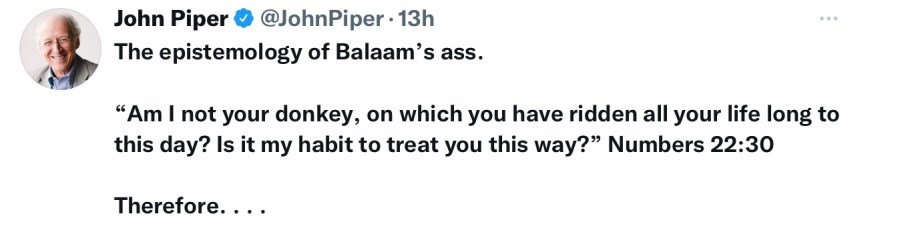
Midst all the “controversy” around John Mac Arthur, John Piper purposefully decided to post this tweet yesterday.

It provides an argument for defending the wrong-doing of ministry leaders and pastors.

Those engaged in wrong actions, decisions, attitudes, or behavior will want to grab hold of this Old Testament passage — men like John Mac Arthur — here is some help.

Initially, some might not understand the argument being made, but it is clear, clever, and also subtly odious!

♦♦♦♦♦ ♦♦♦♦♦ ♦♦♦♦♦ ♦♦♦♦♦ ♦♦♦♦♦

√  “The epistemology of Balaam’s ass:”

Interestingly, it is the KJV that uses the word “ass.”  It is not translated that way in the NKJV, NIV, or ESV. I was surprised that John Piper would use the headline wording as found in the KJV translation, since he has consistently endorsed the ESV and virtually only cites the ESV.  Hmmm?

√  “Epistemology:” Simply stated, epistemology is about — how we know what we know.

√  Numbers 22:30:

  • Balaam is beating “the donkey” upon which he is seated because “the donkey” refuses to move forward. Balaam does not realize that the Lord gave “the donkey” the ability to see the angelic messenger with a sword in his hand. Therefore, “the donkey” ran out of the pathway and into the field. Moments later, “the donkey” moved into a vineyard bounded by walls, and Balaam’s foot was crushed against that wall.
  • The Lord also used the donkey to speak to Balaam supernaturally.
  • “And the donkey said to Balaam, ‘Am I not your donkey, on which you have ridden all your life long to this day? Is it my habit to treat you this way?’ And he said, ‘No.’”
     — Now Piper quotes from the ESV!  Hmmm! —
  • “The donkey” is making the argument that this is a “one-off.”  This is not me. You should know me.  After all your life knowing me, you know that this is not how I have behaved or served you! Don’t you beat me as if this is how I typically behave?

√  “Therefore:”  The reader of the tweet is called upon to arrive at Piper’s conclusion, without Piper having to state it!

“Therefore” — you draw the conclusion!

That is skillful!  Had Piper stated his “sought after” conclusion, he would have left the door open to serious criticism regarding his handling of the passage, its legitimate application, and whether the passage suggests or is even designed to provide a legitimate epistemology.

Obviously, the point that Piper is making is not about “donkeys,” but it is about those whom Piper considers a “donkey.” 

A “donkey” is a twisted yet skillful way to frame his imagery.  Twisted because“the donkey” is actually the one being beaten, and “the donkey” is correct in the argument it is making.

Skillfully twisted/skewed  because the aim is to call up that KJV imagery, and artfully frame the critics as “Balaam’s ass.” Piper purposefully chose to begin with the KJV version of the headline words  – “Balaam’s ass.”

That KJV headline title frames the picture! The message is . . . . Even a “donkey” can figure this out!  You don’t know what you are talking about, and even a “donkey” knows that! That is why the tweet is titled, “The epistemology of Balaam’s ass.” [3]

♦♦♦♦♦ ♦♦♦♦♦ ♦♦♦♦♦ ♦♦♦♦♦ ♦♦♦♦♦

#1 – Piper’s “epistemology” (how we know what we know, how we know people ) would allow “one-off-wrong-doing” without regard to the seriousness of the wrong.  It ignores the nature and/or context of the situation under examination.  It is thoroughly “John Piper” and will be accepted by those committed to him, as well as those who are committed to John Mac Arthur.

An interesting question worth asking is . . . How does that “epistemology” work with  . . . .

  • Moses striking the rock — (with whom the Lord spake face to face)
  • David & Bathsheba, King from the line of Judah, the great shepherd of Israel (a man after God’s own heart)
  • Simon, in Acts 8:13-24
  • et al.

. . . . 

#2 – Such an “epistemology” assumes that what has happened is all that has happened — that it is only “a one-off.”

Whether biblical examples or present-day situations, let us not assume that it is a “one-off.”  We know that such is not the case with various individuals in the Scriptures. [1].

We also know that it is a mistake to assume “once and done” when it comes to our sinfulness.

What often happens is that others find the courage to speak out after the supposed “one-off” is reported.  That is happening with John Mac Arthur as well.

Let’s see what John Piper says after the second and third examples of the same come to light, which has already begun!  The epistemology may need to find another home or passage.

. . . . 

#3 – There are sins and wrong-doing which disqualify, regardless of whether or not it is typical behavior.  Some actions are so egregious that the ministry is significantly impaired and even forfeited. The integrity and reputation of ministry leaders are paramount to one’s effectiveness.

. . . . 

#4 – Whether or not a sinful action, decision, or response is typical, is there any recognition of wrong-doing.  Surely, Piper is not saying that if it is not typical, no apology need be made, no forgiveness be sought, and/or no restitution be made. Surely, the answer is not to “go dark,” refuse to respond,  and refuse to confess our sins to one another!

Obviously not!  Perhaps, another Piper tweet will clarify that and not leave the impression that wrong actions, decisions, responses, and behavior should merely be considered a one-time happening, with little need of a genuine and humble follow-up.  I am “confident” that Piper does not teach — “Look — It happens.  Just move on; forgive and forget.”

Surely, he and others believe in what Matthew 5 teaches — “Lay your Bible down on the pulpit, and go, and reconcile!” (TMV)  That reconciliation might even take more than a one-off attempt!

. . . . 

#5 – Using Scripture as a weapon, as a tool to defend wrong-doing is heinous.

There is a legitimate argument to be made “epistemologically” — and it doesn’t take using a Bible passage to arrive at it.

Even the world knows that we are all guilty of “one-offs,” even two or three-offs.  We all know (believers or not) that none of us want to be defined by a decision, actions, or response.

The issue is “a pattern”. . . .  AND the issue is whether we will honestly and appropriately address the wrong when we are aware or made aware of it.

Sadly and apparently, there is a pattern.  More sad is the reality that Mac Arthur seems to “go dark” when such wrong-doing is identified.  He does not offer an apology or seek forgiveness from those who have been used or mishandled, such as Mrs. Gray.  Rather, he hides out in “the cave of biblical axioms” — “Nothing in all the world is more important or more valuable than the truth.”[2]

. . . . .

It is not important to know whether John Piper is purposefully coming to Mac Arthur’s defense. No one knows that but John Piper.  Nevertheless, his “exposition” does provide a semblance of a biblical argument for those who engage in such actions as Mac Arthur and others.  I predict that this “exposition” will be cited and repeated!

Perhaps it is about coming to his own defense as the same “controversy” has been part of BBC and BC&S.

Whatever, the tweet has a purpose, and it will be used by some to defend wrong-doing, and to allow more wrong decisions, actions, attitudes, and behavior. . . .

“It’s just a one-off. 
Nothing to get upset about.
Forgive & Forget — Genuine Apology Or Not

Even a “donkey” can figure this out!


1. Abraham giving away Sarah — oops twice  (but the only one called a friend of God).  Had the second account not been included in the O.T. record by the Lord, it would have been seen as a one-time occurrence. I wonder how many other incidents of the same kind are not included in the Scriptural record that marked God’s great men and women?

Based on this kind of so-called “biblical epistemology,” I might even suggest Judas, as outlandish as that be, but where was any pattern.  Not even his fellow disciples knew that he would betray the Lord.

2. “Truth War, by John Mac Arthur, pg XII
The cave of biblical axioms allows one to hide out in a defensive cave of self-righteousness and piety —  I’m like Jesus!

How about making this point — “Nothing in the Christian life is more important than forgiveness-our forgiveness of others and God’s forgiveness of us.” — also by John Mac Arthur

3. Yepper, I remember John Piper’s famous quote —  “God is most glorified when . . . .”  I am confident that purposefully calling up the imagery of “Balaaam’s ass” to frame an argument qualifies as glorifying.

. . . . 

“It is obvious from the text that leadership is the absolute priority in seeking to establish each of these things. Because, if the leadership is wrong, then everything else will be wrong with it. . . . Most problems—most unsolved problems—in a local church can be traced to defective leadership—can be traced to defective leadership, almost without exception. . . . . I am aware of churches in our immediate environment here that are completely bedeviled by all kinds of stuff. And ultimately, it may be traced to failure at the level of pastoral leadership. — Alistair Begg

“How did you go bankrupt? Two ways. Gradually, then suddenly.”

You are probably aware of the serious controversy that is presently revolving around John Mac Arthur and Grace Community Church. This is but one of several controversies that involve Mac Arthur.  Interestingly, one of the other recent contentious issues has been about Mac Arthur’s comments about Beth Moore.   They are both connected![1] 

I would argue that the cause of both controversies is ideological!

Some ministry leaders and pastors are ideologues — that is, it is an ideology that drives their outlook and comments.  It is no different from the political world.  The reason some political figures take the road they are on, and/or refuse to change course, is because an ideology controls what they see and how they think.  While “the average working man or woman” knows how crazy it is to be doing this-or-that, the ideology controls the decisions being made, even to “crazy.”

Likewise, men like John Mac Arthur hold to an ideology that controls what they see and think.  In this case it is complementarianism. . . . 

Generally, “Complementarianism is the theological view that although men and women are created equal in their being and personhood, they are created to complement each other via different roles and responsibilities as manifested in marriage, family life, religious leadership, and elsewhere.” [2]

Mac Arthur sees life through that set of glasses and therefore implies that Beth Moore should “go home.” The words “go home” suggest a more harsh directive than merely returning to your home — The woman’s place is in the home, not in seminars and speaking venues where the Bible is taught.  Men teach the Bible! Period. Stop. End of Sentence.

My point is not to debate “complementarian” vs. “egalitarian,” or to argue for any position along the continuum.  Rather, it is to point out that this is what happens when an ideology colors how you see and think. 

When an ideology so rules what one sees and thinks, even the most offensive actions are not seen for what they are!  The ideology naturally and obviously results in both “Go home,” as well as the most recent repulsive revelation relating to marital counseling — and no surprise, specifically to the wife and mother! [3]

How? Ideology! Merely read the advice given to the wife and mother in an abusive family situation, and you will understand the authoritative and influential sway of ideological thinking . . .  (and it gets even sadder! [5])

Even when such family counseling violates what “the average Christian man or woman” realizes as wrong — if not outrageous — for the ideologue, there is no pause or compunction about walking onto that road.  “You said what to that wife and mother!”  — is the average Christian’s response! And I would suggest that” the common man or woman’s response” will severely damage Mac Arthur’s ministry in the end!

When a system of thought, a particular doctrinal position, and/or the preeminence of a particular biblical truth blinds — ideological choices and decisions rule the day. The ideology is in control, and it controls the way one sees and thinks — and what one says and how one preaches.  It affects one’s hermeneutics,  homiletics, and pragmatics — one’s interpretation of Scripture, what is preached in the pulpit, and how that works itself out in life.  [4]

At times, we are confused about how someone could say or do what they have said or done in a ministry or a local church. The answer may be more simple than we understand — It is ideologically driven! A system of thought, an ideology, a theological dogma is driving the car. That ideology controls the conversation among the passengers and what roads are taken in a ministry — and even who we are willing to run over on the road.

While the outrage may seem sudden, it was actually gradually heading that way for years!

“How did you go bankrupt?”
Two ways. Gradually, then suddenly.”

Ernest Hemingway, The Sun Also Rises

P.S.  Even Sadder! [5]


  1. “Friel [the moderator at the 2019 GCC conference] explained that he would say a word and then let each of them give a one word or short answer response to that word. MacArthur joked that he felt like he was being set up before giving his answer to Friel’s first word “Beth Moore.” The well-respected pastor responded, “Go home.” A chorus of laughter and gasps filled the room. . . .

    MacArthur then said he would like to add one more thing to his comment regarding Beth Moore, comparing her to a Home Shopping Network jewelry salesperson.

    “Just because you have the skill to sell jewelry on the tv sales channel doesn’t mean you should be preaching,” MacArthur said. “There are people who have certain hawking skills—natural abilities to sell—they have energy and personality and all of that—umm, that doesn’t qualify you to preach.”
    ============================================================
    “Dr. MacArthur, Beth Moore?”
    “How many words do I get?” MacArthur asked.
    “Go home. There is no case that can be made biblically for a woman preacher – period, paragraph, end of discussion,”


Link: Beth Moore:

I’m going to tell y’all a story because I think this is important and enough time is gone by that I hope it will be obvious it’s not meant to be self-serving. After a certain public mockery at a pastors conference, I was literally heartsick for the ones who had done it. I thought how miserable they must be for having ridiculed a sister in Christ publicly like that. I knew what I was going to say when they contacted me because it would have been completely sincere: I was going to say I knew what it was like to let your mouth get away from you & I forgive you without hesitation. But that contact never came. It baffled me and made me sad because I believed them to be people of spiritual integrity even if I did not see eye to eye with them. That they felt no need to apologize was more worrisome to me than the ridicule.

Y’all, this isn’t a game. These things matter to the Lord. We are followers of Jesus. Not one of us is exempt from conviction of sin and the responsibility and right, thank God, by the blood of Christ and power of his cross, to repent. We need an awakening of integrity. I need one.

2. https://www.christianity.com/wiki/christian-terms/what-are-complementarianism-and-egalitarianism-what-s-the-difference.html

3.  Julie Roys: John MacArthur Shamed, Excommunicated Mother for Refusing to Take Back Child Abuser

4. “Theological Ideology” produces John Mac Arthurs and John Pipers.  It also creates a “Piped Piper” — complete with followers who see what the Bible supposedly teaches through his “theological ideological eyes!”  Interesting, both John Piper and John Mac Arthur are embroiled in serious controversies, if not scandals, because of ideological positions which have led to it!  With Piper, and sadly many others, it is Calvinism or “New/ Neo Calvinism” that is driving the car.

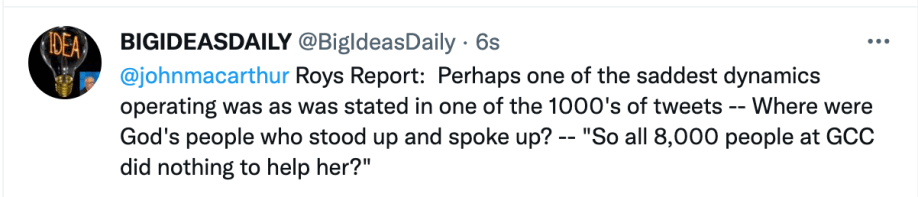
5. BIGIDEASDAILY

@BigIdeasDaily

Roys Report: Perhaps one of the saddest dynamics operating was as was stated in one of the 1000’s of tweets — Where were God’s people who stood up and spoke up? — “So all 8,000 people at GCC did nothing to help her?”

An Open Letter ….. Four Elders Resign

Yes, Open Letters Are Still Needed!
Four Resign From Elder Board At Chapel Hill Bible Church.

If you want to see . . . .

#1how typically churches respond to disagreement (emphasis mine), and

#2 how an effective open letter is written (emphasis mine),

. . . the one written by Walker and Katherine Hicks is the most illustrative of both.

♦♦♦♦♦ ♦♦♦♦♦ ♦♦♦♦♦

February 2022

Dear fellow CHBC elders and brothers in Christ,

Katherine and I have approached our life in the church as a family affair, so my involvement as an elder has always involved both of us. We have made the decision for me to resign as an elder together based on our shared experiences. We have been members of the church for the better part of thirty years (joining the community in the early 1990’s) and have joyfully served and been served by this body for our entire adult lives. Out of a love, concern for, and long commitment to this church family, we are compelled to more fully share our reasons for my resignation from the board.

Our history at CHBC

The Bible Church has been the defining institution in my walk with Christ. I encountered Him as a freshman at UNC in 1994, and in the fall of 1995, a friend at Campus Crusade for Christ suggested that I check out this church on the edge of campus. Upon visiting, I heard the Gospel professed with a clarity, depth, authenticity, and earnestness that I had never encountered before. The worship, the sermons, and the community all pointed me to Jesus through the conduit of the scriptures in a way that was entirely fresh, vibrant, alive, and genuine. I had never experienced anything like it.

Katherine and I got engaged in October of 1996, and Pastor Randy Russell conducted our pre-marital counseling and marriage. We set our roots into the soil of this community and became involved in youth ministry and young adults fellowship, and through those avenues began to grow the kind of deep, long-lasting, intergenerational, Gospel-centered friendships that CHBC specializes in. We are dear friends with many of those we met in the late 90’s to this day.

The Bible Church hit rocky times in the late 90’s and early 2000’s, but Katherine and I remained committed to it, for many reasons. First of all, we understand a church to be primarily a family, and families should not break apart slightly or easily when facing difficulties. Secondly, those rich and deepening relationships formed the core of our life at the church, more so than the Sunday morning experiences or other programming aspects. We were serving the body through our youth ministry leadership and also getting fed through those relationships with others committed to following Christ and growing in Him through Scripture, prayer, and fellowship.

Another challenging season awaited CHBC in the late 2000’s, when many people left and the remaining body floundered, staying afloat but barely. I was called to eldership in 2010. The ensuing 12 years have been some of the most rewarding and, simultaneously, discouraging years of our lives in the church. The church embarked on a new era with the hiring of a new lead pastor in 2011, and I, as an elder voting “yes,” was so excited about the new chapter ahead of us. I have spent the last 6 years as a member and secretary of the Oversight Team. Since June of 2021, I have been on sabbatical from eldership duties.

Why I am resigning from leadership

Over the last few years, Katherine and I have both had myriad occasions where we witnessed people in our church body being marginalized or mistreated. We have heard the stories of an array of wounded people, including women, people of color, children, elders, and current and former employees. We brought concerns about those situations to leadership. We shared hurtful attitudes and racialized statements towards people of color, dismissive and demeaning treatment towards women, and thoughtless, callous, dishonest, and even unethical treatment towards employees and other leaders. After the investigation of the executive pastor, we advocated for care and protection for our staff after learning about the ways that they had been wronged.

Each time that we came forward as advocates of those people, we strove to speak respectfully, as we saw church leaders as brothers in Christ and our friends. We sought to honor the proper channels and lines of authority. We came with the full expectation that our leadership would meet those concerns with the biblically-driven compassion, sadness and concern that we felt. We came with the humble understanding that we may not see all situations fully, so we asked questions to fill in gaps or correct any facts we had wrong. We fully expected they would want to know more to understand these situations better. We thought we would get answers to our questions. We thought that we would have dialogue about what went wrong and how we, as a body, could make the situation right and avoid such wrongs in the future. We never expected anything from our leaders other than assertive action to move toward better understanding, repentance, and repair.

Instead, every time, we were met, at best, with vague apologies about people hurting and, at worst, rebukes for having brought the concern forward. A few elders came to me to ask questions and listened to our stories; some have shown sympathetic concern. But never did key leadership ask more than the most basic of questions or show any desire to better understand any of these situations. Only on a few occasions did we hear any recognition by our leadership of wrongs, but those recognitions were primarily of the least significant elements of those issues and came with justifications and disclaimers. There has never been a clear acknowledgement of harm that has been done to our brothers and sisters at CHBC. Instead we have heard defenses of actions, and even outright calls for us to apologize for having brought up our concerns. And from many in leadership, we have gotten a lot of head-nodding and silence; and never have more than a small minority of elders converted their sympathetic concern into action to address the problems we clearly have. We cannot comprehend these responses from fellow followers of Christ, especially those who have taken the mantle of leadership and profess a gospel that is based on our recognition of brokenness and need for Jesus.

Katherine submitted a letter to leadership in May of 2021 that articulated some of the growing concerns we’ve had in recent years. Those concerns have only heightened in the ensuing months by our experiences where I have tried to follow the clear biblical call to elders to shepherd the flock by guiding them, protecting them, and serving as advocates for them.

Excerpts from Katherine’s letter (with a couple of updates and modifications) are below:

I want to be able to stay at this church that I have called home for almost 30 years, but sadly cannot do that if we do not aggressively change course, as I think that we have veered far from Jesus. I think we have glaring blind spots that are doing damage to the Gospel and to people in our body. I am a mother who sees her children, friends, and many fellow believers and non-believers being emotionally and spiritually harmed. I am a follower of Jesus who sees many of her fellow brothers and sisters in Christ at CHBC (leaders and others) both actively inflicting and passively condoning that harmover and over again and in the name of Jesus — all the while simultaneously demonstrating both total ignorance of the harm they cause and arrogance about their moral and spiritual authority. It’s painful in so many ways to watch.

Some people are valued more than others

First, I have seen people “on the margins,” as well as the concerns of those people, be devalued, minimized, and silenced in and by our church. I include in this category, at a minimum, non-white people, women, people of low socioeconomic and/or educational status– which, if you do the math, is the majority of people.

Ironically, though, people “on the margins” were Jesus’s first priority, whom he regularly ate and fellowshipped with, and clearly deeply related to. These are the people that he was born into – and I know not by accident. Throughout scripture, God has always displayed a special concern for the vulnerable. And he reached those people by being with them and attending to both their physical and spiritual needs.Now, certainly, CHBC attends to the earthly needs of people in our church body through the benevolence fund, staff’s generous counseling of people who are struggling with various issues, and I’m sure many other ways that I do not see. In addition, CHBC facilitates plenty of one-off projects to serve people outside of the church but I think we can agree that those are not the priority of our church.

However, serving people is also different from respecting and considering those people as having something to offer to you and to the church. This latter area is where I think we fall short. I see a theme in our church that the voices of people who do not fit a certain profile are not valued. I have seen it happen repeatedly where people who have differing ideas are often discredited. When discussing important points or initiatives that other Christian organizations who more aggressively attend to the earthly needs of people in our community, I heard, “yes, but what’s their theology?” before celebrating their generosity and kindness and how they are loving and providing for people in ways that are very much like Jesus did; this is a form of discrediting. I have seen women having their needs and concerns minimized and then, on top of that, when they have expressed their frustrations about not being heard, they have been chastised for being disrespectful and deemed “ungodly.” I have seen people bravely convey their painful experiences of both explicit and subtle “silent” discrimination in and outside the church, and not receive the compassion that is so clearly warranted. [Additional specific examples and instances removed for confidentiality purposes.]

Recognition of sin, confession, and repentance

I see a clear and consistent reluctance to investigate, recognize, confess, and repent of sin within our leadership and church body, despite the fact that the willing recognition of sin, confession, and repentance are some of the most profound acts of faith to which we are clearly called.

Recent situations demonstrate that reluctance so clearly in multiple ways. Related to the executive pastor issues, I know many people told leadership there were problems all along. How, though, could those same problems, when seen by an outside consultant, leave that consultant deeply alarmed? Why not investigate those when they were reported in the years prior? And then once it all came out, the public statement was not one recognizing and confessing leadership’s complicity in all of it, but one about how leadership was going to have to work harder to do an extra job? Repentance was critical at that point for healing and the obvious next step, but it’s not what happened. Why not?

I have also seen this reluctance play out in the way that race issues have been addressed at the church, since that is something that I have been intimately involved with and have seen firsthand. Over the last several years, we have heard a lot of talk and preaching about race issues. I have been so deeply encouraged by that. I appreciated sermons on that topic and the awareness that has been brought in the many applications of scripture to those issues, along with other church events. Yet, at no point have we really investigated, confessed, repented of, and sought to address the challenges of racism in our body. It’s a difficult but crucial first step before any racial development can occur. Plus, confession and repentance of sins are foundations of our faith. I realized when I read the letter sent after the Capitol riots, though, that we were experiencing the direct repercussions of never having done that. I saw damage being done with the words – a neglect to care for those who were most vulnerable in our body at that moment, people who had been threatened and were justifiably terrified for their safety. What I have observed both from the pulpit and from church leadership has been an academic and “safe” study of this sin, as if it is sin that others deal with, but not us.

The anemic response from elders to the responses to the survey of congregants of color at CHBC clearly exemplifies the gravity of this problem. Where is the care? Where is the compassion? I see in that situation that even the leaders of the church are illiterate in these issues that are so significant to many in our body and in our society. How are we to reach people for Jesus if we cannot speak on these things? If we were truly investigating race issues, we would know that and be working hard to root out that sin that binds us. But we haven’t. We understand that a “white paper” on race issues is in development; putting efforts toward a document to demonstrate expertise on these issues without ever recognizing or addressing the many appeals for care in our body only further demonstrates the cognitive dissonance at play.

I have noticed what most people in power typically do with events that have negatively affected marginalized people. They will so often hear each of those stories and decide that they were one-off eventswithout import, writing them off as either one person arbitrarily behaving badly toward another or likely the “victim” deserving what came to them. So those stories are erased in their minds as only that, one-off events. However, if instead of erasing those events, one was to plot them on a graph, a clear pattern would emerge. People in those marginalized groups have enough data points that they, as a matter of their own physical and emotional safety, do not erase – and they clearly see the patterns. At the same time, though, the people in power look at their “graph” and don’t see anything, because all those points were erased along the way. And those that see the patterns see them clearly and it alarms them, and it frustrates them that those people who are their bosses, leaders, and decision-makers make decisions without regard to them. I see that having happened in our church. We have to consider why so many data points have clearly been erased at CHBC along the way, leading leadership to miss those patterns.

Katherine’s insights articulate for me many of my reasons for resigning. In addition, perhaps most disturbingly, I have seen that our leadership has increasingly been willing to compromise its integrity and behave in ethically questionable ways. We have witnessed alarming efforts to hide truth and to control and limit essential information from not only congregants but from officers of the church. The patterns are clear and have also been recognized by many “concerned congregants” in our body, yet they have thus far been disregarded, excused and dismissed by our leadership.I have brought my concerns, supported by specifics, to elders and church officials in conversation after conversation and email after email. This letter is not the place to rebroadcast the specifics of those concerns (involving, for example, recent resignations and firings), but I can no longer serve in such an environment in good conscience.

Recognition of my own complicity (wow!)

I want to be clear that I own my part in contributing to the dysfunction of the leadership. On many occasions and in many ways, I participated in allowing our church to drift. Time and again, I did not push hard enough for course correction or advocate effectively for biblical priorities. I allowed myself to be persuaded in group settings to go along with unsound decisions that, in hindsight, did not reflect wise, biblical thinking. I was in a position of influence and power, and I failed to use that influence assertively and productively for the kingdom.As a result of my shortcomings, many people were hurt, and our church’s witness has been compromised. For this, I sincerely repent and apologize to the congregants who entrusted me with the church’s care.

My call to the elder board

In inviting GRACE to assess our church, we have opened up a golden opportunity for CHBC to change course. GRACE is renowned for its effective work in helping churches navigate just the sort of problems we are having; it is arguably the most respected agency in the field. I am so grateful for their help. As we approach the release of their report in the months to come, I am concerned that there will be a reluctance to share GRACE’s report broadly and transparently. I am also bothered to have even seen hints of communications and actions that may already be undermining GRACE’s potential recommendations and the impact of the report. For example, I have heard leadership question GRACE’s accepted definition of “abuse,” and I’ve heard general criticism of the use of that word and concept. I have also heard, in a recent sermon, criticism of the recent proliferation of material about church dysfunction, expressing general skepticism about the integrity and value of abuse response and labeling it as a “cottage industry” – while we are the midst of an assessment from a leading organization in the field. I urge you, the elders, to express wholehearted, unequivocal support for GRACE’s assessment and to advocate strongly for a full and transparent sharing of the ensuing report.

Katherine closed her letter with a story and an exhortation. I’d like to finish by sharing it.

I’ll tell you a true story that I feel relates to this situation. Years ago, I had a colleague who also did health economics research, like I do. For several years, much of his time at work was spent on studies aimed at understanding the costs and benefits of an eye screening program for children. The screen was a fairly simple and low-cost one, but identified a fairly rare eye problem that, if diagnosed and treated, prevented many debilitating and expensive problems in the future. He was becoming somewhat of an expert in our field regarding interventions for eye and vision problems. One day my colleague was at Target with his kids. He saw something that he thought one of his sons, who was around 8 or 9 at the time, would like, so made a statement about that item to the son. The boy looked up toward the item, then hesitated, stepped a few feet over, and then clearly recognized and acknowledged how much he liked it. His dad was confused and asked, “What just happened there? Why did you step to the side like that? You could see it from where you were.” His son replied, “Oh, I just had to get myself in a place so that I could use my good eye to see it.” He and his wife soon learned that their son had the very problem with his vision that he had been working for years to get diagnosed in other kids. My colleague was an expert on this vision problem but didn’t recognize that it was right there in his own family.

I think the Bible Church unknowingly has only “one good eye.” It is great at studying and appreciating the scriptures. It is a warm and nurturing place for many people. But I would argue that one of our eyes doesn’t work, the one that truly shows Christ’s love for everyone, regardless of their theology, gender, or race; the one that respects and honors all people’s value; the one that is transparent about our depravity and genuinely celebrates our need for Jesus; and the one that recognizes clear patterns that would be evident if the “data points” of people within and outside our church body were recognized. I feel like we are like Esther in the palace with the king, ignorant of the travesty that is about to unfold, and just wanting the Mordecais in our midst to put on some nicer clothes and stop making a scene. Like she did, though, we have to inquire and we have to respond. We are at a critical point in our church journey in deciding whether we are going to do the hard work and recognize that two eyes are better than one, or live in the fear that currently holds us back from that. We serve the maker of the universe, thank the Lord, and we can trust that we don’t need to live in that fear.

We have been putting out this “call to respond” to the systemic shortcomings in our church again and again over the course of this last year and even before. To our dismay and sadness,not only has that call fallen on deaf ears, but it has met considerable active resistance. We love the Bible Church and grieve that it has become what it is today. We exhort you, the elders, to respond boldly to the moment. We will pray for you, trusting the matchless power and love of the Father to bless CHBC, and we continue to covet the prayers of the faithful for ourselves.

In Christ,
Walker and Katherine Hicks

♦♦♦♦♦♦♦

As I read this letter, along with the other three letters, I said to myself . . . . .
This is why you need to write an open letter! 

It speaks loudly about the dynamics that operate when calling out wrong, and
it alone offers hope for needed change!

♦♦♦♦♦♦♦


P.S.  The lines highlighted in blue are all so typical when it comes to standing up and speaking out in a ministry or local church setting.  Just follow the ⋅⋅⋅⋅⋅⋅⋅⋅⋅⋅⋅⋅⋅⋅⋅⋅⋅